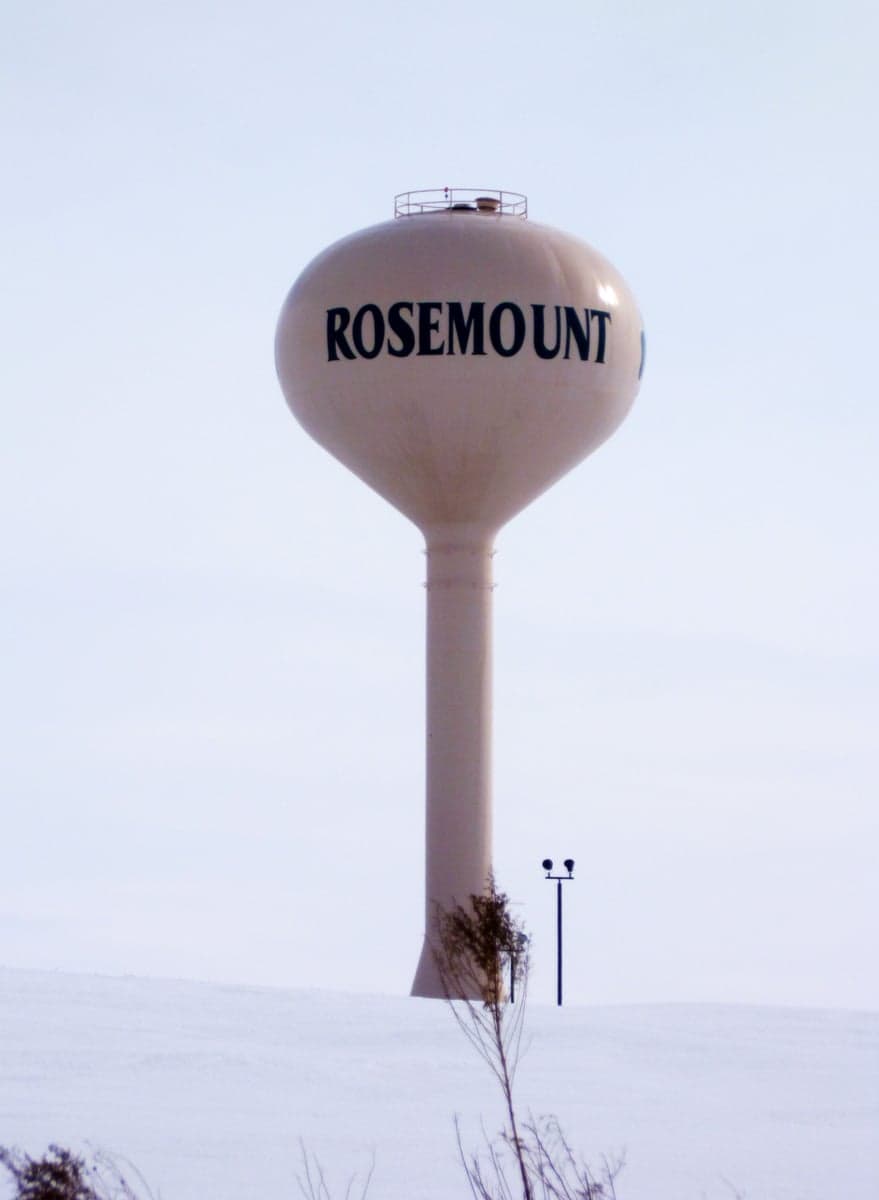
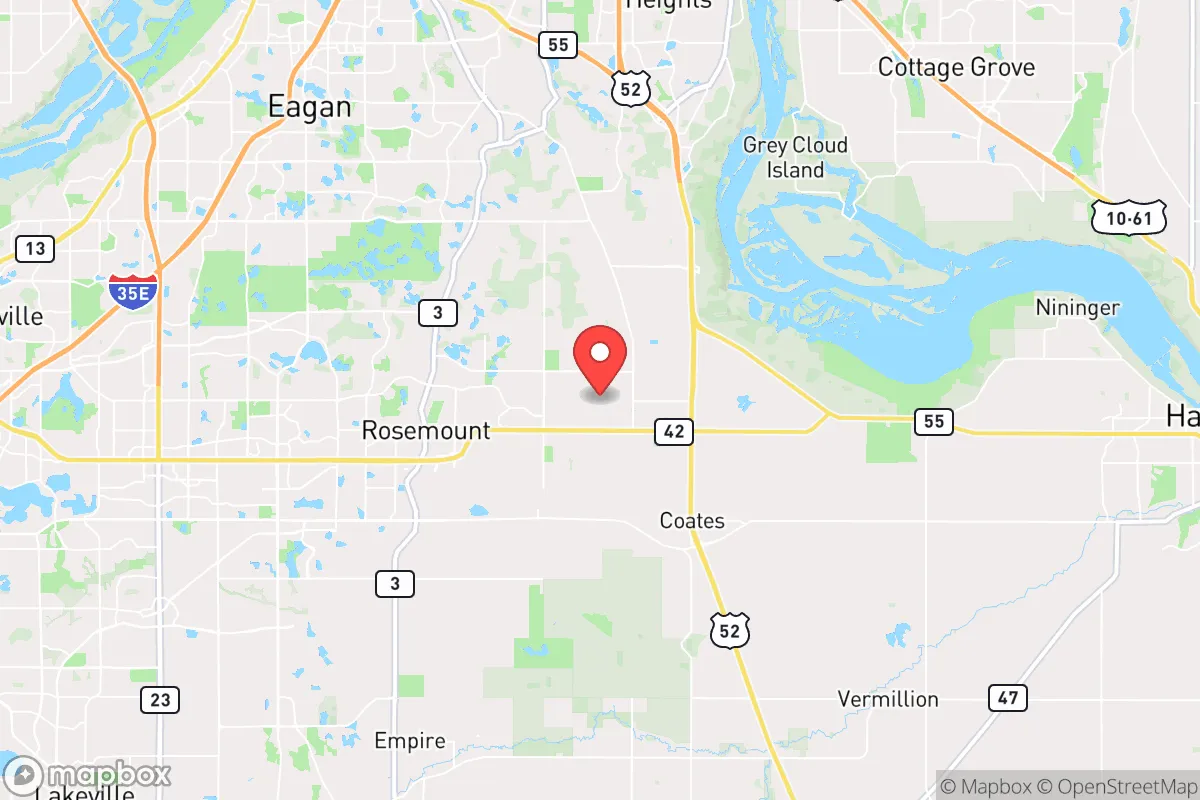
Photo: Wikipedia
Demographics of Rosemount, MN
Affluence Level in Rosemount, MN
An upper-middle-class area. Household wealth, education levels, and homeownership run ahead of national benchmarks.
People of Rosemount, MN
Today, Rosemount, Minnesota is a predominantly white, family-oriented suburb of 26,509 residents with a notably high college attainment rate of 50.3%. The city’s population is 82.1% white, with small but distinct minority communities: 3.9% Hispanic, 3.6% Black, 3.8% East and Southeast Asian, and 1.4% Indian (subcontinent). The foreign-born share is just 1.8%, well below the national average, reflecting a population shaped more by domestic in-migration from within Minnesota and the Upper Midwest than by international immigration.
How the city was settled and grew
Rosemount’s original settlers were primarily German and Irish farmers drawn by the fertile land of the Minnesota River Valley in the 1850s. The city was officially platted in 1856, and its early economy revolved around agriculture, with wheat and dairy as primary outputs. The arrival of the Chicago, Milwaukee, St. Paul and Pacific Railroad in the 1870s spurred a modest population bump, but Rosemount remained a small farming hamlet through the early 20th century. The historic Downtown Rosemount district, centered on 145th Street and Robert Trail, was the original commercial and social hub, where German and Irish families built the first churches, schools, and general stores. The Westfield neighborhood, developed in the 1920s and 1930s, housed many of the second-generation farm families who transitioned to local trades. By 1950, the population was still under 1,000, and the city’s character was overwhelmingly rural and ethnically homogeneous—descendants of the original German and Irish settlers.
Modern era (post-1965)
Rosemount’s modern growth began in earnest after 1965, driven by two forces: the expansion of the Twin Cities metro area and the construction of major employers. The 1970s saw the opening of the Rosemount Research Center (now part of the Dakota County Technical College campus) and the arrival of Rosemount Inc. (now Emerson Automation Solutions), a manufacturing plant that drew skilled workers from across the Midwest. The Briarwood neighborhood, built in the 1970s and 1980s, absorbed many of these new residents—mostly white families from Minneapolis and St. Paul seeking larger lots and newer schools. The 1990s and 2000s brought a second wave of domestic in-migration, this time from exurban counties and other Midwestern states, filling the Greenwood and Southfork subdivisions. These areas remain overwhelmingly white today, with homeownership rates above 80%. The small Hispanic and Black populations (3.9% and 3.6% respectively) are concentrated in the Dakota Hills area, near the Dakota County Technical College and the city’s newer apartment complexes. The East and Southeast Asian community (3.8%) and Indian community (1.4%) are more dispersed, with many families drawn by professional jobs at Emerson, the nearby Amazon fulfillment center in Rosemount, and the broader Twin Cities tech sector. Notably, the foreign-born share has remained flat at 1.8% since 2010, indicating that these minority populations are largely U.S.-born or long-term residents rather than recent immigrants.
The future
Rosemount’s population is projected to grow to roughly 35,000 by 2040, driven by continued suburban expansion and the development of the UMore Park area—a 5,000-acre former University of Minnesota research site that is being master-planned for mixed-use development. This new district is expected to attract a younger, more diverse population, though the city’s demographic profile is likely to remain predominantly white and college-educated. The Hispanic and Black shares may rise modestly as new apartment and townhome construction in the UMore Park area provides more affordable entry points. However, the Indian and East/Southeast Asian communities are expected to plateau or grow slowly, as Rosemount lacks the ethnic enclave infrastructure (e.g., ethnic grocery stores, religious institutions) that attracts chain migration. The city is not tribalizing into distinct ethnic enclaves; rather, it is homogenizing around a middle-to-upper-middle-class, family-oriented identity. The biggest demographic shift will be generational: as the large Baby Boomer cohort ages out, younger families—many from within the metro—will replace them, keeping the city’s median age (currently 36.2) stable.
For a conservative-leaning individual or parent considering a move, Rosemount offers a stable, low-crime, high-amenity environment with a population that is overwhelmingly native-born, English-speaking, and family-focused. The city is becoming more suburban and less rural, but its demographic trajectory is one of gradual, moderate diversification rather than rapid change. The next decade will see more rooftops and retail, but the essential character—a safe, well-educated, predominantly white community—will remain intact.

* Values derived from national, state, county, city and local statistics and may differ in a specific area. Last updated: 2026-05-01T13:12:38.000Z
Narrative content on this page is AI-generated and may contain mistakes. Verify any details that matter before acting on them.
ReloMaps may earn a commission from affiliate links at no extra cost to you.

