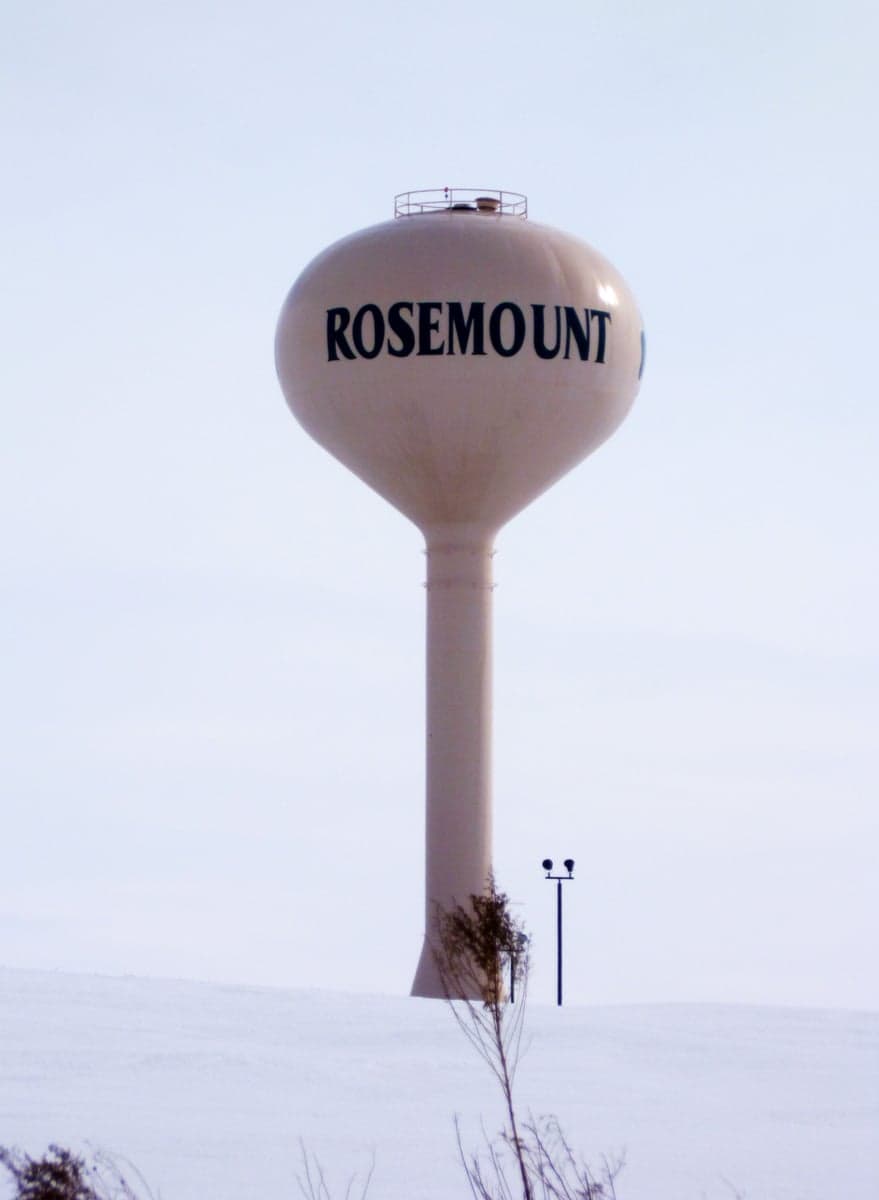
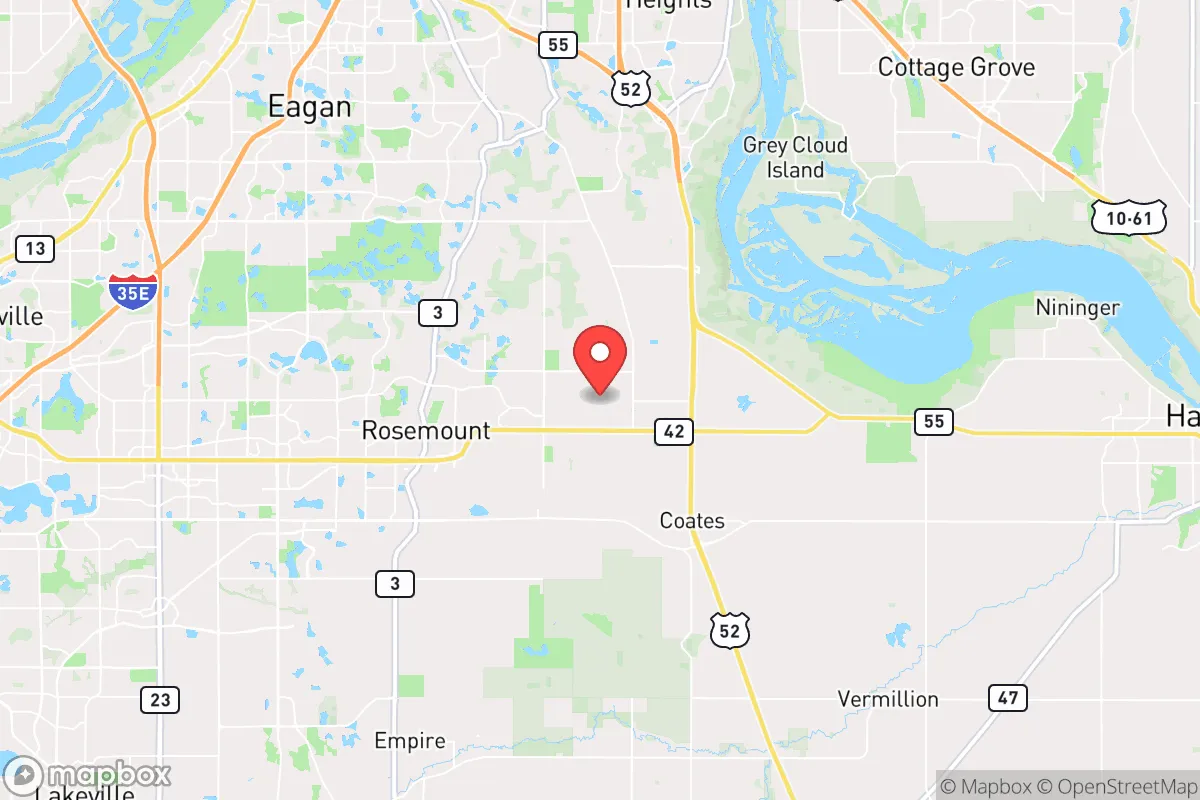
Photo: Wikipedia
Strategic Assessment of Rosemount, MN
Meaningful friction. Expect exposure to either population pressure, blast zones, or natural disaster risk. Consider buying a retreat property.
What does the Strategic Assessment tell us?
Our Strategic Assessment grades tactical survivability of an area. Major population centers, military targets, fallout zones, natural disasters, and border exposure all drive risk — lower exposure means a more defensible position in a crisis.
This is heavily inspired by Joel Skousen's Strategic Relocation book. Highly recommended you checkout the book ($)What does this tell us?
Our Strategic Assessment grades tactical survivability of an area. Major population centers, military targets, fallout zones, natural disasters, and border exposure all drive risk — lower exposure means a more defensible position in a crisis.
This is heavily inspired by Joel Skousen's Strategic Relocation book. Highly recommended you checkout the book ($)Strategic Pillars

Key Distances
Regional Safe Places
Below is our recommended "safe zones" in Minnesota and the surrounding area based on our strategic heuristics. For most people, it's unrealistic to live in a “safe zone” full-time due to work, family or other personal reasons. They tend to be more rural. However, many of these areas are perfect for second homes and retreat properties that double as a vacation home or even a short-term rental.
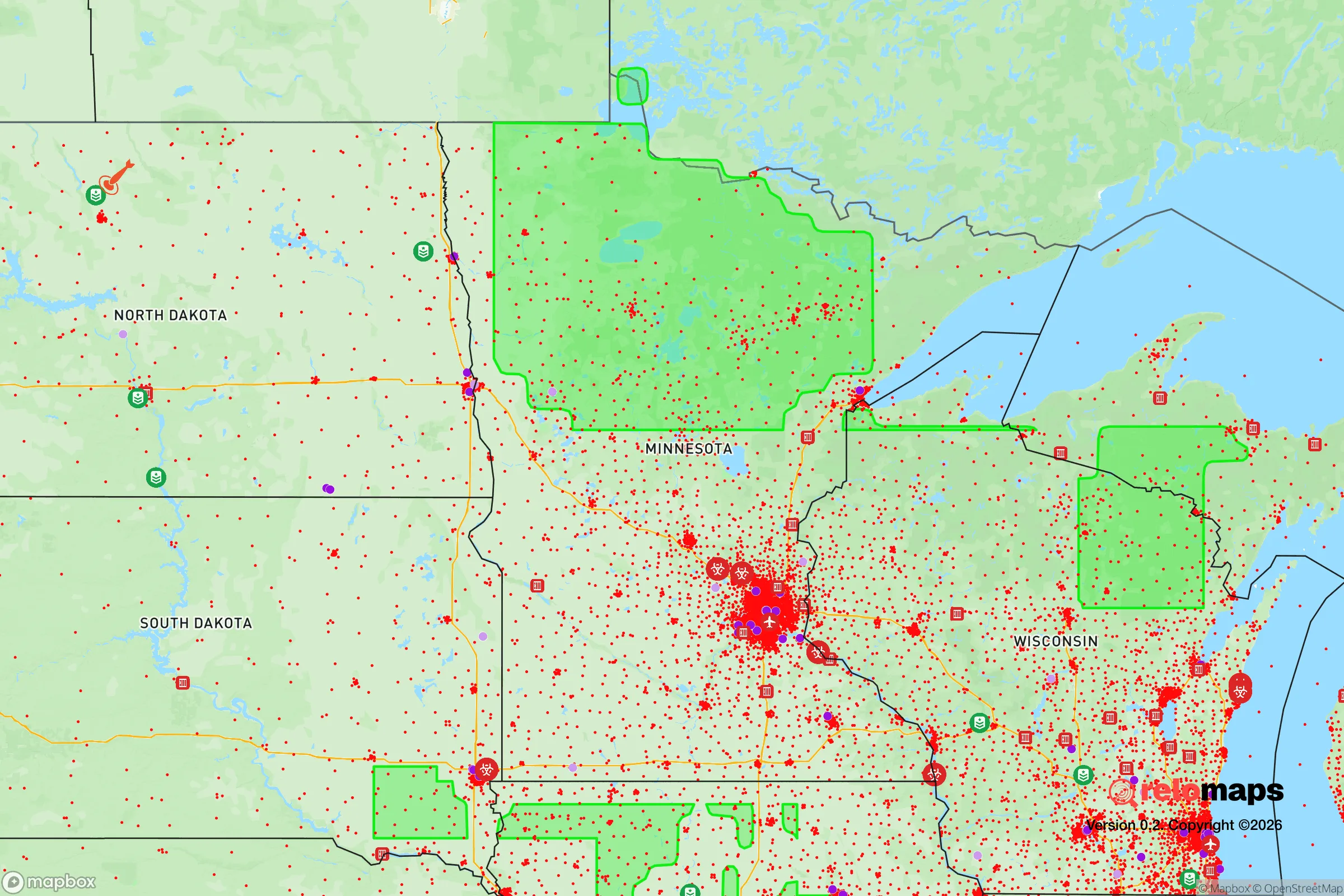
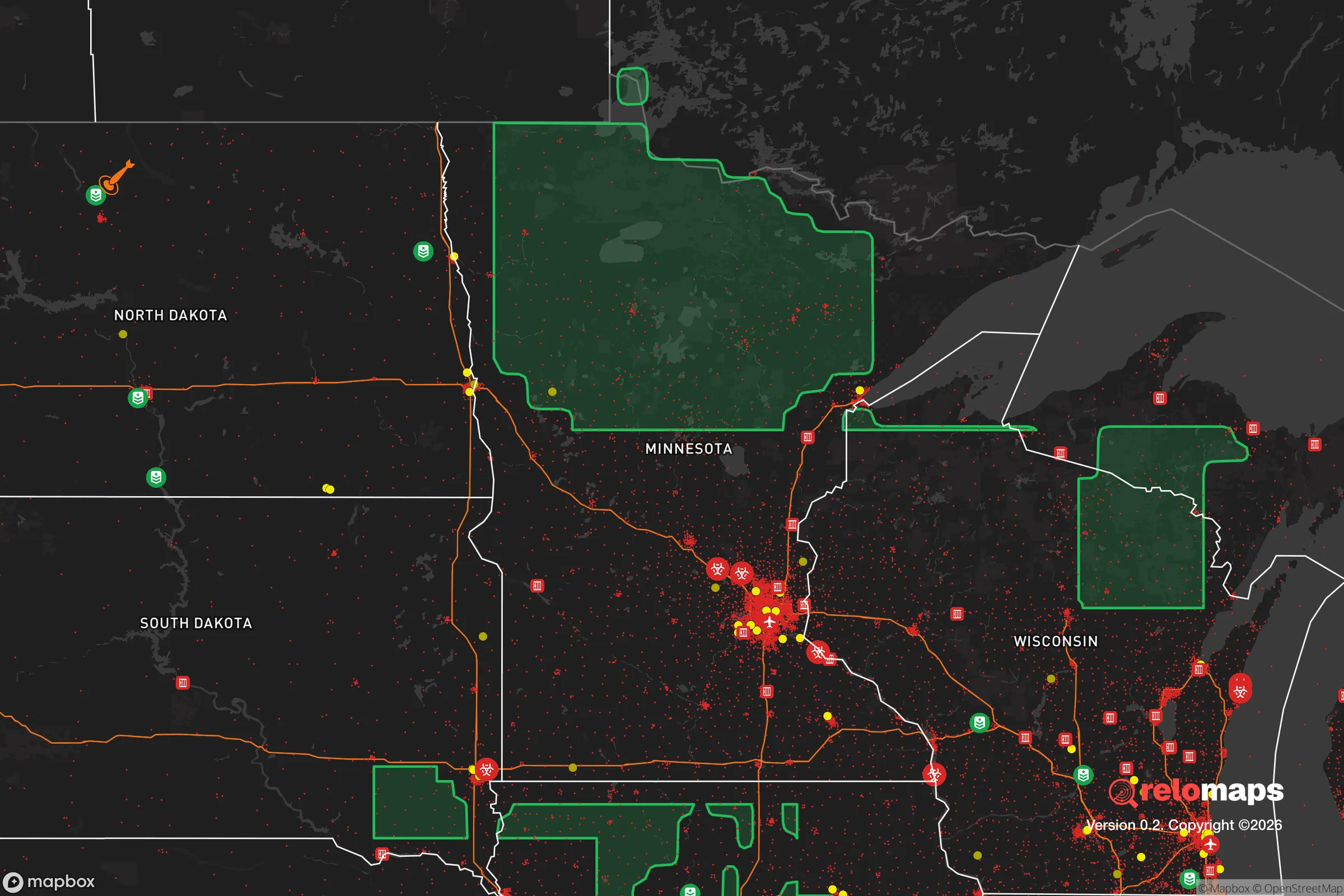


Important Note: For informational purposes only. This does not mean nothing bad ever happens in the green zones. Please use common sense. This is based on public data and modeled with AI. We tried to take a conservative approach but mistakes happen. We update this regularly as new information becomes available.
Solar Generator Recommendations
Backup power matters more here than in safer locations. We've picked three solar generators across budgets and capacity tiers — start with the budget unit if you only need a few essentials, or step up if you want to run a fridge and HVAC for days at a time.

Jackery Portable Power Station Explorer 300
Budget OptionPower on the Go: Weighing only 11 lbs, it's convenient to set up and store with book-sized foldable solar panels

BLUETTI Portable Power Station AC180
Designed for both indoor and outdoor scenarios, AC180 is highly capable as it has a robost capacity and continuous output power.

EF ECOFLOW DELTA Pro Ultra Power Station
Upgraded PickEcoFlow DELTA Pro Ultra is a whole-home energy system designed to grow with your family. Integrated with the Smart Home Panel 2, it scales to meet your evolving energy needs — keeping your home powered, intelligent, and secure through every stage of life.
We earn a commission, at no additional cost to you.
Strategic Assessment Analysis
Rosemount, Minnesota, sits in a strategic sweet spot that resilience-minded relocators should take seriously: close enough to the Twin Cities to access resources and employment, yet far enough to avoid the worst of urban collapse scenarios. Located in Dakota County, roughly 20 miles south of St. Paul, this community of about 28,000 offers a blend of suburban infrastructure and rural adjacency that makes it a viable base for those prioritizing self-sufficiency and security. Its position along the Mississippi River corridor and near major transportation arteries like Interstate 35E and Highway 52 provides both logistical advantages and potential vulnerabilities, depending on how events unfold.
Geographic position and natural advantages for long-term security
Rosemount’s location is defined by its position on the eastern edge of the Minnesota River Valley, with the Mississippi River about 10 miles to the east. This places it within a region of relatively fertile soil, ample groundwater, and moderate climate—factors that matter for extended disruptions. The area sits atop the Prairie du Chien-Jordan aquifer, a significant groundwater source that could sustain well-dependent properties. The surrounding landscape is a mix of agricultural fields, wooded bluffs, and wetlands, offering natural cover and defensible terrain for those who know how to use it. The city’s elevation, roughly 950 feet above sea level, keeps it above flood-prone zones along the Mississippi, a practical advantage for avoiding waterborne contamination or displacement during extreme weather events. For a relocator, the ability to grow food, access clean water, and maintain a low profile in a semi-rural setting is a tangible asset—especially compared to denser suburbs like Eagan or Burnsville, which are more exposed to civil unrest spillover from the cities.
Risks, exposures, and proximity to fallout-relevant landmarks
No location is without liabilities, and Rosemount has several that demand attention. The most glaring is its proximity to the Rosemount Research Center, a U.S. Department of Energy facility that handles nuclear weapons components and classified materials. This site, located just west of the city, is a high-value target in any major conflict or terrorist scenario. A direct strike or sabotage event there could render large portions of the surrounding area uninhabitable for years due to radiological contamination. Additionally, the city lies within 30 miles of the Twin Cities metropolitan area, a population center of 3.7 million that would become a focal point for civil unrest, resource shortages, and disease outbreaks during a national crisis. The Minneapolis-St. Paul International Airport and Fort Snelling military base are both within 25 miles, making the region a likely staging ground for federal responses that could bring unwanted attention or movement restrictions. Interstate 35E, a major north-south artery, runs through the area and could become a chokepoint for evacuation or a corridor for looters. For a survivalist, these factors mean that Rosemount is not a remote bug-out location—it’s a suburban buffer zone that requires careful planning for egress and security.
Practical resilience for a relocator: food, water, energy, and defensibility
For those willing to invest in preparation, Rosemount offers a workable foundation. Water access is a strong point: the aquifer beneath the area is reliable, and many rural properties already have private wells. Municipal water comes from the Mississippi River, which could be compromised during a disaster, so a well or rainwater catchment system is a wise addition. Food production is feasible, with local farms and garden centers like Gerten’s Greenhouse and Dakota County’s agricultural extension providing resources. The city’s zoning allows for backyard chickens and small livestock in many areas, and the surrounding farmland offers opportunities for barter or direct purchase from growers. Energy independence is more challenging: the grid is reliable day-to-day, but solar panel installations are permitted and increasingly common. Natural gas is the primary heating fuel, which could be disrupted; wood-burning stoves or propane backups are worth considering. Defensibility varies by neighborhood. Older sections near the city center have tighter lots and more visibility, while newer developments on the outskirts—like those near Dodd Road or 145th Street—offer larger lots, tree cover, and multiple access points. The Rosemount Police Department is well-regarded and maintains a low crime rate, but in a prolonged crisis, law enforcement resources would likely be stretched thin. A relocator should prioritize a property with a basement, a fenced perimeter, and a clear line of sight to approach routes.
The overall strategic picture for Rosemount is one of cautious viability. It is not a remote sanctuary, nor is it a high-risk urban core. It occupies a middle ground that rewards preparation and penalizes complacency. For a conservative-leaning individual or family who values community stability, access to resources, and the ability to maintain a low profile, Rosemount offers a reasonable base of operations—provided the risks of the nearby DOE facility and metropolitan proximity are acknowledged and mitigated. The key is to treat it as a hub, not a fortress: build local networks, stockpile supplies, and have a secondary plan for relocation if the situation deteriorates beyond what suburban resilience can handle. In a world where the unthinkable becomes increasingly thinkable, Rosemount is a place where a prepared person can hold ground, but only if they see it clearly for what it is—a compromise between isolation and access, with real trade-offs that demand respect.

* Values derived from national, state, county, city and local statistics and may differ in a specific area. Last updated: 2026-05-01T13:12:38.000Z
Narrative content on this page is AI-generated and may contain mistakes. Verify any details that matter before acting on them.
ReloMaps may earn a commission from affiliate links at no extra cost to you.

