Photo: Wikipedia
Demographics of Royal Oak, MI
Affluence Level in Royal Oak, MI
An upper-middle-class area. Household wealth, education levels, and homeownership run ahead of national benchmarks.
People of Royal Oak, MI
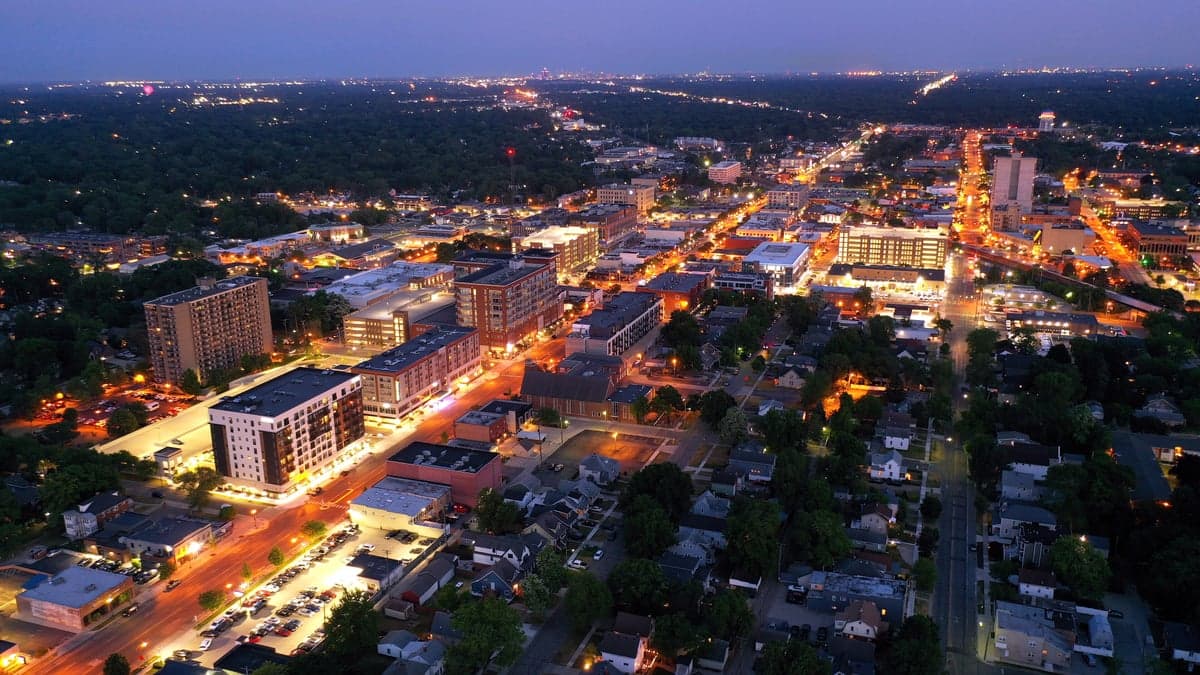
Royal Oak, Michigan, is a densely developed inner-ring suburb of Detroit with 57,880 residents, known for its walkable downtown, historic housing stock, and a population that is 80.8% white, 62.6% college-educated, and notably less diverse than the surrounding metro area. The city’s identity is shaped by a long history of ethnic European settlement, a mid-century suburban boom, and a recent wave of young professionals and families drawn by its urban amenities. Foreign-born residents make up just 2.8% of the population, a figure well below the national average, reflecting a community that has been slow to attract new immigrant streams. For conservative-leaning movers, Royal Oak offers a stable, family-oriented environment with strong schools and a low crime rate, but its demographic homogeneity and high housing costs are key considerations.
How the city was settled and grew
Royal Oak’s original population was drawn by the 1817 land cession of the Treaty of Fort Meigs, which opened the area to Yankee and European settlement. The first wave of settlers were farmers of English, German, and Irish stock, who established the agricultural grid that still defines the city’s street layout. The arrival of the Detroit and Milwaukee Railroad in 1840 spurred the first real population cluster around what is now the Downtown Royal Oak district, where a small commercial center emerged to serve the surrounding farms. By the early 20th century, the city’s population swelled with Polish and Italian immigrants who found work in Detroit’s auto plants and built tight-knit neighborhoods in the Northwood and South of 11 Mile areas, characterized by modest bungalows and Catholic parish churches. The post-World War II era brought a massive wave of white, middle-class families fleeing Detroit’s urban core, transforming Royal Oak into a classic bedroom suburb. This boom filled the Ravenwood and Whittier neighborhoods with Cape Cods and ranch homes, and by 1960 the city’s population had peaked at over 85,000.
Modern era (post-1965)
The 1965 Hart-Cellar Act, which ended national-origin quotas, had a muted effect on Royal Oak compared to nearby cities like Warren or Dearborn. The city did not experience a significant influx of new immigrant groups; instead, its population declined steadily from the 1970s through the 1990s as families aged in place and younger generations moved farther out to Oakland County suburbs. The most notable demographic shift in this period was the gradual arrival of East/Southeast Asian residents—now 2.6% of the population—who settled primarily in the East of Main neighborhood, drawn by proximity to Beaumont Hospital and the city’s strong public schools. The Indian-subcontinent population, at 1.3%, is smaller and more dispersed, with no single ethnic enclave. The Black population, now 6.1%, grew modestly after 2000, concentrated in the South of 11 Mile area near the Detroit border, though Royal Oak remains far less diverse than Detroit or even neighboring Ferndale. The Hispanic population, at 4.7%, is the fastest-growing minority group, with families moving into the Northwood neighborhood for its affordable older homes and access to I-75.
The future
Royal Oak’s population is slowly homogenizing by income and education rather than by race. The city’s high home prices and 62.6% college-educated rate are pricing out lower-income families of all backgrounds, while the foreign-born share (2.8%) shows no sign of rising. The East/Southeast Asian community is stable but not expanding, as younger professionals in that group often move to higher-status suburbs like Troy or Novi. The Indian-subcontinent population is likely to remain small, as Royal Oak lacks the ethnic infrastructure—temples, grocers, community centers—that draws larger concentrations. The Black and Hispanic populations are growing incrementally, but from a low base, and are unlikely to reach parity with the metro area’s diversity within the next decade. The city is not tribalizing into distinct ethnic enclaves; rather, it is becoming a more uniformly affluent, white-collar community where the main dividing line is between long-term homeowners and new renters in the downtown apartment towers.
For a conservative-leaning mover, Royal Oak is becoming a stable, high-amenity suburb with a strong sense of place and low demographic churn. The population is aging in place, with young families replacing empty-nesters in the historic neighborhoods, but the city’s high cost of entry and limited racial diversity mean it will likely remain a predominantly white, college-educated enclave. The bottom line: Royal Oak is a safe, well-run city with excellent schools and a vibrant downtown, but it is not a destination for those seeking rapid demographic change or a multicultural environment.

* Values derived from national, state, county, city and local statistics and may differ in a specific area. Last updated: 2026-04-24T03:37:19.000Z
Narrative content on this page is AI-generated and may contain mistakes. Verify any details that matter before acting on them.
ReloMaps may earn a commission from affiliate links at no extra cost to you.

