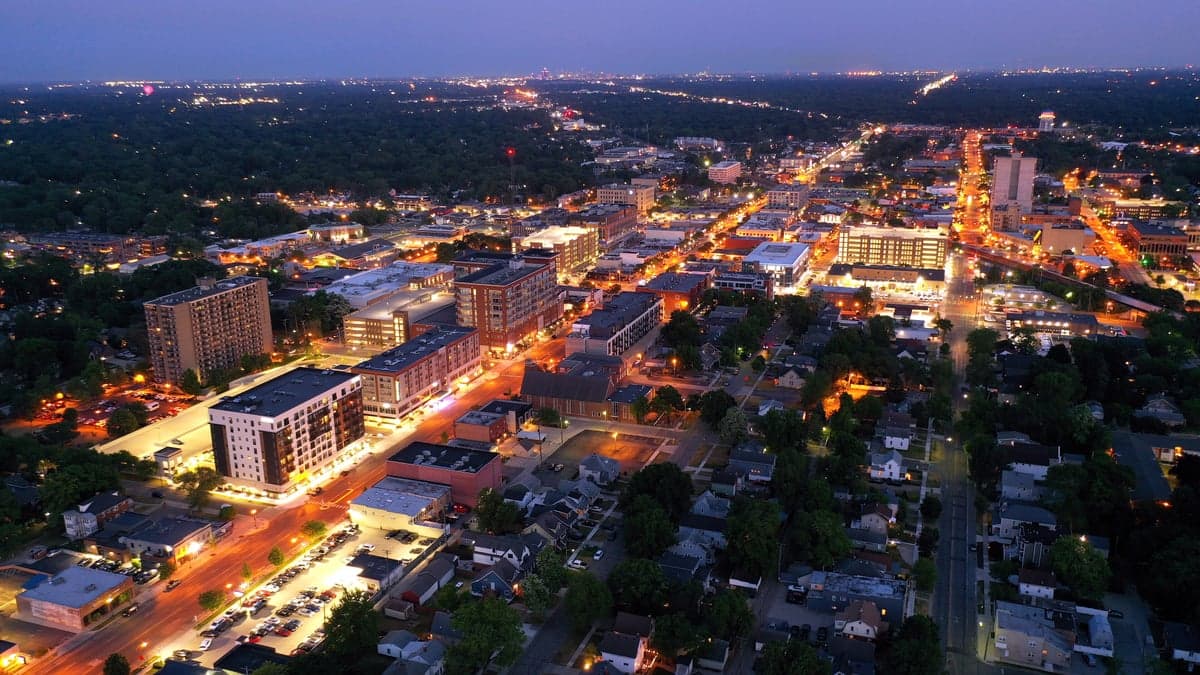
Photo: Wikipedia
Political ClimatePolitical Climate in Royal Oak, MI
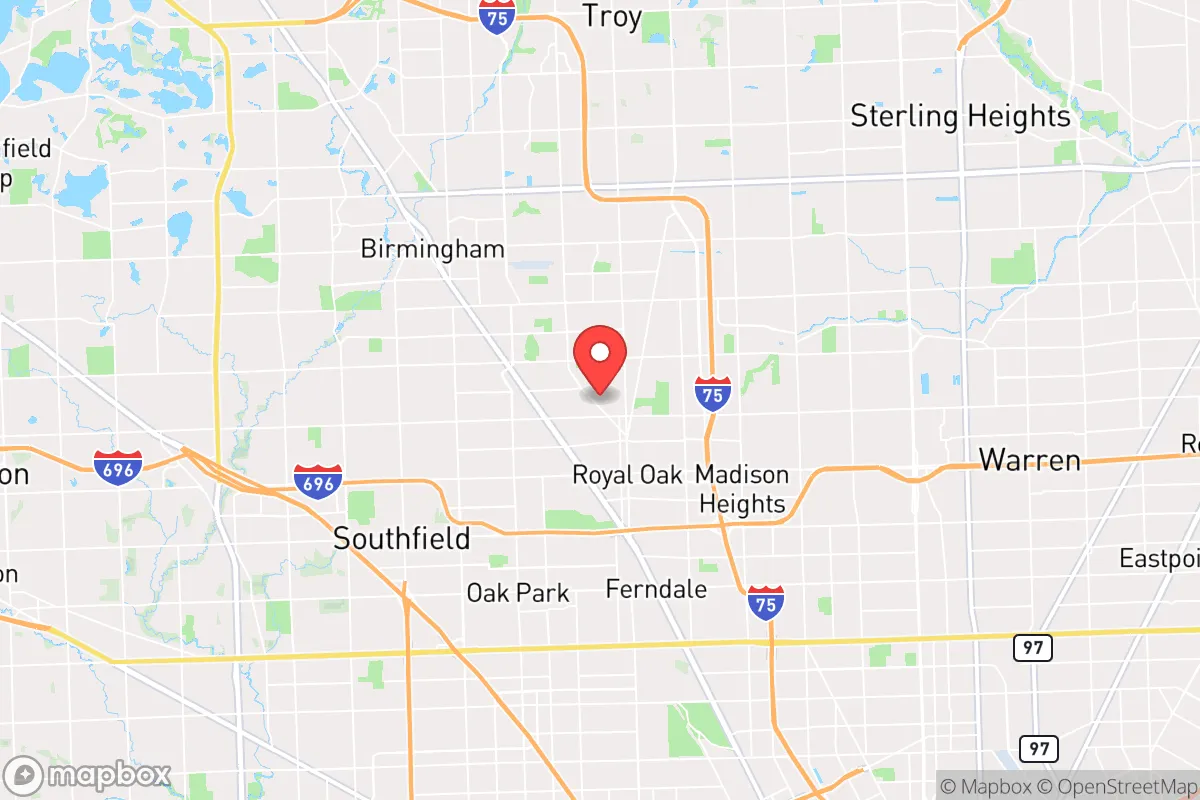
District shown is the primary district for this city’s centroid. Cities may span multiple districts.
Local Political AnalysisPolitical Analysis of Royal Oak, MI
Royal Oak has shifted noticeably to the left over the past decade, a trend that’s hard to miss if you’ve been around here long enough. Back in the 2000s, the city was a reliable swing area, often voting within a few points of the statewide average, but by 2024, it had become a solidly Democratic stronghold, with Oakland County as a whole going +14 for the Democratic presidential candidate. The local city commission and school board have followed suit, increasingly embracing progressive policies that raise eyebrows for anyone who values limited government and personal freedoms.
How it compares
If you drive just a few miles north or west, you’ll hit places like Troy, Birmingham, or Bloomfield Hills—wealthier suburbs that still lean Republican or are at least more balanced, often splitting tickets between local GOP candidates and moderate Democrats. Head south into Detroit, and you’re in a completely different political universe, but that’s expected. The real contrast is with Royal Oak’s immediate neighbors: Ferndale to the south is even further left, practically a progressive enclave, while Clawson to the east and Madison Heights to the north are more working-class and politically mixed. Royal Oak used to be the middle ground, but now it’s part of that growing urban-suburban corridor where progressive ideology has taken hold, and it’s concerning to see how quickly that shift has happened.
What this means for residents
For folks who value personal autonomy and want government to stay out of their lives, the changes are tangible. The city council has pushed through zoning changes that make it easier to build high-density apartments, often overriding neighborhood concerns about traffic and character. There’s been a steady push for more bike lanes and pedestrian-only zones, which sounds nice in theory but can feel like a nanny-state approach to how you get around. Property taxes have crept up to fund expanded public services and diversity initiatives, and some local business owners grumble about new regulations on everything from outdoor seating to signage. The school district has adopted curriculum updates that emphasize social-emotional learning and DEI training, which some parents see as overreach into what kids should be taught at home. It’s not a disaster, but it’s a slow drift toward more control from the top down.
One cultural distinction that stands out is Royal Oak’s embrace of “smart growth” and transit-oriented development, which sounds progressive but has practical downsides. The city has actively discouraged new single-family home construction in favor of mixed-use projects, making it harder for families to find a traditional house with a yard. The downtown area, once a classic Main Street with independent shops, is now dominated by chain restaurants and breweries catering to a younger, more transient crowd. If you’re a longtime resident who remembers when the biggest political fights were about potholes and school funding, the current focus on climate action plans and racial equity audits can feel like a distraction from the basics. Looking ahead, I’d expect Royal Oak to keep trending left, especially as more young professionals move in from Detroit and Ann Arbor, but the older, more conservative homeowners still have a voice—for now. Keep an eye on the next city council election; if the progressives sweep again, you’ll know the old Royal Oak is truly gone.

State Political ClimatePolitical Climate in Michigan
State Political AnalysisPolitical Environment in the State
Michigan has shifted from a reliably purple battleground to a state where Democrats now hold unified control of the governor’s office, both chambers of the legislature, and the state Supreme Court—a trifecta achieved for the first time in four decades after the 2022 elections. Over the past 10-20 years, the state has moved from a moderate, union-driven swing state to one where progressive policies are being enacted rapidly, driven largely by the explosive growth of the Detroit metro area’s suburban and urban vote. For a conservative considering relocation, the key takeaway is that while the state’s rural and exurban areas remain deeply red, the political center of gravity has shifted decisively leftward, and the trend shows no sign of reversing.
Urban vs. rural divide
The political map of Michigan is a stark story of two Michigans. The urban core of Detroit and its inner-ring suburbs like Southfield and Ferndale are overwhelmingly Democratic, producing massive vote margins that often decide statewide races. The city of Detroit alone routinely delivers 95%+ of its vote to Democratic candidates. Meanwhile, the western side of the state, including the Grand Rapids metro area (Kent County), has been trending blue in recent cycles—Kent County flipped to Biden in 2020 and has stayed Democratic in subsequent elections, driven by a growing professional class and younger voters. The reliably red strongholds are the rural thumb and northern Lower Peninsula, with counties like Oscoda, Alcona, and Montmorency regularly voting 65-70% Republican. The critical swing region is the suburban ring around Detroit—places like Macomb County (home to Warren and Sterling Heights) and Oakland County (Bloomfield Hills, Troy). Macomb was a bellwether for Trump in 2016 but has since drifted back toward Democrats, while Oakland County has become a Democratic stronghold. The result is that Republicans now need to run up massive margins in rural areas to offset the urban and suburban vote, a math problem that grows harder each cycle as the Detroit suburbs become more diverse and educated.
Policy environment
The policy landscape under Governor Gretchen Whitmer and the Democratic trifecta has shifted aggressively leftward. On taxes, Michigan’s income tax rate was temporarily reduced from 4.25% to 4.05% in 2023 due to a trigger law, but the legislature has since moved to freeze that reduction, effectively raising taxes back to the higher rate. Property taxes remain relatively high, with an average effective rate of 1.54%, and the state’s Headlee Amendment caps on property tax growth have been eroded by court rulings. On education, Michigan has eliminated the “Read by Grade Three” retention law, expanded the state’s school aid fund to include universal pre-K, and passed a $24 billion school aid budget—the largest in state history—but with no school choice expansion. The 2023 repeal of right-to-work was a major blow to economic freedom, allowing unions to once again require dues as a condition of employment. Election laws have been loosened significantly: the 2022 passage of Proposal 2 established nine days of early voting, automatic voter registration, and drop boxes statewide. On healthcare, the state expanded Medicaid under the Affordable Care Act and has codified abortion rights into the state constitution via Proposal 3 in 2022, which also removed nearly all restrictions. For a conservative, the regulatory environment is increasingly hostile to gun rights (red flag laws passed in 2023, universal background checks, safe storage requirements) and parental rights (the state has banned conversion therapy for minors and expanded LGBTQ+ anti-discrimination protections in schools).
Trajectory & freedom
Michigan is becoming less free by any objective measure, especially for conservatives. The 2023 legislative session was one of the most aggressive in modern state history. The red flag law (HB 4946) allows courts to temporarily seize firearms from individuals deemed a risk to themselves or others, with no criminal conviction required. The universal background check law (HB 4838) now applies to all firearm transfers, including private sales. The safe storage law (HB 4839) mandates that firearms be stored locked and unloaded, with criminal penalties for violations. On parental rights, the state has banned the use of conversion therapy for minors (HB 4616) and passed the LGBTQ+ Inclusive Curriculum Law (HB 4833), which requires schools to teach about the contributions of LGBTQ+ individuals in social studies. The Repeal of Right-to-Work (HB 4004) means workers in unionized workplaces can no longer opt out of paying union dues. On the positive side for liberty, the state has not imposed a statewide mask or vaccine mandate since 2021, and the legislature has passed some property tax relief for seniors. But the overall trajectory is clear: the state government is expanding its reach into personal decisions around firearms, education, and healthcare, while shrinking economic freedom through union power and higher taxes.
Civil unrest & political movements
Michigan has been a flashpoint for political activism on both sides. The 2020 Whitmer kidnapping plot and the armed protests at the state capitol over COVID-19 restrictions put Michigan in the national spotlight. The “Operation Gridlock” protest in April 2020 saw thousands of conservatives, many from rural areas like Lapeer and Livingston County, surround the capitol in Lansing to protest the governor’s stay-at-home orders. On the left, the “Michigan Liberation” and “Detroit Justice Center” groups have organized protests against police funding and for criminal justice reform. Immigration politics are less visible than in border states, but Washtenaw County (Ann Arbor) has declared itself a “sanctuary county,” and Detroit has long had a “welcoming city” ordinance. Election integrity remains a hot-button issue: the 2020 election saw widespread allegations of irregularities in Detroit’s absentee ballot counting process, leading to the “Audit the Vote” movement. The 2024 election cycle saw continued controversy over the state’s new early voting and drop box system, with Republican observers alleging insufficient oversight. A new resident would notice the political tension most acutely in the suburbs of Detroit and Grand Rapids, where yard signs and bumper stickers are common, and local school board meetings have become battlegrounds over curriculum and library books.
Projection
Over the next 5-10 years, Michigan is likely to continue its leftward drift. Demographic trends favor Democrats: the state’s growing Asian and Hispanic populations (especially in Oakland and Wayne counties) lean Democratic, while the white working-class base of the GOP is aging and shrinking. The in-migration pattern is mixed—some conservatives are moving to northern Michigan (Traverse City area) and the Upper Peninsula, but these are low-population areas. The real story is the continued suburbanization of the Detroit metro, where young professionals and remote workers are moving into formerly Republican areas like Rochester Hills and Novi, shifting them blue. The state’s Democratic trifecta is likely to hold through at least 2026, and if Proposal 3’s abortion rights coalition remains energized, it could lock in Democratic control for a decade. For a conservative, the practical outlook is that Michigan will continue to pass gun control, expand union power, and increase taxes, while cultural issues like parental rights and school choice will face headwinds. The best-case scenario for conservatives is a split government after 2026, but the structural advantages for Democrats in the state legislature (due to gerrymandering reforms that actually helped Democrats) and the governor’s office make a full reversal unlikely.
For a conservative considering a move to Michigan, the bottom line is this: you can find like-minded communities in the rural thumb, the northern Lower Peninsula, and parts of western Michigan, but you will be living under a state government that is actively hostile to your values on guns, taxes, education, and parental rights. The state’s natural beauty, Great Lakes access, and relatively low cost of living (outside of Ann Arbor and Traverse City) are real draws, but the political trajectory is unmistakably leftward. If you value personal freedom in the traditional sense—the right to keep and bear arms, to choose your children’s education, to keep more of your income—Michigan is becoming a harder place to call home. The best advice is to look at counties like Livingston (Howell) or Ottawa (Holland), which remain reliably red, but understand that state-level policies will still affect you regardless of where you live.
* Values derived from national, state, county, city and local statistics and may differ in a specific area. Last updated: 2026-04-24T03:37:19.000Z
Narrative content on this page is AI-generated and may contain mistakes. Verify any details that matter before acting on them.
ReloMaps may earn a commission from affiliate links at no extra cost to you.

