Photo: Wikipedia
Political ClimatePolitical Climate in Saint Paul, MN
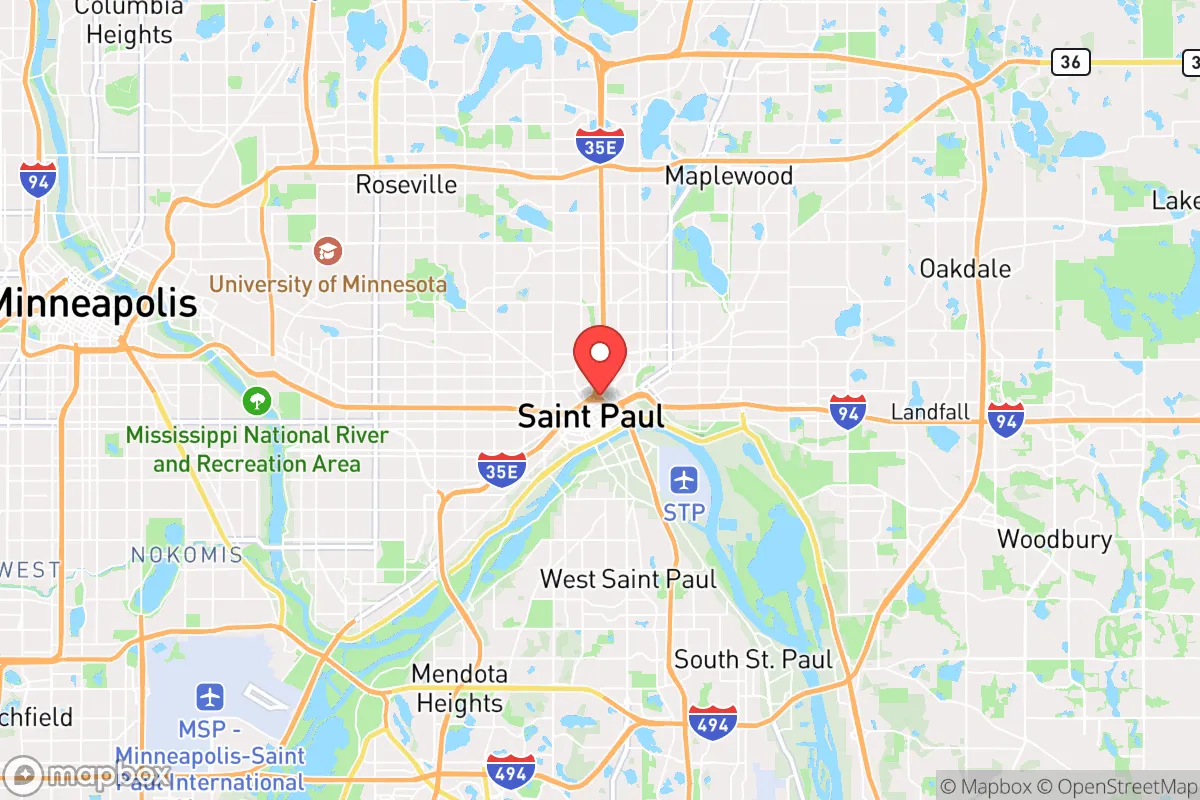
District shown is the primary district for this city’s centroid. Cities may span multiple districts.
Local Political AnalysisPolitical Analysis of Saint Paul, MN
Saint Paul is about as blue as it gets in Minnesota, with a Cook PVI of D+18, meaning it votes nearly 20 points more Democratic than the national average. But if you’ve lived here as long as I have, you know that label doesn’t tell the whole story. This city used to have a strong, quiet conservative streak—especially in the working-class neighborhoods east of downtown and along the river. Over the last decade, though, the political center has shifted hard left, and it’s not just the voting numbers. The local government has embraced a brand of progressive activism that feels less like representation and more like a social experiment, and a lot of us are watching the consequences play out in real time.
How it compares
Drive 15 minutes west to Edina or Minnetonka, and you’ll find suburbs that still lean center-right on fiscal issues, even if they vote blue nationally. Head 30 minutes north to White Bear Lake or Forest Lake, and you’re in solidly red territory—places where property taxes are a dinner-table topic and the phrase “defund the police” gets you laughed out of the room. Saint Paul, by contrast, has gone all-in on progressive policies that neighboring towns treat with caution. The city council has pushed rent control, sanctuary city status, and police oversight measures that make even some DFL voters wince. Meanwhile, surrounding Ramsey County suburbs like Maplewood and Roseville are more moderate, but they’re getting pulled along by Saint Paul’s agenda. It’s a stark reminder that if you value local control over your own property and safety, the city line matters a lot more than the county line.
What this means for residents
For the average homeowner or small-business owner, the political climate here translates into a few uncomfortable realities. First, property taxes have climbed steadily—Saint Paul’s levy increased by nearly 8% in 2024 alone—while city services like snow removal and road repair feel slower than ever. Second, the push for “police reform” has led to a 30% drop in sworn officers since 2020, even as violent crime rates in some precincts have ticked up. You’ll hear city hall say crime is down overall, but ask anyone who’s had their car broken into on Summit Avenue or their garage burglarized in Mac-Grove, and they’ll tell you a different story. The city’s rent control ordinance, passed in 2021, has actually reduced new housing construction by about 40%, according to local builders, making it harder for young families to find a place to live. These aren’t abstract political debates—they’re daily frustrations that make you wonder if the people in charge are living in the same city.
What daily life is like for families
If you’re raising kids here, you’ll notice the political climate seeps into the schools. Saint Paul Public Schools have embraced equity-focused curriculum and gender-inclusive policies that some parents find overreaching. School board meetings have become battlegrounds over library books and parental notification, and the district’s enrollment has dropped by over 5,000 students since 2019, with many families opting for charters or moving to suburbs like Woodbury or Cottage Grove. On the plus side, the city’s parks and libraries are still top-notch, and the farmers’ markets are lively. But the cultural vibe is increasingly one-size-fits-all progressive: you’ll see pride flags on every other porch, but a “Don’t Tread on Me” sticker on a truck might get you a side-eye at the coffee shop. It’s not hostile, exactly, but it’s not the live-and-let-live place it used to be.
Looking ahead, I don’t see Saint Paul swinging back anytime soon. The state legislature is firmly DFL-controlled, and the city’s activist base is energized and organized. If you’re considering a move here, just know that your vote will be a drop in a very blue bucket, and your voice on local issues will compete with well-funded progressive groups. The city’s trajectory feels like a slow-motion experiment in how far left a mid-sized Midwestern city can go before the people who pay the bills start voting with their feet. So far, a lot of them already have.

State Political ClimatePolitical Climate in Minnesota
State Political AnalysisPolitical Environment in the State
Minnesota has shifted from a classic purple battleground to a reliably blue state over the past two decades, with Democrats (DFL) now controlling all three levers of state government as of 2023. The state voted for Hillary Clinton by 1.5 points in 2016, Joe Biden by 7 points in 2020, and Kamala Harris by roughly 4 points in 2024 — a clear leftward drift, but still closer than neighboring Wisconsin or Michigan. The real story is the collapse of Republican performance in the suburban Twin Cities ring, which has flipped from red to blue in just two election cycles, while rural and exurban counties have become dramatically redder. For a conservative considering relocation, the bottom line is that Minnesota is no longer a swing state — it’s a one-party DFL state with aggressive progressive policymaking.
Urban vs. rural divide
The political map of Minnesota is a tale of two worlds. The Minneapolis-St. Paul metro area, home to over 60% of the state’s population, drives the blue wave. Hennepin County (Minneapolis) and Ramsey County (St. Paul) are deep blue, but the real shift has been in the inner-ring suburbs — places like Edina, Bloomington, and Roseville — which were reliably red as recently as 2016 but now vote Democratic by double digits. The outer-ring exurbs like Lakeville, Prior Lake, and Woodbury have become competitive, with Woodbury flipping to Biden in 2020 after voting for Trump in 2016. Meanwhile, rural Minnesota has hardened into a Republican stronghold. Counties like Stearns (St. Cloud), Olmsted (Rochester), and Dakota (south of the cities) are now solidly red, with Trump winning Stearns by 18 points in 2024. The Iron Range in northeastern Minnesota — historically a DFL stronghold — has also shifted right, with St. Louis County (Duluth) becoming a true battleground. The divide isn’t just geographic; it’s cultural. The metro areas are increasingly secular, diverse, and college-educated, while rural areas are older, whiter, and more working-class. This split makes statewide politics a constant tug-of-war, but the metro’s population growth gives the DFL a structural advantage that’s unlikely to fade.
Policy environment
Since the DFL took full control in 2023, Minnesota has enacted a sweeping progressive agenda that conservatives will find alarming. The state now has a progressive income tax with a top rate of 9.85% on income over $200,000 (single filers), one of the highest in the nation. Property taxes are moderate but rising, with the average effective rate around 1.05%. Sales tax is 6.875% statewide, but local options can push it higher. On education, Minnesota passed a universal free school meals program and increased per-pupil funding by 10%, but also enacted a “trans refuge” law that shields gender-affirming care for minors from out-of-state legal challenges — a major red flag for parents concerned about parental rights. Healthcare is heavily regulated, with a state-based insurance exchange and a public option for low-income residents. Election laws have been loosened: Minnesota now has automatic voter registration, same-day registration, and no-excuse absentee voting, which critics argue weakens election integrity. The state also legalized recreational marijuana in 2023, with a 10% excise tax. For conservatives, the policy environment is increasingly hostile to traditional values, with the state actively expanding government control over healthcare, education, and taxation.
Trajectory & freedom
Minnesota is clearly trending toward less personal freedom, especially for conservatives. The 2023 legislative session was a firehose of progressive bills. The PRO Act (Protecting Reproductive Options) codified abortion rights and removed nearly all restrictions, including parental notification for minors. The Trans Refuge Act (HF 146) made Minnesota a sanctuary for gender-affirming care, overriding parental consent laws from other states. On gun rights, the state passed universal background checks and a “red flag” law (Extreme Risk Protection Order), allowing courts to temporarily seize firearms from individuals deemed a risk — a direct infringement on Second Amendment rights. Property rights took a hit with a new “climate-friendly” building code that mandates electric-only new construction in many areas, effectively banning natural gas hookups. On the positive side for conservatives, Minnesota has no state-level rent control, and property taxes are still lower than in Illinois or New York. But the trend is unmistakable: the state is using its trifecta to expand government power into areas of personal choice, from medical decisions to gun ownership to energy use. The 2024 session saw a push for a “clean energy standard” that would require 100% carbon-free electricity by 2040, which will drive up energy costs.
Civil unrest & political movements
Minnesota has been a flashpoint for civil unrest since the 2020 George Floyd protests, which caused over $500 million in property damage in Minneapolis and St. Paul. The aftermath saw a surge in left-wing activism, with groups like the Minnesota Freedom Fund bailing out protesters and the city of Minneapolis attempting to defund its police department (a measure that ultimately failed in a 2021 referendum). On the right, the Minnesota Gun Owners Caucus and Minnesota Family Council have become more organized, but they’re fighting an uphill battle. Immigration politics are tense: Minnesota is a “sanctuary state” in practice, with a 2023 law prohibiting state and local law enforcement from cooperating with federal immigration authorities unless a criminal warrant is issued. This has led to friction in communities like Worthington and Willmar, where immigrant populations have grown rapidly. Election integrity remains a hot-button issue: the 2020 election saw a narrow 7,000-vote margin for Biden, and while no widespread fraud was proven, the lack of voter ID laws and the expansion of mail-in voting have left many conservatives skeptical. The 2024 election was relatively quiet, but the underlying distrust persists. A new resident will notice the political polarization in everyday life — from yard signs to local news coverage — and the metro area’s progressive activism is hard to ignore.
Projection
Over the next 5-10 years, Minnesota is likely to become even more solidly blue. Demographic trends favor the DFL: the Twin Cities metro is growing faster than the rest of the state, driven by young professionals and immigrants, while rural areas continue to lose population. The 2024 election results showed that even Rochester, home to the Mayo Clinic and a growing tech sector, is trending left. Republicans have little hope of winning statewide office unless they can make inroads in the suburbs, but the party’s current platform — focused on cultural issues and election integrity — hasn’t resonated with suburban swing voters. The DFL’s trifecta is likely to persist through at least 2026, and possibly beyond, given the state’s gerrymandered legislative maps (drawn by a court, but still favoring Democrats). The biggest wildcard is the state’s fiscal health: Minnesota has a $17.5 billion surplus as of 2024, but the new spending commitments — including paid family leave, universal school meals, and the public option — could strain future budgets. If the economy turns, the DFL’s tax-and-spend approach could become a liability. For now, a conservative moving to Minnesota should expect a state government that is actively expanding its reach into personal lives, with little prospect of a political reversal in the near term.
For a conservative considering Minnesota, the practical takeaway is this: you’ll find like-minded communities in the exurbs and rural areas, but you’ll be living under a state government that is hostile to your values on guns, education, healthcare, and taxes. The cost of living is moderate, the natural beauty is real, and the job market is strong — but the political climate is increasingly restrictive. If you value low taxes, parental rights, and Second Amendment protections, Minnesota is a state to watch from a distance, not to move into blindly. If you do move, target counties like Stearns, Wright, or Sherburne — they’re still red, but even they are feeling the blue creep from the metro. The bottom line: Minnesota is a beautiful state with a growing government problem, and it’s not getting better anytime soon.
* Values derived from national, state, county, city and local statistics and may differ in a specific area. Last updated: 2026-05-01T21:48:53.000Z
Narrative content on this page is AI-generated and may contain mistakes. Verify any details that matter before acting on them.
ReloMaps may earn a commission from affiliate links at no extra cost to you.

