Photo: Wikipedia
Demographics of Salem, MA
Affluence Level in Salem, MA
A middle-class area roughly in line with national averages across income, home values, education, and employment.
People of Salem, MA
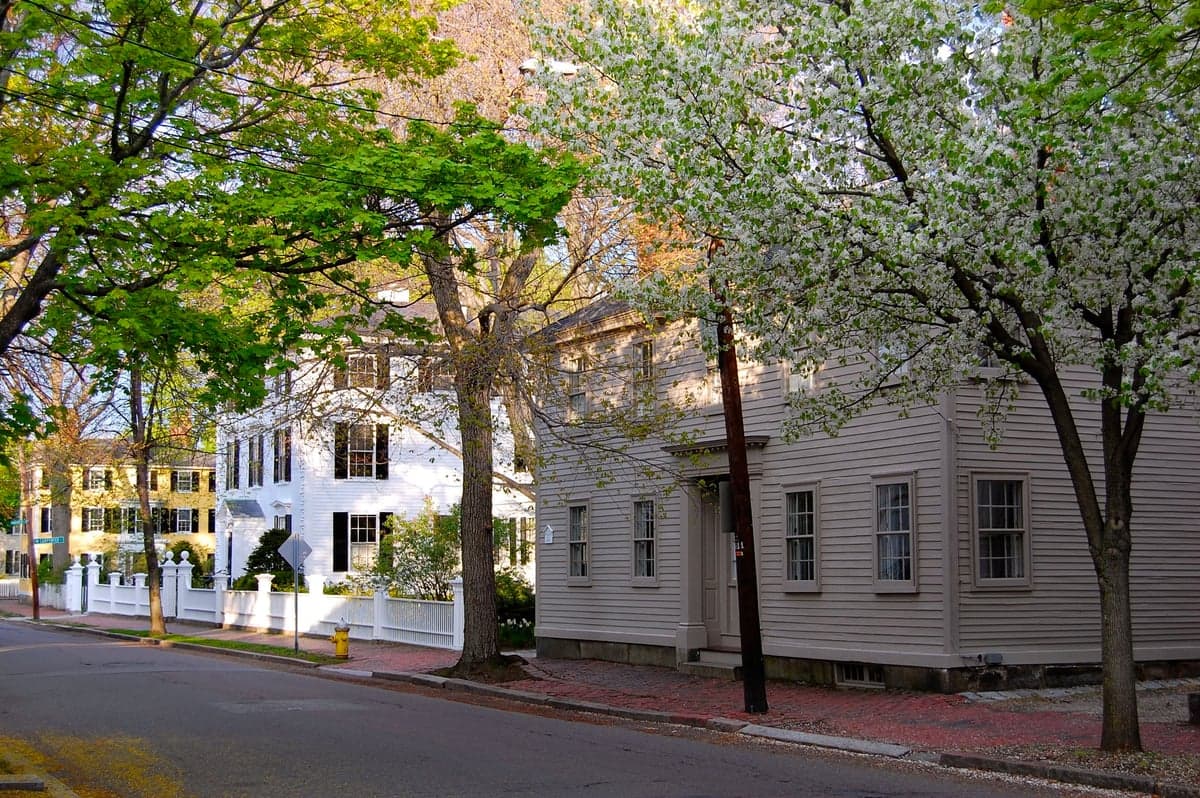
Salem, Massachusetts, is a densely settled historic city of 44,241 residents, known for its maritime heritage and witch trial tourism, but today its population is notably more diverse than its colonial image suggests. The city is majority-white (67.6%) but has a substantial Hispanic community (19.4%), a small but established Black population (5.1%), and growing East/Southeast Asian (2.3%) and Indian-subcontinent (0.9%) communities. With nearly half of adults holding a college degree (49.6%), Salem’s character blends working-class roots with a professional, educated influx, creating a politically progressive but culturally traditional New England city that is denser and more urban than surrounding North Shore suburbs.
How the city was settled and grew
Salem was founded in 1626 by English Puritan fishermen and traders, making it one of the oldest continuously inhabited settlements in the United States. The original population clustered around the Salem Common and Washington Square neighborhoods, building a maritime economy based on cod fishing, shipbuilding, and later the China trade. By the early 19th century, Salem was one of the wealthiest cities per capita in the nation, with merchant families like the Derbys and Crowninshields dominating Federal Street and the McIntire Historic District. The city’s first major demographic shift came with Irish Catholic immigration during the Great Famine (1845–1852), with Irish laborers settling in the Point Neighborhood along the waterfront, working in the tanneries and factories. French-Canadian mill workers arrived in the 1870s, establishing a presence in North Salem around the Naumkeag Steam Cotton Company. Polish and Italian immigrants followed in the early 1900s, creating tight-knit enclaves in South Salem and the Willow Avenue area. By 1920, Salem was a majority-immigrant city, with over 40% of residents foreign-born, primarily from Europe.
Modern era (post-1965)
The 1965 Hart-Celler Act reshaped Salem’s demographics by opening immigration from Latin America and Asia. The most significant post-1965 change has been the growth of the Hispanic population, which now stands at 19.4%. Dominican and Puerto Rican families began arriving in the 1970s and 1980s, settling primarily in the Point Neighborhood and South Salem, areas that had seen white flight to suburbs like Beverly and Marblehead. These neighborhoods remain the city’s most diverse, with Hispanic residents now forming a plurality in the Point. The Black population (5.1%) is smaller and more dispersed, with concentrations in the Highland Avenue corridor and near Salem State University. East/Southeast Asian residents (2.3%) are a newer arrival, many connected to the city’s hospitals and tech firms, living in the Downtown and Collins Cove areas. Indian-subcontinent residents (0.9%) are a small but growing professional cohort, often employed in healthcare or education. Domestic in-migration has been driven by young professionals and families from the Boston metro area, attracted by Salem’s walkability, historic housing stock, and commuter rail access. This has accelerated gentrification in Downtown and the McIntire Historic District, pushing some working-class families to less expensive neighborhoods like North Salem.
The future
Salem’s population is slowly diversifying but remains majority-white, and the city is not homogenizing into a single identity. The Hispanic community is the fastest-growing segment, projected to approach 25% of the population by 2035, driven by both immigration and higher birth rates. This growth is concentrated in the Point Neighborhood, which is becoming a distinctly Hispanic enclave with Dominican-owned bodegas, Pentecostal churches, and Spanish-language signage. Meanwhile, the white population is aging and declining slightly, offset by an influx of college-educated newcomers in Downtown and Federal Street areas. The East/Southeast Asian and Indian communities are small but stable, likely to grow modestly as Salem State University and North Shore Medical Center recruit internationally. The city is not tribalizing into hostile enclaves, but distinct neighborhood identities are hardening: the Point is increasingly Hispanic and working-class, while Downtown and the historic districts are becoming whiter, wealthier, and more professional. Over the next decade, Salem will likely see continued gentrification pressure on the Point, as its waterfront location and proximity to the commuter rail attract development. For a conservative-leaning mover, Salem offers a dense, walkable city with strong community institutions and a traditional New England feel, but its politics are firmly progressive, and property taxes are high relative to surrounding towns.
Salem is becoming a more diverse, educated, and expensive city, where historic neighborhoods retain distinct ethnic and economic identities. For someone moving in now, the city offers a vibrant, historic setting with good schools and transit access, but expect a liberal political environment and rising housing costs that may push working-class families further north or west.

* Values derived from national, state, county, city and local statistics and may differ in a specific area. Last updated: 2026-04-23T06:47:15.000Z
Narrative content on this page is AI-generated and may contain mistakes. Verify any details that matter before acting on them.
ReloMaps may earn a commission from affiliate links at no extra cost to you.

