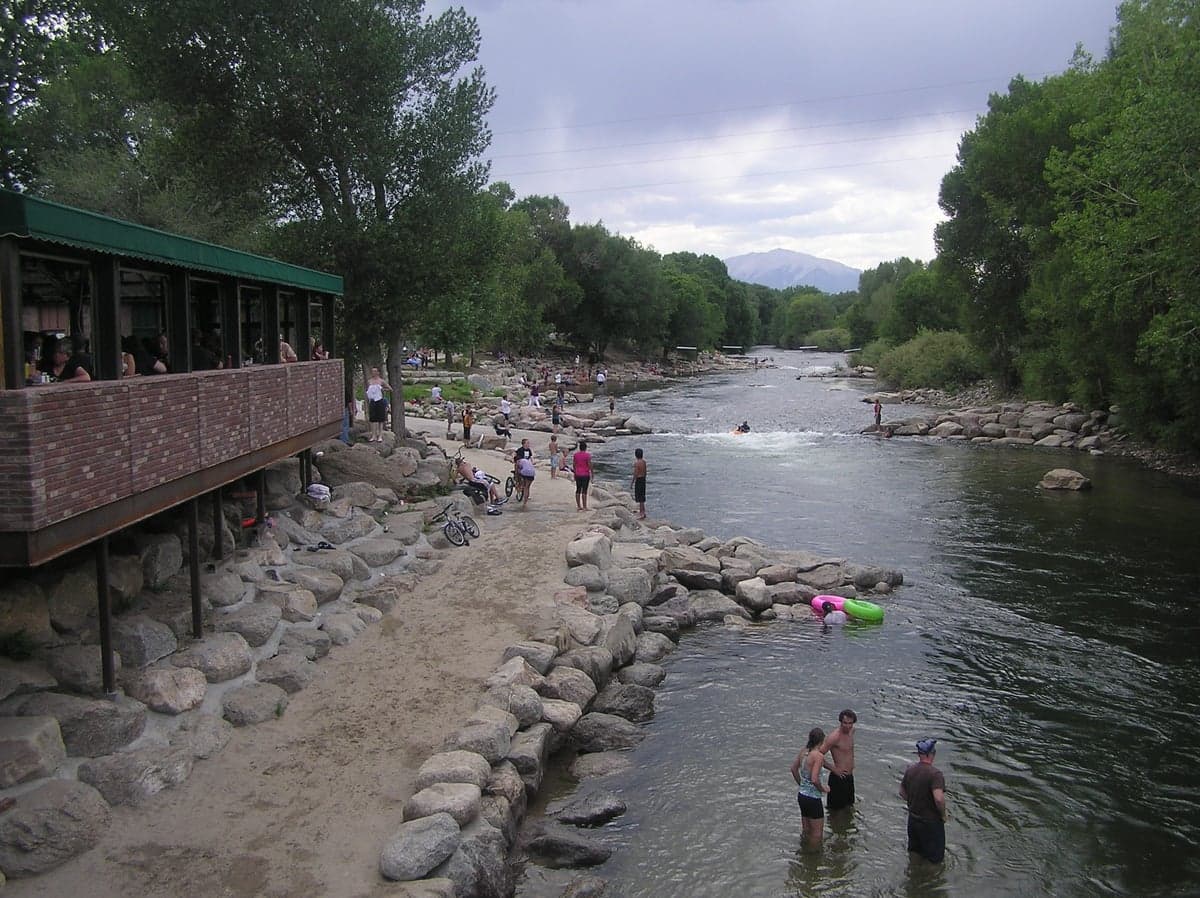
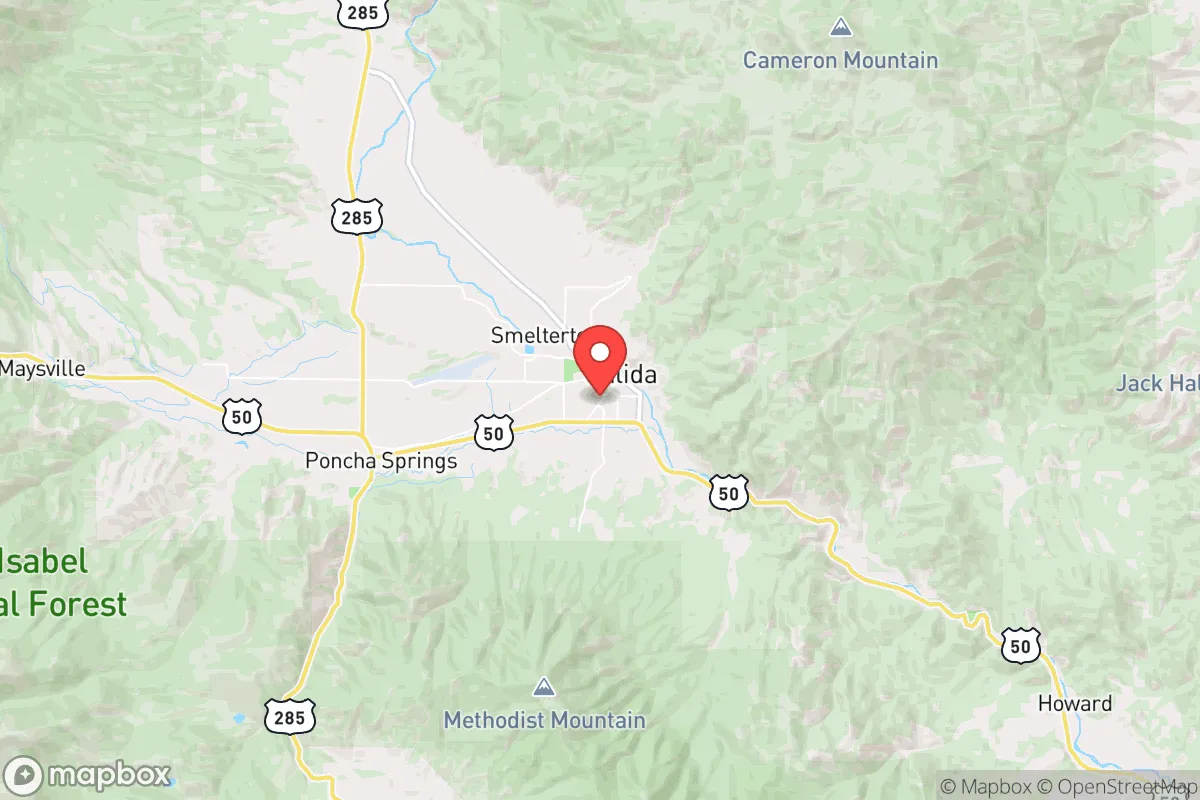
Photo: Wikipedia
Demographics of Salida, CO
Affluence Level in Salida, CO
A middle-class area roughly in line with national averages across income, home values, education, and employment.
People of Salida, CO
Salida, Colorado, is a small, predominantly white city of 5,786 residents, characterized by a high proportion of college-educated adults (56.1%) and a notably low foreign-born population (0.9%). The city’s identity is shaped by its historic railroad and mining roots, now overlaid with a culture of outdoor recreation and tourism, giving it a blend of working-class heritage and newer, amenity-driven migration. With a Hispanic population of 10.9% and negligible Black (0.0%) and East/Southeast Asian (1.8%) communities, Salida remains one of Colorado’s least ethnically diverse cities, a demographic reality rooted in its settlement history.
How the city was settled and grew
Salida was founded in 1880 as a railroad town, a creation of the Denver and Rio Grande Western Railroad, which chose the site at the confluence of the Arkansas River and South Arkansas River for its rail yards and roundhouse. The original population was overwhelmingly white, drawn from Anglo-American settlers moving west, along with a smaller number of European immigrants—primarily Irish, Italian, and German laborers—who built the railroad and worked in the nearby gold and silver mines of the surrounding San Juan Mountains. The city’s historic core, the Downtown Historic District along F Street, was the commercial and social hub for these early workers, while the North Side neighborhood, just north of the Arkansas River, housed many railroad employees in modest frame homes. A small Hispanic community, largely of Mexican-American descent, formed later in the early 20th century, concentrated in the South Side area near the river, where they worked in agriculture and railroad maintenance. By 1950, Salida’s population hovered around 4,500, and the city remained a stable, white-majority working-class town, with the West End neighborhood developing as a more affluent area for business owners and professionals.
Modern era (post-1965)
After the 1965 Hart-Cellar Act, Salida saw no significant immigration wave—its remote inland location and lack of industrial job growth offered little pull for new foreign-born populations. Instead, the city’s demographic change came from domestic in-migration, beginning in the 1970s and accelerating after 2000, as retirees, second-home buyers, and remote workers were drawn by the Arkansas River’s whitewater rafting, the nearby Monarch Ski Area, and the city’s preserved Victorian architecture. This influx has been overwhelmingly white and college-educated, reshaping the Downtown Historic District into a hub of galleries, breweries, and boutique shops, while the North Side has seen gentrification, with older homes renovated by newcomers. The Hispanic population, which peaked at roughly 15% in the 1990s, has declined to 10.9% as of the latest data, partly due to rising housing costs pushing some families to outlying areas like Poncha Springs. The South Side neighborhood remains the most Hispanic area, though its share is shrinking. The East/Southeast Asian population (1.8%) is very small, consisting mostly of a few families involved in tourism or healthcare, with no distinct enclave. The Black population is zero, and the Indian-subcontinent population is zero, reflecting the city’s lack of diversity beyond its white and Hispanic base.
The future
Salida’s population is likely to continue its trajectory of slow growth—projected to reach roughly 6,200 by 2035—driven by continued domestic in-migration of white, affluent, and older residents seeking a mountain lifestyle. The Hispanic community, already declining in share, may plateau or shrink further as younger Hispanic adults move to larger Colorado cities like Denver or Pueblo for more job opportunities and affordable housing. The city is not tribalizing into distinct ethnic enclaves; rather, it is homogenizing into a predominantly white, college-educated population, with the West End and Downtown Historic District becoming increasingly upscale, while the North Side and South Side see gradual redevelopment. The foreign-born population is unlikely to rise significantly, as Salida lacks the industrial or agricultural jobs that attract immigrants, and its housing market is among the least affordable in the Arkansas Valley for lower-income families. The next decade will likely see Salida become more culturally homogeneous, with a growing divide between long-term working-class residents and newer, wealthier arrivals.
For someone moving in now, Salida offers a stable, safe, and scenic environment with a strong sense of community, but it is a place where demographic change is driven by domestic migration, not immigration. The city is becoming more affluent and white, with a shrinking Hispanic presence, and the cost of entry is rising. New residents should expect a population that values outdoor recreation, local arts, and a slower pace of life, but with limited racial or ethnic diversity—a reality that aligns with the city’s historical trajectory as a white-majority railroad town turned mountain retreat.

* Values derived from national, state, county, city and local statistics and may differ in a specific area. Last updated: 2026-05-16T10:00:57.000Z
Narrative content on this page is AI-generated and may contain mistakes. Verify any details that matter before acting on them.
ReloMaps may earn a commission from affiliate links at no extra cost to you.

