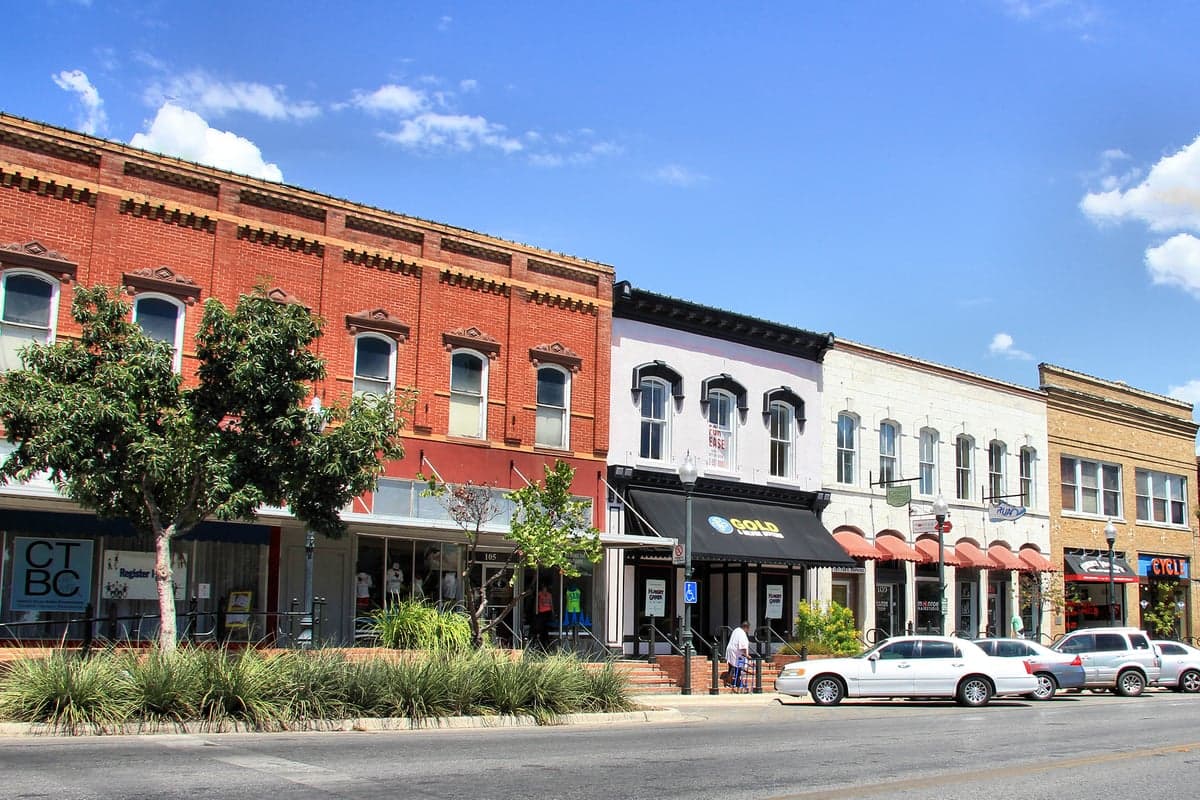
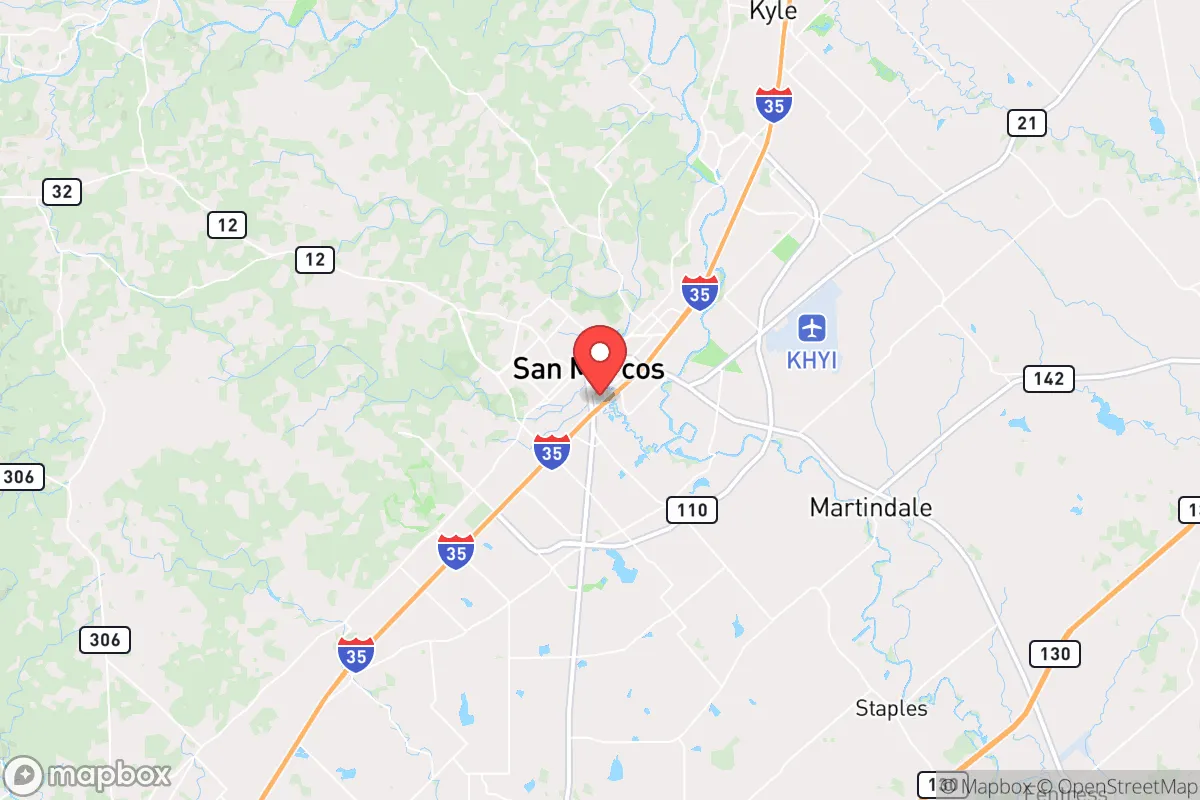
Photo: Wikipedia
Demographics of San Marcos, TX
Affluence Level in San Marcos, TX
A middle-class area roughly in line with national averages across income, home values, education, and employment.
People of San Marcos, TX
The people of San Marcos, TX today number roughly 68,920, forming a dense, fast-growing college town where no single ethnic group holds a majority. The city’s character is defined by a near-even split between non-Hispanic white residents (45.4%) and Hispanic or Latino residents (41.9%), with smaller Black (5.2%), East/Southeast Asian (1.5%), and Indian-subcontinent (0.6%) communities. A relatively high college-educated share (37.3%) reflects the gravitational pull of Texas State University, while a low foreign-born rate (4.9%) indicates that most growth comes from domestic migration rather than new immigration. San Marcos is becoming a younger, more diverse, and more educated place than its surrounding rural counties, but its demographic story is one of gradual mixing rather than rapid ethnic replacement.
How the city was settled and grew
San Marcos was founded in 1851 on the site of a Tonkawa and later Spanish mission outpost, drawing Anglo-American settlers from the U.S. South who arrived via the San Antonio–Austin corridor. The original population was overwhelmingly white and Southern, attracted by fertile bottomland along the San Marcos River and the promise of cotton and cattle ranching. The arrival of the International–Great Northern Railroad in 1881 shifted the economy toward trade and small manufacturing, and the establishment of what became Texas State University (then Southwest Texas State Normal School) in 1899 began drawing a modest stream of faculty and students from across Texas. The historic Dunbar neighborhood, centered on Martin Luther King Drive, was the city’s first distinct ethnic enclave, settled by Black families who moved to San Marcos after the Civil War to work as sharecroppers and domestic laborers. By 1900, the population was roughly 2,500 and nearly entirely white and Black, with a small Mexican-origin community clustered near the railroad tracks in what is now the West End area. The city grew slowly through the first half of the 20th century, reaching about 12,000 by 1950, with the university and a small garment industry anchoring the economy.
Modern era (post-1965)
The post-1965 period brought two major demographic shifts. First, the Hart-Cellar Act of 1965 and subsequent immigration reforms had a modest direct effect on San Marcos—the foreign-born share remains low at 4.9%—but the city began absorbing Hispanic families migrating from South Texas and northern Mexico, drawn by construction, service jobs, and the university’s growing Hispanic enrollment. These families concentrated in the La Vista and Hillside Terrace neighborhoods south of the railroad tracks, areas that remain predominantly Hispanic today. Second, the explosive growth of Texas State University—from 7,000 students in 1970 to over 38,000 today—transformed San Marcos from a sleepy county seat into a regional education and retail hub. This drew a wave of white and Asian faculty, staff, and students, many settling in newer subdivisions like Kyle Crossing and Post Road on the city’s north and east sides. The Black population, which had been roughly 15% in 1970, declined to 5.2% by 2024 as middle-class Black families moved to larger metros like Austin and San Antonio, leaving the Dunbar neighborhood smaller and older. The East/Southeast Asian community (1.5%) is small but visible near the university, while the Indian-subcontinent population (0.6%) is almost entirely tied to tech and academic jobs at Texas State and the nearby Austin tech corridor.
The future
San Marcos’s population is heading toward a stable, two-group majority of white and Hispanic residents, with smaller Black and Asian communities that are unlikely to grow rapidly. The Hispanic share has risen steadily from roughly 25% in 1990 to 41.9% today, and that trend is expected to continue as younger Hispanic families age into childbearing years and as continued domestic migration from South Texas and the Rio Grande Valley brings new arrivals. The white share, while declining in percentage terms, is growing in absolute numbers due to university expansion and Austin spillover. The city is not tribalizing into rigid enclaves—most neighborhoods are moderately mixed—but La Vista and Hillside Terrace remain heavily Hispanic, while Kyle Crossing and Post Road are majority white and Asian. The foreign-born rate is unlikely to rise sharply because San Marcos lacks the industrial or agricultural jobs that draw large immigrant populations; the city’s growth will remain domestic. Over the next 10–20 years, San Marcos will likely become a majority-Hispanic city with a large white minority, a small Black community, and a thin but stable Asian and Indian presence tied to the university.
For someone moving to San Marcos now, the city offers a young, educated, and politically moderate environment that is more diverse than its rural neighbors but less cosmopolitan than Austin. The population is growing fast—about 2–3% annually—and the housing stock is expanding outward into new subdivisions, meaning newcomers will find a city that is still being built. The dominant experience is one of mixing: white and Hispanic residents share schools, churches, and retail spaces, and the university acts as a demographic blender. The city is not a place of sharp ethnic boundaries, but of gradual integration, with the university and the river as the two unifying forces.

* Values derived from national, state, county, city and local statistics and may differ in a specific area. Last updated: 2026-05-11T20:36:25.000Z
Narrative content on this page is AI-generated and may contain mistakes. Verify any details that matter before acting on them.
ReloMaps may earn a commission from affiliate links at no extra cost to you.

