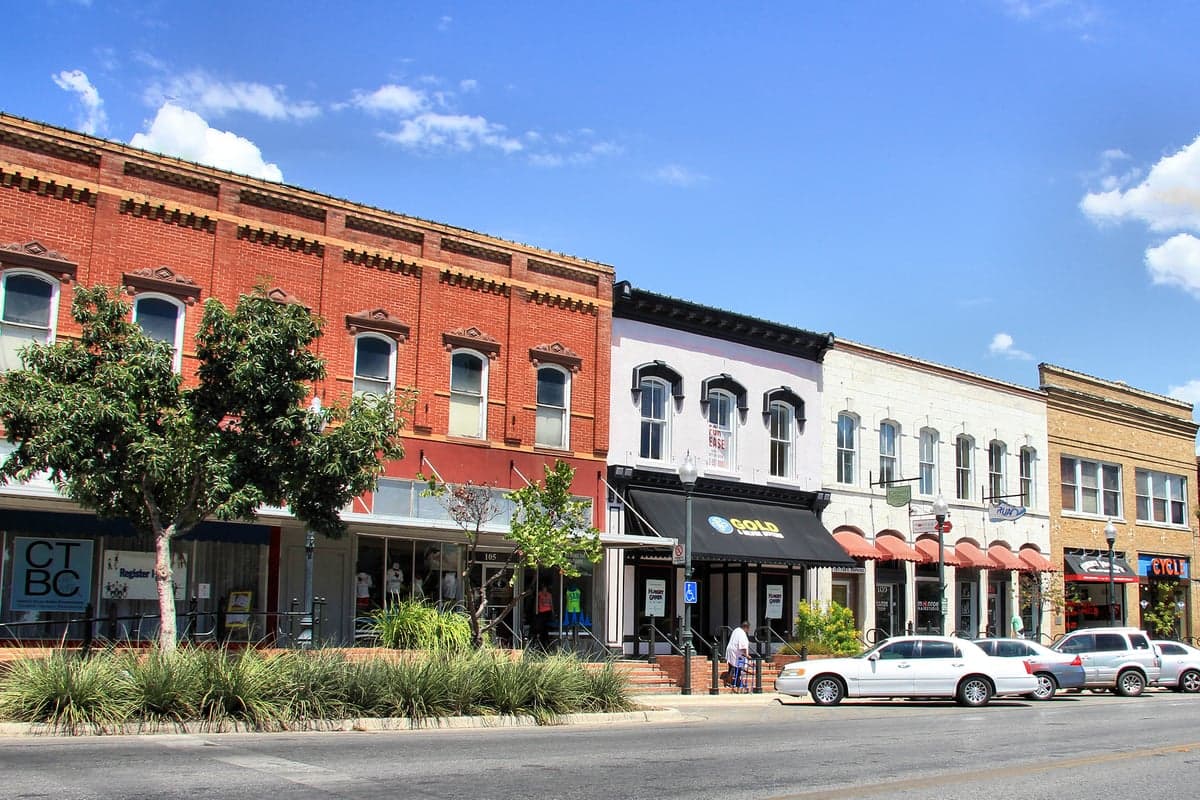
Photo: Wikipedia
Personal Sovereignty in San Marcos, TX
Strong independent fundamentals that actively favor personal liberty and low regulation.
What does Personal Sovereignty tell us?
Personal Sovereignty measures your capacity for self-reliance and independence with minimal government friction. Higher scores mean fewer barriers between you and the way you want to live... but it assumes you have the space you need and good neighbors.
What does this tell us?
Personal Sovereignty measures your capacity for self-reliance and independence with minimal government friction. Higher scores mean fewer barriers between you and the way you want to live... but it assumes you have the space you need and good neighbors.
State Policy
Energy independence: Net exporter (220% of energy produced in-state)
Personal Liberty
Homesteading

Personal Liberty Analysis
San Marcos, Texas, offers a mixed bag for those prioritizing personal sovereignty, but the state-level framework provides a strong foundation that local governance hasn't fully undermined. Nestled between Austin and San Antonio, this college town (home to Texas State University) operates under Texas’s broad preemption laws that limit city-level overreach on firearms, property rights, and taxation. However, the city’s progressive lean—driven by a large student population and a vocal activist base—means you’ll need to watch for local ordinances that nibble at the edges of your autonomy. For a survivalist or prepper, the key question isn’t whether Texas protects your rights, but whether San Marcos’s specific policies and demographics create friction for self-reliant living.
Tax burden and regulatory posture: How Texas’s low-tax model plays out locally
Texas’s lack of a state income tax is your biggest win here—every dollar you earn stays in your pocket, with no state-level confiscation for income, capital gains, or corporate earnings. San Marcos’s combined state and local sales tax rate is 8.25%, which is standard for the region but adds up on everyday purchases. Property taxes are the real bite: Hays County levies around 2.1% of assessed value, which is high by national standards but typical for Texas. The city’s regulatory posture is generally light—no city-level rent control, no burdensome business licensing for home-based operations, and no local income tax. However, San Marcos has adopted aggressive tree preservation ordinances and stormwater management rules that can complicate clearing land for a garden or building a detached workshop. If you’re looking to run a home-based prepping supply business or a small fabrication shop, the city’s zoning code is permissive for home occupations, but you’ll need to check for HOA covenants if you’re in a subdivision. The overall tax burden is manageable, but the property tax rate means owning land here is a long-term cost you must factor into your independence calculus.
Self-defense and gun law specifics: What the Second Sanctuary status means for you
San Marcos is a Second Amendment Sanctuary City, a designation that formally opposes state-level red flag laws and local enforcement of federal firearm restrictions. This matters because it signals that local law enforcement won’t cooperate with federal overreach on gun control. Texas law allows permitless carry (constitutional carry) for anyone 21 or older who can legally possess a firearm, and San Marcos has not added any local restrictions beyond state law. Open carry of handguns is legal, and long guns are unrestricted. The city does have a no-gun zone at Texas State University (under state law), but that’s a campus-specific rule, not a citywide ban. For self-defense, you can carry in most public spaces, including parks and sidewalks, but private businesses can post 30.06 or 30.07 signs to prohibit concealed or open carry. The Hays County Sheriff’s Office is generally pro-2A, and the city’s police department has not shown hostility to lawful gun owners. If you’re a prepper, the sanctuary status gives you a buffer against future federal gun grabs, but you should still plan for the possibility of state-level changes—Texas politics can shift, and the sanctuary designation is symbolic, not legally binding.
Self-reliance and homesteading viability: Lot sizes, zoning, and off-grid feasibility
San Marcos’s zoning is a mixed bag for homesteaders. Inside city limits, most residential lots are 5,000 to 10,000 square feet, which is tight for serious food production. The city allows backyard chickens (hens only, no roosters) on lots under an acre, but you’ll need a permit and must follow setback rules. Goats, pigs, and other livestock are generally prohibited within city limits unless you have a special use permit. For off-grid living, the city requires connection to municipal water and sewer if available, which kills the dream of a fully self-contained rainwater catchment and composting toilet system. However, the ETJ (Extra-Territorial Jurisdiction) areas just outside city limits—like parts of Kyle, Buda, and unincorporated Hays County—offer more freedom. There, you can find 1- to 5-acre lots with fewer restrictions, and some allow private wells, septic systems, and solar panels without city interference. The county has no building codes for agricultural structures, so you can erect a barn, greenhouse, or workshop without permits. For a prepper, the best bet is to buy land in the ETJ or rural Hays County, where you can legally hunt on your property (with a license) and store bulk supplies without HOA meddling. The city’s floodplain regulations are strict near the San Marcos River, so check FEMA maps before buying.
Personal liberties: Parental rights, medical autonomy, speech, and property
Texas law generally protects parental rights, including the right to homeschool without state interference, opt out of school vaccines, and direct your child’s medical care. San Marcos CISD has not been aggressive in challenging these rights, but the district’s progressive board has pushed for critical race theory and gender ideology curriculum in the past, which may conflict with your values. You can opt your child out of specific lessons, but you’ll need to stay vigilant. Medical autonomy is strong at the state level—Texas has banned vaccine passports and prohibits local health departments from mandating masks or vaccines for private businesses. However, San Marcos’s city council has a history of declaring public health emergencies and attempting to impose local restrictions, though state preemption usually overrides them. Free speech is protected, but the city’s no-camping ordinances and restrictions on panhandling have been used to target political protesters, so be aware that local authorities may use nuisance laws to suppress dissent. Property rights are solid: Texas has strong eminent domain protections, and San Marcos has not engaged in aggressive land grabs. The city’s historic preservation overlay in the downtown area can restrict what you do with older homes, but outside that zone, you have wide latitude to modify your property. For a prepper, the biggest concern is the city’s fire code, which limits bulk storage of flammable materials (like propane or fuel) in residential areas—you’ll need to store supplies in a detached shed or garage to comply.
Overall, San Marcos offers a B-minus grade for personal sovereignty compared to rural Texas counties like Llano or Blanco. The state-level protections on guns, taxes, and parental rights are strong, but the city’s progressive council, high property taxes, and restrictive zoning for homesteading create friction. If you’re a single individual or a family willing to live just outside city limits and stay engaged in local politics, you can carve out a high degree of autonomy here. But if you want maximum freedom to prep, hunt, and live off-grid without local interference, you’re better off in a county with no zoning and lower taxes. San Marcos is a compromise—good state laws, mediocre local implementation, and a culture that will test your patience if you value traditional self-reliance.

* Values derived from national, state, county, city and local statistics and may differ in a specific area. Last updated: 2026-05-11T20:36:25.000Z
Narrative content on this page is AI-generated and may contain mistakes. Verify any details that matter before acting on them.
ReloMaps may earn a commission from affiliate links at no extra cost to you.

