Photo: Wikipedia
Political ClimatePolitical Climate in San Marcos, TX
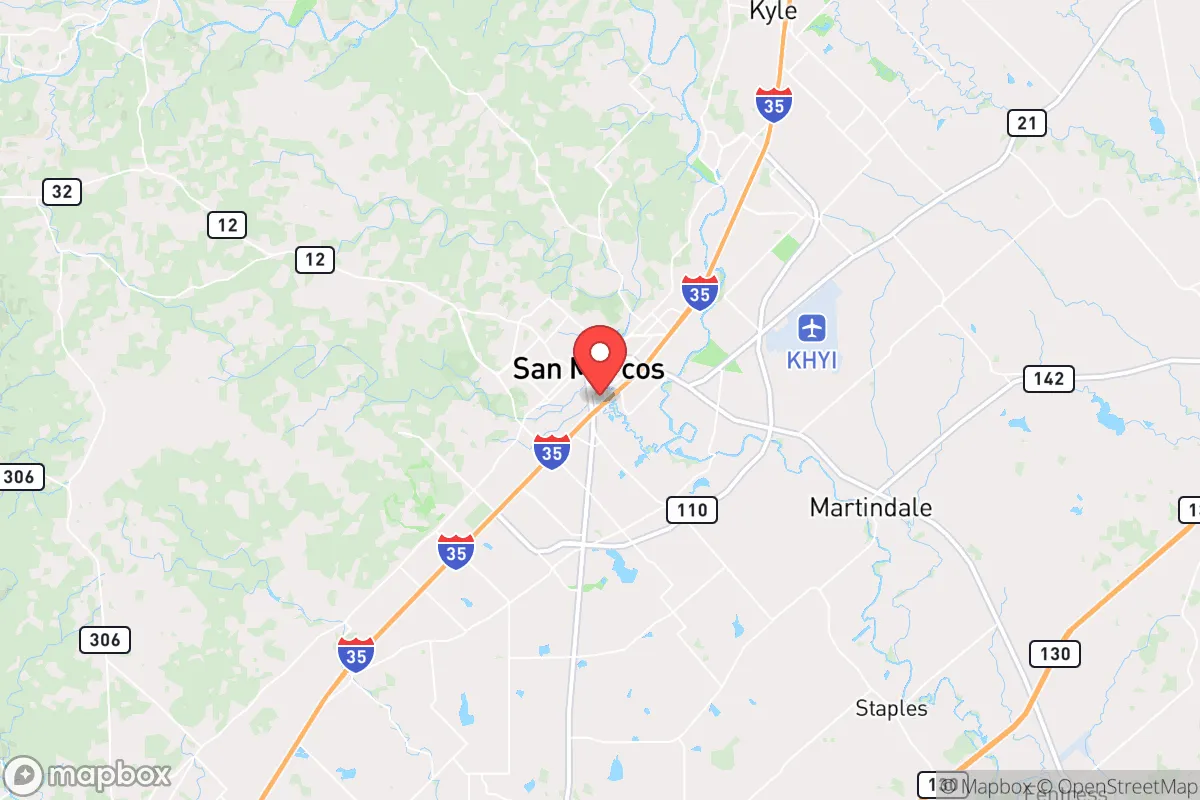
District shown is the primary district for this city’s centroid. Cities may span multiple districts.
Local Political AnalysisPolitical Analysis of San Marcos, TX
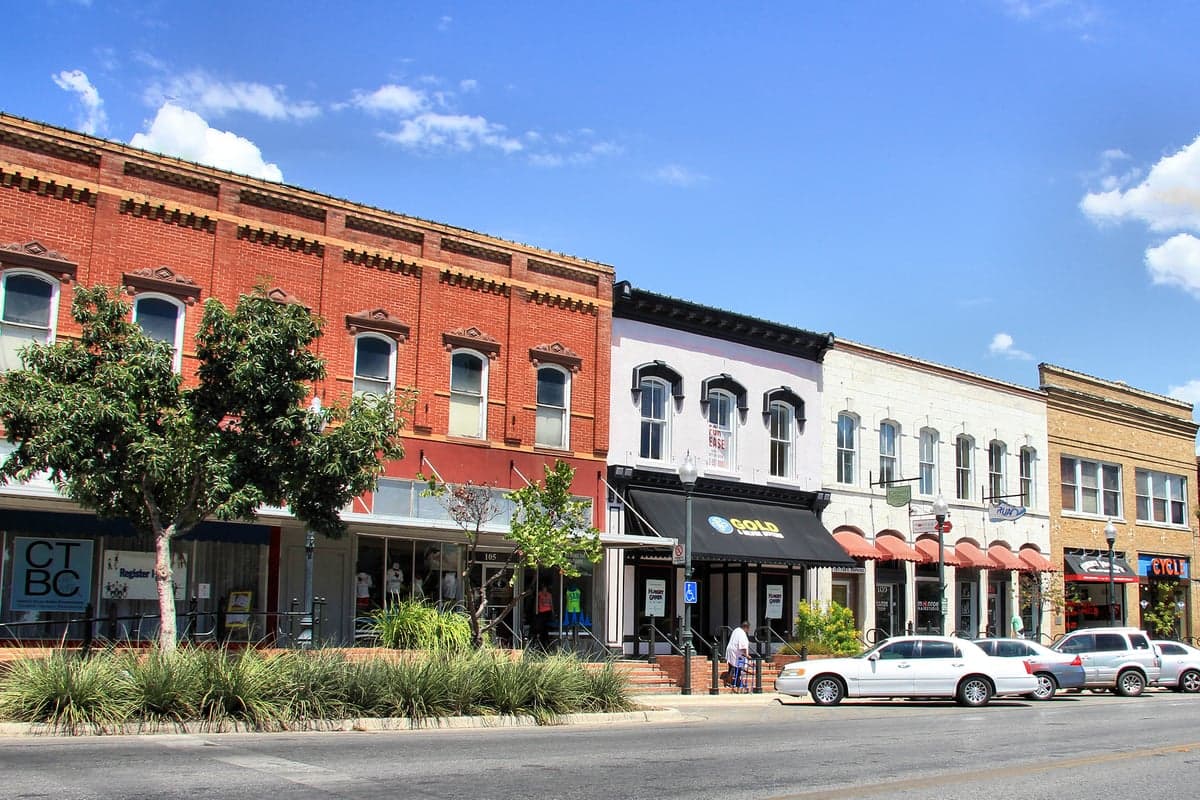
San Marcos, Texas, has a political climate that is a stark outlier compared to the rest of the state, and it’s a shift that’s happened fast. The city now carries a Cook PVI of D+19, meaning it votes nearly 20 points more Democratic than the national average. That’s a massive contrast to Texas as a whole, which sits at R+4. If you’ve been here since the early 2000s, you remember when this town was a quiet, conservative-leaning college community. Now, it’s a progressive stronghold, and the change feels like it happened overnight. The driving force is Texas State University, which has grown rapidly and brought in a younger, more transient population that votes overwhelmingly left. The surrounding areas—like Kyle to the north and San Marcos’s own rural outskirts—still lean red, but the city core has been completely transformed.
How it compares
When you compare San Marcos to the rest of Texas, you’re looking at two different worlds. The state as a whole is reliably Republican, with a PVI of R+4, meaning it votes about 4 points more Republican than the national average. San Marcos, by contrast, is D+19—a 23-point gap from the state. That’s not just a difference; it’s a chasm. Drive 20 minutes south to New Braunfels or 30 minutes east to Lockhart, and you’re back in solidly conservative territory. Even Austin, which is famously liberal, has a PVI of D+23, so San Marcos is actually closer to Austin’s politics than to its own county’s rural voters. This creates a real tension: the city council and school board are increasingly progressive, while the county commission and state representatives are still conservative. It’s a recipe for constant policy battles, especially on issues like property taxes, zoning, and public safety.
What this means for residents
For a conservative resident, living in San Marcos means watching your local government push policies that feel out of step with traditional Texas values. The city has embraced sanctuary city rhetoric, resisted state-level immigration enforcement, and pushed for higher density zoning that often leads to more government control over private property. The school district has also shifted, with curriculum debates and a focus on diversity, equity, and inclusion initiatives that many long-time residents see as ideological overreach. If you value personal freedoms—like the right to keep and bear arms without extra local restrictions, or the right to run a small business without heavy regulation—you’ll find the city council increasingly hostile to those principles. The tax burden has also crept up, as the city spends more on social programs and administrative bloat. It’s not the San Marcos I grew up in, where folks minded their own business and the government stayed out of your life.
What this means for the future
Looking ahead, the trend is concerning. The university keeps expanding, and with it, the voter base that supports progressive candidates. The 2024 election saw San Marcos vote over 60% for the Democratic presidential candidate, and local races are now dominated by candidates who openly advocate for policies like rent control, defunding the police, and carbon-neutral mandates. If you’re a conservative, you’re increasingly a minority voice in city hall. The long-term outlook is that San Marcos will continue to diverge from the rest of Texas, becoming a blue island in a red state. That means more friction with the state legislature, more lawsuits over local ordinances, and a growing sense of cultural alienation for anyone who doesn’t buy into the progressive agenda. It’s still a great place to live if you keep your head down, but the political climate is something you have to navigate carefully—especially if you value the freedoms that made Texas great in the first place.

State Political ClimatePolitical Climate in Texas
State Political AnalysisPolitical Environment in the State
Texas has been a reliably Republican state for decades, with a Cook Partisan Voting Index of R+4, but the political landscape is far from monolithic and has shifted notably over the past 10-20 years. The dominant coalition remains a mix of rural conservatives, suburban moderates, and business-oriented Republicans, but explosive growth in cities like Austin, Dallas, and Houston has introduced a persistent Democratic minority that now holds every major urban county. Over the last three cycles, the GOP’s margin of victory has narrowed from double digits to single digits, driven largely by in-migration from blue states and a rapidly diversifying electorate, though the state legislature and statewide offices remain firmly in Republican hands.
Urban vs. rural divide
The political map of Texas is a stark checkerboard of deep blue urban islands surrounded by vast red rural and exurban territory. The major Democratic strongholds are Harris County (Houston), Dallas County, Bexar County (San Antonio), Travis County (Austin), and El Paso County — these five counties alone deliver roughly 40% of the statewide Democratic vote. In 2020, Joe Biden won Harris County by 13 points and Travis County by 52 points, while Donald Trump carried rural counties like Loving, King, and Roberts by margins exceeding 90%. The suburbs are the real battleground: places like Collin County (north of Dallas) and Williamson County (north of Austin) were once reliably red but have shifted purple. In 2020, Trump won Collin County by only 4 points after winning it by 19 points in 2016, and Williamson County flipped from +15 R to +2 R. Meanwhile, the Rio Grande Valley — historically Democratic — has shown signs of a rightward shift, with counties like Zapata and Starr moving double digits toward the GOP in 2024. The urban-rural divide is not just about population density; it reflects a cultural chasm between the libertarian-leaning, business-friendly ethos of rural Texas and the progressive, government-dependent priorities of the major metros.
Policy environment
Texas operates under a low-tax, low-regulation framework that appeals strongly to conservative relocators. There is no state income tax, and the property tax system — while high in many areas (averaging 1.6-2.0% of assessed value) — is offset by the lack of a state levy. The regulatory posture is business-friendly: Texas is a right-to-work state, has no state-level minimum wage above the federal $7.25, and has streamlined permitting for energy and construction. On education, the state has expanded school choice through the 2023 creation of education savings accounts (ESAs) for special needs students and low-income families, though a universal voucher bill failed in the 2023 session. Healthcare policy remains a flashpoint: Texas has not expanded Medicaid under the ACA, leaving roughly 18% of the population uninsured, the highest rate in the nation. Election laws were tightened in 2021 with Senate Bill 1, which added ID requirements for mail-in ballots, banned 24-hour and drive-through voting, and empowered partisan poll watchers. The state also passed a near-total abortion ban (SB 8) in 2021, enforced through private civil lawsuits, and in 2023 enacted a law (HB 12) banning gender-transition procedures for minors. For a conservative family, the policy environment is broadly aligned with traditional values, though the property tax burden and lack of Medicaid expansion can be practical concerns for lower-income households.
Trajectory & freedom
Over the past five years, Texas has moved decisively toward expanding personal liberty in several key areas, while contracting it in others — and the net direction depends heavily on which freedom you prioritize. On gun rights, Texas became a constitutional carry state in 2021 (HB 1927), allowing permitless carry of handguns for anyone 21 or older who can legally possess a firearm. On parental rights, the 2023 passage of HB 12 (banning gender-transition procedures for minors) and the 2021 "Save Women's Sports" Act (SB 2) have strengthened parental authority over medical and educational decisions. On property rights, the 2023 passage of SB 2038 limits the ability of homeowners' associations to restrict solar panels and rainwater harvesting, and the 2021 "Take Back Texas" law (HB 2730) restricts the ability of local governments to regulate short-term rentals. However, freedom has contracted in other areas: the 2021 election integrity law (SB 1) added bureaucratic hurdles to voting, and the state's aggressive use of eminent domain for the Texas-Mexico border wall and private toll roads has raised property rights concerns. The 2023 "Death Star" law (HB 2127) preempts local ordinances on everything from paid leave to eviction rules, which conservatives see as limiting local control but supporters argue protects businesses from a patchwork of regulations. Overall, Texas is trending more free on cultural and economic issues, but less free on local governance and voting access.
Civil unrest & political movements
Texas has seen its share of political flashpoints, particularly around immigration and election integrity. The 2021 "Operation Lone Star" border security initiative, launched by Governor Greg Abbott, has deployed thousands of state troopers and National Guard members to the border, leading to ongoing legal battles with the Biden administration over razor wire and buoys in the Rio Grande. In 2023, the state passed SB 4, which makes illegal entry into Texas a state crime, directly challenging federal immigration authority — a move that has drawn both praise from conservatives and lawsuits from civil liberties groups. On the left, the 2020 racial justice protests in Austin and Dallas were among the largest in the state's history, with Austin alone seeing over 100 consecutive nights of demonstrations. The "Defund the Police" movement briefly gained traction in Austin, leading to a $150 million cut to the police budget in 2020, but was largely reversed by 2022 after a spike in violent crime. Election integrity remains a hot-button issue: the 2020 election in Texas saw no widespread fraud, but the 2021 SB 1 law was passed in response to concerns about mail-in ballot security. Secession rhetoric — "Texit" — has been a fringe movement for years, with a 2022 Texas GOP platform plank calling for a referendum on independence, but it remains politically marginal. A new resident would notice the heavy law enforcement presence at the border, the prevalence of "Don't Tread on Me" flags in rural areas, and the occasional protest in downtown Austin, but overall the state is not experiencing the kind of sustained civil unrest seen in Portland or Seattle.
Projection
Over the next 5-10 years, Texas is likely to become more politically competitive at the statewide level, but the Republican majority in the legislature and on the courts is unlikely to be seriously threatened. Demographic trends favor the Democrats: the state's Hispanic population, which leans Democratic but is shifting rightward, is growing rapidly, and in-migration from California and New York brings more moderate-to-liberal voters to the suburbs. However, the GOP is also gaining ground among Hispanic voters in the Rio Grande Valley and among working-class voters in rural areas. The key battleground will be the suburban ring counties around Dallas, Houston, and Austin — places like Fort Bend, Denton, and Hays — where the margin will determine control of the state House. If current trends hold, Texas could become a true swing state by 2032, but the state's political institutions (gerrymandered districts, voter ID laws, and a conservative judiciary) will slow that shift. For a conservative relocator, the projection is cautiously optimistic: the state will remain culturally conservative on most issues, but the political environment will become more contentious, with higher-profile fights over school choice, property taxes, and immigration. The biggest wildcard is whether the GOP can hold the suburbs by moderating on issues like marijuana legalization and healthcare access, or whether the party will double down on cultural battles that alienate college-educated voters.
For a new resident — especially a conservative family or individual — Texas offers a political environment that is broadly aligned with traditional values, low taxes, and personal liberty, but it is not without its tensions. You will find a state that respects gun rights, protects parental authority, and keeps government small, but you will also encounter high property taxes, a strained healthcare system, and growing political polarization in the suburbs. The bottom line: Texas is still the best bet in the country for someone seeking a conservative-friendly state with a strong economy, but the political winds are shifting, and the next decade will determine whether it remains a red fortress or becomes a purple battleground. If you move here, expect to be part of that fight — and to pay for it in property taxes.
* Values derived from national, state, county, city and local statistics and may differ in a specific area. Last updated: 2026-05-11T20:36:25.000Z
Narrative content on this page is AI-generated and may contain mistakes. Verify any details that matter before acting on them.
ReloMaps may earn a commission from affiliate links at no extra cost to you.

