
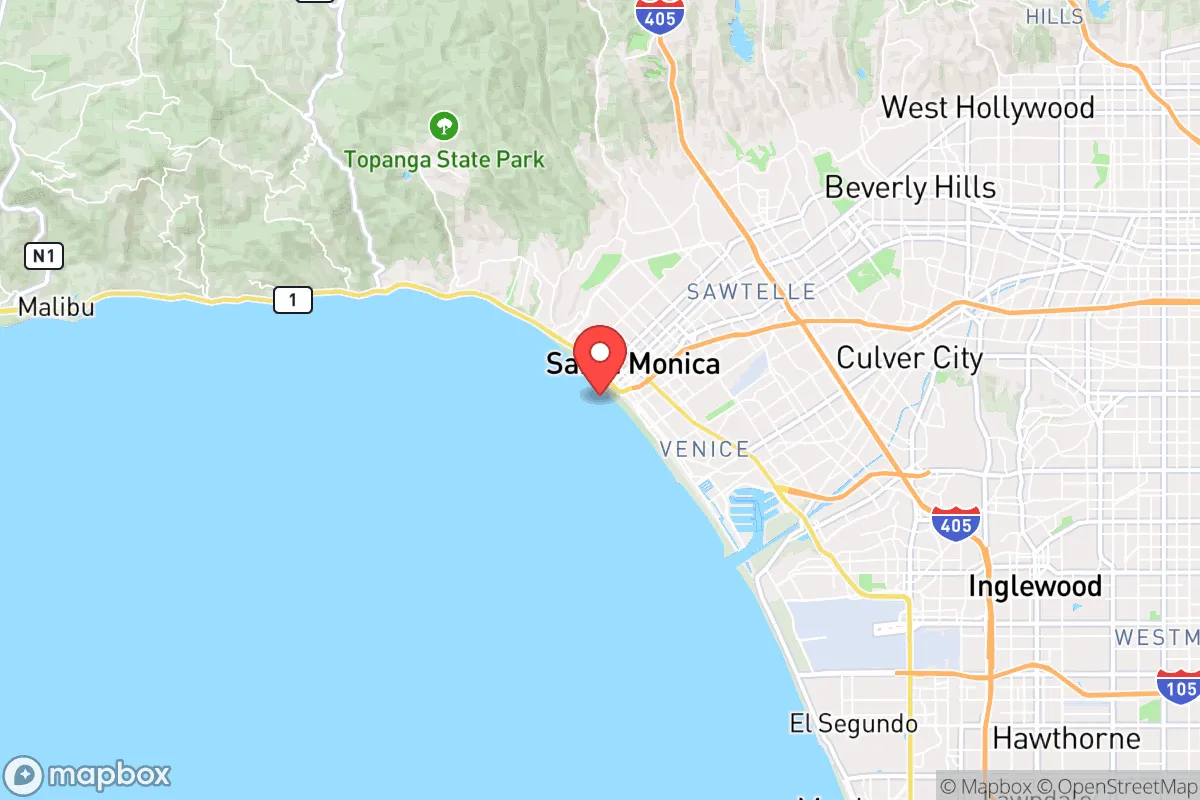
Photo: Wikipedia
Personal Sovereignty in Santa Monica, CA
Moderate friction. Expect trade-offs in some aspect of personal liberty and independence.
What does Personal Sovereignty tell us?
Personal Sovereignty measures your capacity for self-reliance and independence with minimal government friction. Higher scores mean fewer barriers between you and the way you want to live... but it assumes you have the space you need and good neighbors.
What does this tell us?
Personal Sovereignty measures your capacity for self-reliance and independence with minimal government friction. Higher scores mean fewer barriers between you and the way you want to live... but it assumes you have the space you need and good neighbors.
State Policy
Energy independence: Importer (33% of energy produced in-state)
Personal Liberty
Homesteading

Personal Liberty Analysis
Santa Monica presents a challenging environment for those prioritizing personal sovereignty, with a dense regulatory framework and high tax burden that significantly constrain individual autonomy compared to much of the United States. As a coastal city within Los Angeles County, its governance reflects a progressive municipal and state posture that actively manages personal choices across housing, business, self-defense, and daily life. For a relocation reader weighing personal freedom, Santa Monica ranks among the most restrictive urban areas in California, though specific pockets of autonomy remain within the broader state context.
Tax burden and regulatory posture for residents and business owners
Santa Monica’s tax and regulatory environment is among the heaviest in Southern California, driven by both city-level ordinances and California state law. The city imposes a sales tax rate of 10.25%, one of the highest in the nation, which directly impacts daily purchasing power. Property taxes are governed by Proposition 13, capping annual increases at 2% of assessed value, but effective rates still average around 0.77% of market value—moderate nationally but high relative to many Sun Belt states. However, the state’s top marginal income tax rate of 13.3% applies to high earners, and Santa Monica’s local business license tax and gross receipts tax add layers of cost for entrepreneurs. The city’s zoning code is dense and prescriptive: residential zones limit home-based businesses, short-term rentals (e.g., Airbnb) are heavily restricted, and new commercial development faces rigorous environmental review under the California Environmental Quality Act (CEQA). For a self-reliant individual, starting a small business or operating a side hustle from home requires navigating a web of permits and fees that can take months. The regulatory posture is best described as high-touch, with city staff actively enforcing noise, signage, and land-use rules—a stark contrast to more laissez-faire jurisdictions like Texas or Florida.
Self-defense and gun law specifics in Santa Monica
California’s firearm laws are among the strictest in the country, and Santa Monica adds no local leniency. The state requires a 10-day waiting period for all firearm purchases, a background check through the California Department of Justice, and a Firearm Safety Certificate. Handgun purchases are limited to one per 30 days, and the state’s roster of approved handguns restricts models available for sale. Open carry of handguns is prohibited, and concealed carry permits (CCW) are issued at the county level by the Los Angeles County Sheriff’s Department. As of 2024, Los Angeles County is a “may-issue” jurisdiction, meaning applicants must demonstrate “good cause” beyond self-defense—a standard that historically results in very few permits issued to ordinary residents. Santa Monica itself has a municipal ordinance prohibiting the discharge of firearms within city limits, and the city’s police department is known for proactive enforcement of gun laws. For a reader prioritizing self-defense autonomy, Santa Monica offers limited options: owning a firearm for home defense is legally possible but burdensome, and carrying one for personal protection is effectively inaccessible for most residents. Less-lethal options like pepper spray are legal but subject to size restrictions. The practical takeaway: personal sovereignty in self-defense is heavily curtailed here.
Self-reliance and homesteading viability: lot sizes, zoning, and off-grid feasibility
Santa Monica’s urban density and zoning make traditional homesteading or off-grid living nearly impossible. The city’s residential lots are small—typically 5,000 to 7,500 square feet for single-family homes—with most properties lacking space for significant food production. Zoning codes restrict keeping livestock: chickens are allowed only with a permit and limited to a small number of hens (no roosters), while goats, pigs, or larger animals are prohibited in residential zones. Water use is tightly regulated by the city and the Metropolitan Water District, with mandatory conservation measures during drought periods—meaning rainwater harvesting is permitted but subject to volume limits and reporting requirements. Solar panels are allowed and incentivized through net metering, but the city’s building code requires permits and structural reviews. Off-grid living—severing from municipal water, sewer, or electricity—is effectively illegal under California’s building and health codes, which mandate connections to public utilities for habitable structures. For a reader seeking self-reliance through gardening, small-scale animal husbandry, or energy independence, Santa Monica offers limited scope. The regulatory environment prioritizes municipal control over individual resource autonomy, making true homesteading viable only in rural parts of California, not within this dense coastal city.
Personal liberties: parental rights, medical autonomy, speech, and property
Santa Monica’s approach to personal liberties reflects California’s broader progressive legal framework, with notable constraints on certain freedoms. Parental rights are balanced by state mandates: California requires school districts to adopt policies supporting LGBTQ+ student privacy, meaning schools may not notify parents of a child’s gender identity without the student’s consent—a point of tension for families prioritizing traditional parental authority. Medical autonomy is mixed: California allows minors 12 and older to consent to mental health and reproductive care without parental approval, and the state has strong vaccine mandates for school attendance (though personal belief exemptions exist for some vaccines). Medical freedom is further limited by the state’s strict licensing of alternative practitioners and its ban on direct primary care arrangements that bypass insurance. Free speech is protected under the First Amendment, but Santa Monica enforces local ordinances on noise, signage, and public assembly that can restrict expressive activities—for example, amplified sound requires a permit, and sidewalk vending is regulated. Property rights are heavily constrained by rent control: Santa Monica’s Rent Control Board oversees approximately 70% of rental units, limiting annual rent increases and eviction grounds. For homeowners, the city’s historic preservation ordinance can restrict exterior modifications. Overall, personal liberties in Santa Monica are exercised within a framework of active government management, with fewer zones of unregulated individual choice than in less densely regulated states.
In summary, Santa Monica offers a low-sovereignty environment relative to most U.S. cities, with high taxes, strict gun laws, minimal homesteading feasibility, and regulated personal liberties. For a relocation reader prioritizing personal autonomy, this area ranks near the bottom among coastal California cities—comparable to San Francisco or Berkeley—and far below cities in states like Texas, Arizona, or Florida. The trade-off is access to a dense urban lifestyle, ocean proximity, and progressive social services, but the cost in personal sovereignty is substantial. Those seeking greater self-reliance, self-defense options, or regulatory freedom would find better alignment in less densely governed regions of the country.

* Values derived from national, state, county, city and local statistics and may differ in a specific area. Last updated: 2026-06-08T04:53:42.000Z
Narrative content on this page is AI-generated and may contain mistakes. Verify any details that matter before acting on them.
ReloMaps may earn a commission from affiliate links at no extra cost to you.

