Photo: Wikipedia
Demographics of Seatac, WA
Affluence Level in Seatac, WA
A middle-class area roughly in line with national averages across income, home values, education, and employment.
People of Seatac, WA
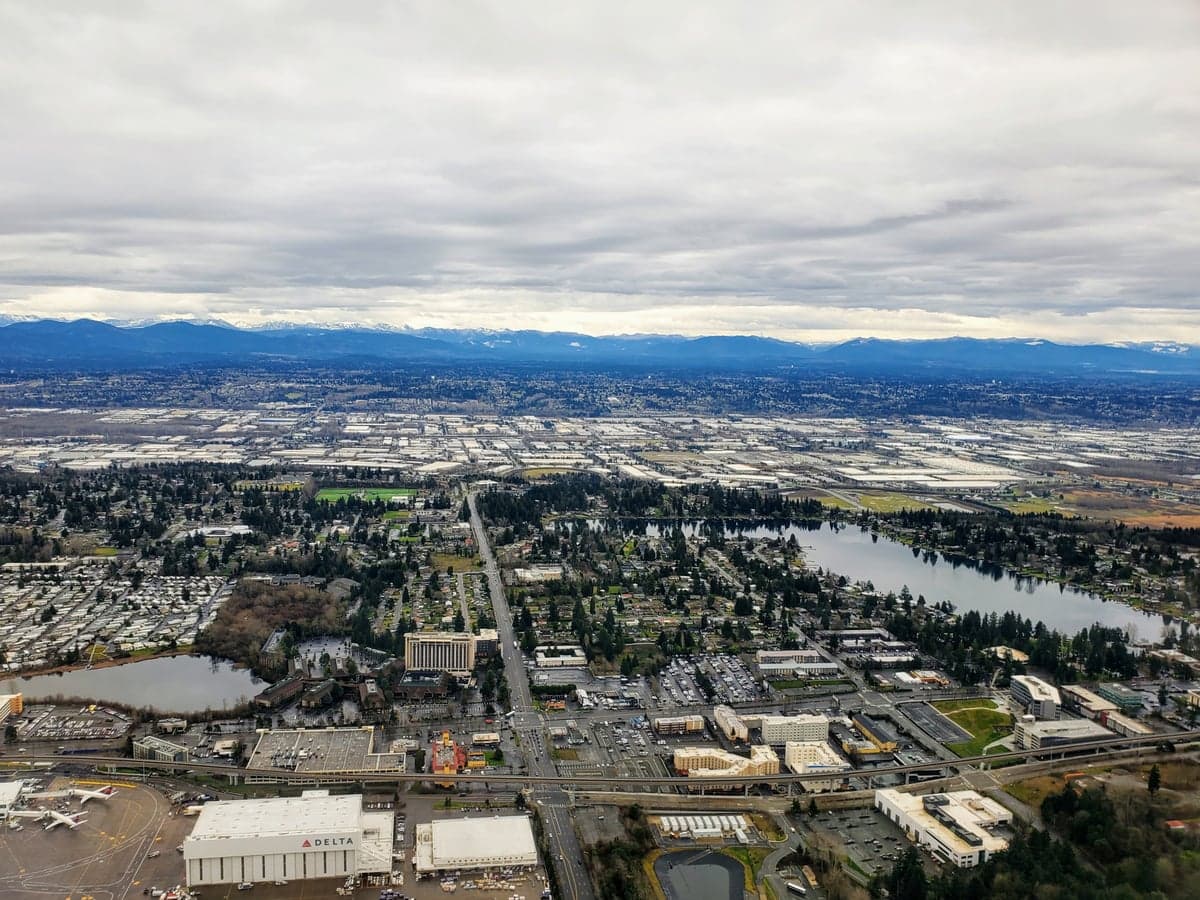
Seatac, Washington, is a compact, densely populated city of 31,143 residents that serves as a major transportation and employment hub for the Seattle-Tacoma region. Its population is one of the most racially and ethnically diverse in the state, with no single group holding a majority: White residents make up 29.3%, Black residents 23.9%, Hispanic residents 22.8%, and East/Southeast Asian residents 12.8%, alongside a notable Indian-subcontinent community at 3.0%. The city’s identity is shaped by its role as the home of Seattle-Tacoma International Airport, its working-class roots, and a rapid demographic transformation over the past three decades that has created a uniquely multicultural, yet economically modest, community.
How the city was settled and grew
Seatac’s human history begins not with a pioneer town but with the mid-20th-century construction of Seattle-Tacoma International Airport, which opened in 1947 on the site of a former dairy farming area. The city itself was not incorporated until 1990, making it a very young municipality. Before the airport, the area was sparsely populated by small farms and summer cabins, with the first significant wave of settlement arriving during World War II, when workers came to build and staff the nearby Boeing plants in Seattle and Renton. These early residents were predominantly White, working-class families who settled in what are now the McMicken Heights and Valley Ridge neighborhoods, areas of modest single-family homes built in the 1940s and 1950s. The airport’s expansion in the 1960s and 1970s drew a second wave of domestic migrants—airline employees, mechanics, and service workers—who filled the post-war housing stock in Bow Lake and Sunset, establishing Seatac’s character as a blue-collar, transit-oriented community.
Modern era (post-1965)
The 1965 Immigration and Nationality Act opened the door to non-European immigration, and Seatac began to diversify rapidly starting in the 1980s. The city’s affordable housing stock and proximity to airport and warehouse jobs attracted a large wave of immigrants from East and Southeast Asia, particularly Vietnamese and Filipino families, who settled in the Angle Lake and North Seatac neighborhoods. By the 1990s, a significant Black population—many from other U.S. cities and East African nations—began moving into the Parkwood and McMicken Heights areas, drawn by lower home prices compared to Seattle and a growing network of community institutions. Hispanic immigration, primarily from Mexico and Central America, accelerated in the 2000s, with families concentrating in the Sunset and Bow Lake neighborhoods, where multi-generational households and rental duplexes are common. The Indian-subcontinent community, though smaller at 3.0%, has grown steadily since 2010, with many professionals working in tech and logistics settling in the newer apartment complexes near the airport. Today, Seatac is a majority-minority city where 19.3% of residents are foreign-born, and the White share has fallen from over 50% in 2000 to 29.3% in 2024.
The future
Seatac’s population is projected to become even more diverse and slightly younger over the next decade, driven by continued immigration and the in-migration of lower-income households priced out of Seattle and Bellevue. The Hispanic and East/Southeast Asian shares are expected to grow the fastest, while the Black population is likely to stabilize or increase modestly. New development is concentrated in the Airport District and along International Boulevard, where high-density apartments and townhomes are replacing older motels and single-family lots. This is dispersing new immigrant communities across the city rather than concentrating them in a single ethnic enclave. The city’s cultural identity is evolving from a purely working-class airport town into a more polyglot, transit-accessible suburb, though it remains economically modest—only 26.6% of adults hold a bachelor’s degree, well below the King County average. The next 10-20 years will likely see Seatac become a denser, more multilingual city, with a growing share of residents employed in airport logistics, warehousing, and hospitality.
For someone moving in now, Seatac is a place of genuine diversity and affordability, but also of economic pressure and rapid change. It offers a rare mix of racial integration and working-class stability in a region dominated by tech wealth, making it a practical choice for families and individuals who value proximity to the airport and a multicultural environment over suburban homogeneity. The city is not gentrifying quickly, but it is densifying, and new arrivals will find a community that is both welcoming and still defining its post-1990 identity.

* Values derived from national, state, county, city and local statistics and may differ in a specific area. Last updated: 2026-09-03T05:18:21.000Z
Narrative content on this page is AI-generated and may contain mistakes. Verify any details that matter before acting on them.
ReloMaps may earn a commission from affiliate links at no extra cost to you.

