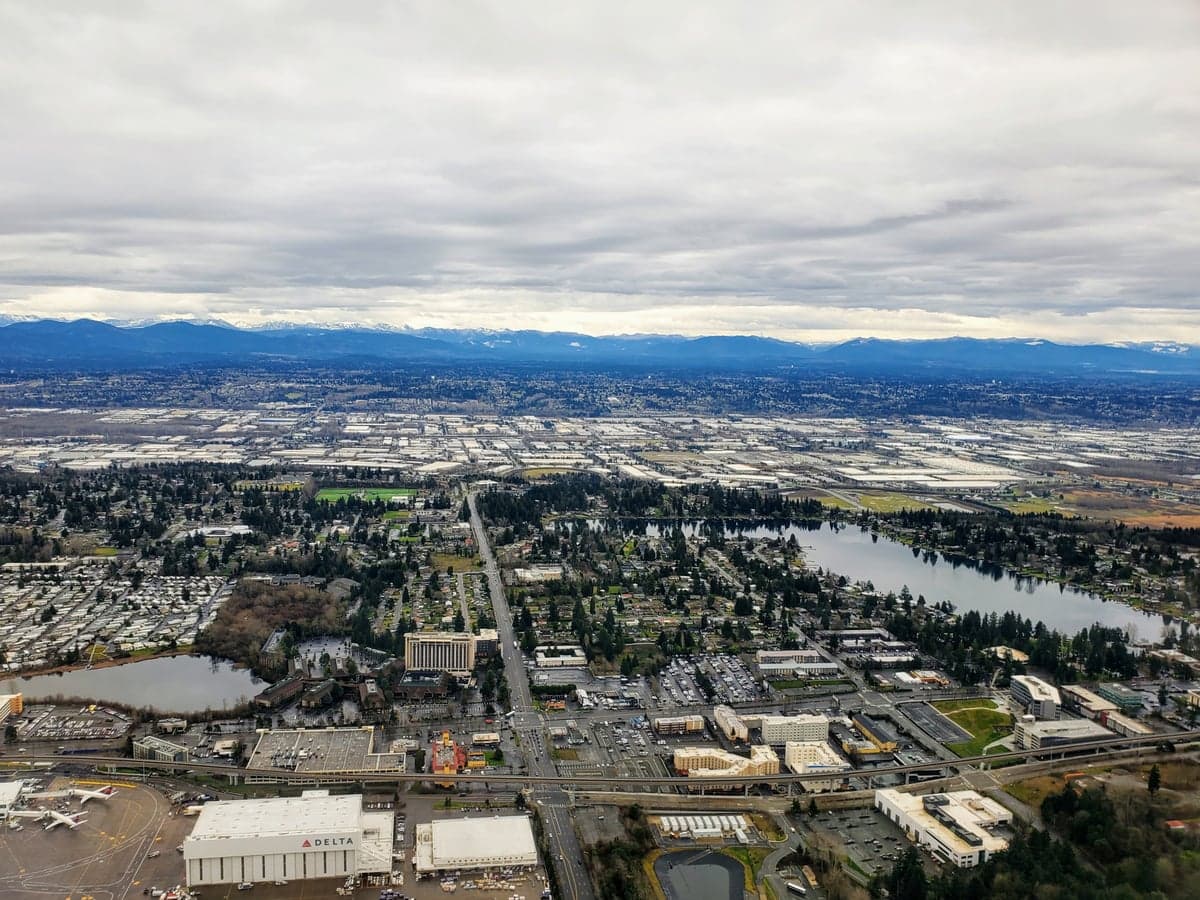
Photo: Wikipedia
Political ClimatePolitical Climate in Seatac, WA
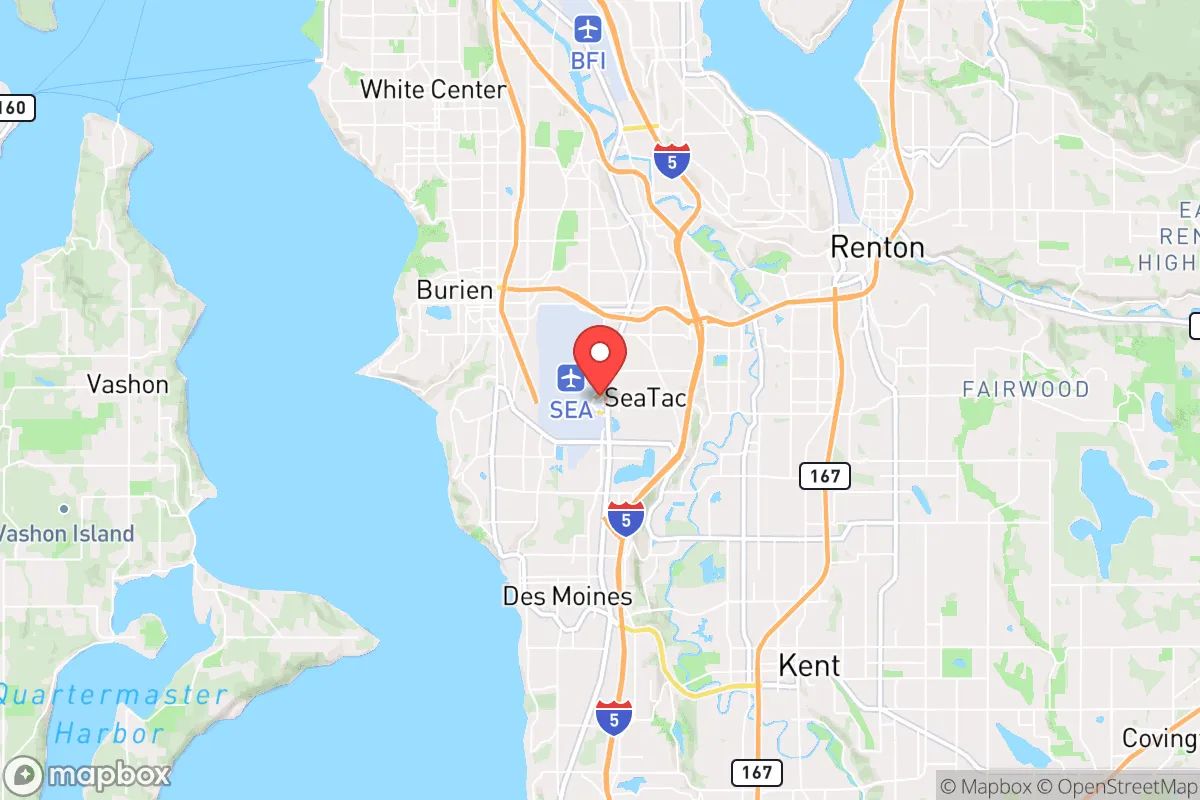
District shown is the primary district for this city’s centroid. Cities may span multiple districts.
Local Political AnalysisPolitical Analysis of Seatac, WA
Seatac is a solidly blue city, with a Cook PVI of D+22 that places it among the most Democratic-leaning communities in the state. That number isn't just a statistic—it reflects decades of local voting patterns, with Democrats routinely winning by 20-plus points in presidential and statewide races. The trajectory here has been steady: Seatac has been reliably liberal since its incorporation in 1990, and if anything, the margin has widened slightly over the last two cycles as the city’s population has grown more diverse and younger. You won’t find much political whiplash in Seatac; it’s a place where the local council, school board, and even the port commission all lean left, and that’s unlikely to change anytime soon.
How it compares
Compared to Washington state as a whole, Seatac is significantly more liberal. While the state’s Cook PVI isn’t publicly listed, statewide elections typically lean Democratic by about 8-10 points—think of it as a D+8 to D+10 environment. That means Seatac is roughly 12-14 points more Democratic than the state average. For context, drive 15 minutes south to Kent or 20 minutes east to Issaquah, and you’ll hit more moderate or even conservative-leaning pockets. Kent’s Cook PVI is around D+8, while Issaquah sits closer to D+5. Head further east to towns like Maple Valley or Black Diamond, and you’ll find areas that vote Republican in local races. Seatac, by contrast, is a Democratic stronghold even within King County, which itself is the state’s most liberal region. The city’s proximity to Sea-Tac Airport and its large immigrant and working-class populations help explain the deep blue tilt—these are communities that consistently prioritize public transit, affordable housing, and labor rights.
What this means for residents
For liberal residents, Seatac is a comfortable fit. You’ll find city council meetings where discussions about climate resilience, police reform, and immigrant protections are routine. The local school district (Highline) is progressive in its policies, and community organizations like the Seatac Community Center host events that reflect left-leaning values. For conservative residents, life here isn’t hostile, but it can feel isolating politically. You won’t see many Trump signs during election season, and local Republican clubs are sparse—you’d have to drive to Auburn or Enumclaw for a more active conservative scene. That said, the city’s practical governance is fairly moderate: the mayor and council focus on nuts-and-bolts issues like road maintenance, airport noise mitigation, and small business support, which means ideological battles are rare. Property taxes are on the higher side (King County’s average is about 0.93% of assessed value), but services like public transit and parks are well-funded.
Culturally, Seatac stands out for its airport-driven economy and its diversity—over 40% of residents are foreign-born, and the city is a hub for Ethiopian, Somali, and Vietnamese communities. This gives local politics a distinct flavor: you’ll hear more about language access, refugee resettlement, and small business incubators than about national culture wars. The city’s policy on short-term rentals (like Airbnb) near the airport is stricter than in neighboring Burien, reflecting a pro-tenant, anti-displacement stance. Looking ahead, expect Seatac to stay blue, but with a pragmatic, service-oriented twist—don’t look for dramatic ideological shifts, just steady, left-of-center governance that keeps the airport humming and the neighborhoods stable.

State Political ClimatePolitical Climate in Washington
State Political AnalysisPolitical Environment in the State
Washington state has been a reliably Democratic stronghold for over a decade, but its political landscape is far more complex than a simple blue label. The state hasn't voted for a Republican presidential candidate since 1984, and Democrats currently hold all statewide executive offices and both U.S. Senate seats. However, the real story is the deepening urban-rural chasm: King County alone delivers roughly a third of the state's total vote, while vast swaths of eastern and southwestern Washington vote as red as any county in Texas or Idaho. Over the last 20 years, the state has shifted leftward on social and environmental policy, but the 2024 election cycle showed the rural vote hardening further, with several counties flipping even more decisively toward Trump compared to 2020.
Urban vs. rural divide
The political map of Washington is essentially a tale of two states. The I-5 corridor from Seattle through Tacoma to Olympia is the engine of Democratic power, with King County delivering about 73% of its vote to Biden in 2020 and even higher margins for local Democrats. Seattle's tech-driven economy and dense urban core produce some of the most progressive voting blocs in the nation. Just east of the Cascades, the picture flips entirely. Yakima County, for example, voted +16 for Trump in 2024, while rural counties like Ferry, Stevens, and Pend Oreille routinely hit 70-75% Republican. The suburbs tell a more nuanced story: Snohomish County (north of Seattle) has trended blue but still has conservative pockets in places like Lake Stevens and Arlington, while Clark County (Vancouver/Portland metro) is a genuine swing area that voted for Biden by just 4 points in 2020 but has been drifting rightward as Californians and Oregonians move in. The Spokane area is the state's second-largest metro and remains a Republican stronghold, though the city itself has become more competitive in recent cycles.
Policy environment
Washington's policy environment is defined by its lack of a state income tax, which is the single biggest draw for conservative-leaning relocators. The state relies heavily on a high sales tax (9-10.5% in most areas) and property taxes that are moderate by West Coast standards but rising fast. The regulatory posture is among the most aggressive in the nation: Washington has a statewide plastic bag ban, a ban on natural gas in new commercial buildings (effective 2026), and the nation's strictest overtime rules for salaried workers. Education policy is dominated by the state's McCleary decision, which forced a massive increase in K-12 funding, but outcomes remain uneven — Seattle's schools are well-funded but struggle with enrollment declines, while rural districts like those in Walla Walla face teacher shortages. Healthcare is heavily regulated, with a state-run insurance exchange and some of the nation's strongest abortion protections codified into law. Election laws are among the most accessible: Washington has universal mail-in voting, same-day registration, and automatic voter registration at the DMV, which conservatives often criticize for lacking ID requirements at the ballot box.
Recent policy direction
The last five years have seen Washington accelerate leftward on nearly every front. In 2023, the legislature passed a ban on the sale of assault weapons (HB 1240) and a 10-day waiting period for all firearm purchases (HB 1143), making it one of the toughest states in the country for gun owners. Magazine capacity is capped at 10 rounds, and open carry is restricted at public meetings and protests. On education, the state passed a parental rights bill in 2024 (SB 5599) that actually reduced parental notification requirements for minors seeking gender-affirming care or abortion — a flashpoint for conservative families. Privacy and surveillance law is mixed: the state has a strong biometric privacy law but also allows warrantless license plate reader data sharing with federal agencies. Property rights are constrained by the Growth Management Act, which forces cities to plan for density and limits rural development. On taxation, the state's capital gains tax (passed 2021, upheld 2023) hits gains over $250,000 at 7%, and a long-term care payroll tax (WA Cares) took effect in 2023, though workers can opt out with private insurance. Voting access remains expansive, but the 2024 election saw ballot drop box arson attacks in Vancouver and Portland, raising security concerns that the state has addressed with increased surveillance and fire suppression in boxes.
Civil unrest & political movements
Washington has a long history of visible political activism, from the 1999 WTO protests in Seattle to the 2020 CHOP/CHAZ occupation in Capitol Hill. The 2020 protests were among the largest and most sustained in the nation, with Seattle seeing over 100 consecutive nights of demonstrations and property damage estimates exceeding $200 million. Since then, the left has organized around climate activism (blockading oil terminals in Anacortes and Tacoma) and abortion rights, while the right has built a robust network of county-level "constitutional sheriff" movements and Second Amendment sanctuary resolutions — over 20 counties have passed such resolutions, though they carry no legal force. Immigration politics are tense: Washington is a sanctuary state (2019 law), and Yakima County has seen ICE raids and counter-protests. Election integrity remains a live issue; the 2020 audit in Spokane County found no irregularities, but conservative groups continue to push for hand-counting and voter ID laws. The most visible flashpoint for new residents is likely the homelessness crisis in Seattle and Portland, which generates constant political friction over camping bans, drug decriminalization (partially reversed in 2023), and public safety.
Projection
Over the next 5-10 years, Washington is likely to become even more polarized geographically. The Seattle metro will continue to grow and diversify, driven by tech and biotech, pushing King County further left. The suburbs of Pierce County (Tacoma) and Snohomish County will remain battlegrounds, but demographic trends favor Democrats as younger, more diverse populations move in. Eastern Washington will harden its Republican identity, especially as Spokane Valley and Tri-Cities attract conservative migrants from California and Oregon. The wild card is the Vancouver/Clark County area, which is growing fast and could flip to a swing county or even lean Republican if housing costs push moderates out of Portland. Climate change will also reshape politics: wildfire seasons and drought in eastern Washington will drive water rights conflicts, while sea-level rise and flooding in Grays Harbor and Whatcom County will test the state's environmental commitments. A conservative moving in now should expect the state government to remain under Democratic control for the foreseeable future, with continued expansion of gun control, environmental regulation, and social spending. A liberal moving in should expect rural resistance to intensify, with more county-level nullification efforts and potential legal challenges to state preemption.
For a new resident, the bottom line is this: Washington offers a high standard of living and natural beauty, but you need to pick your location carefully based on your political comfort zone. If you're conservative, you'll find your people in Spokane, the Tri-Cities, or the rural foothills of the Cascades, but you'll be living under a state government that actively opposes many of your values on guns, taxes, and education. If you're liberal, you'll thrive in Seattle or Olympia, but you'll pay for it with high housing costs and a state tax structure that hits consumption hard. The state's political trajectory is clear — more blue, more regulated, more expensive — but the lived experience varies enormously depending on whether you're west or east of the mountains.
* Values derived from national, state, county, city and local statistics and may differ in a specific area. Last updated: 2026-09-03T05:18:21.000Z
Narrative content on this page is AI-generated and may contain mistakes. Verify any details that matter before acting on them.
ReloMaps may earn a commission from affiliate links at no extra cost to you.

