 Popular
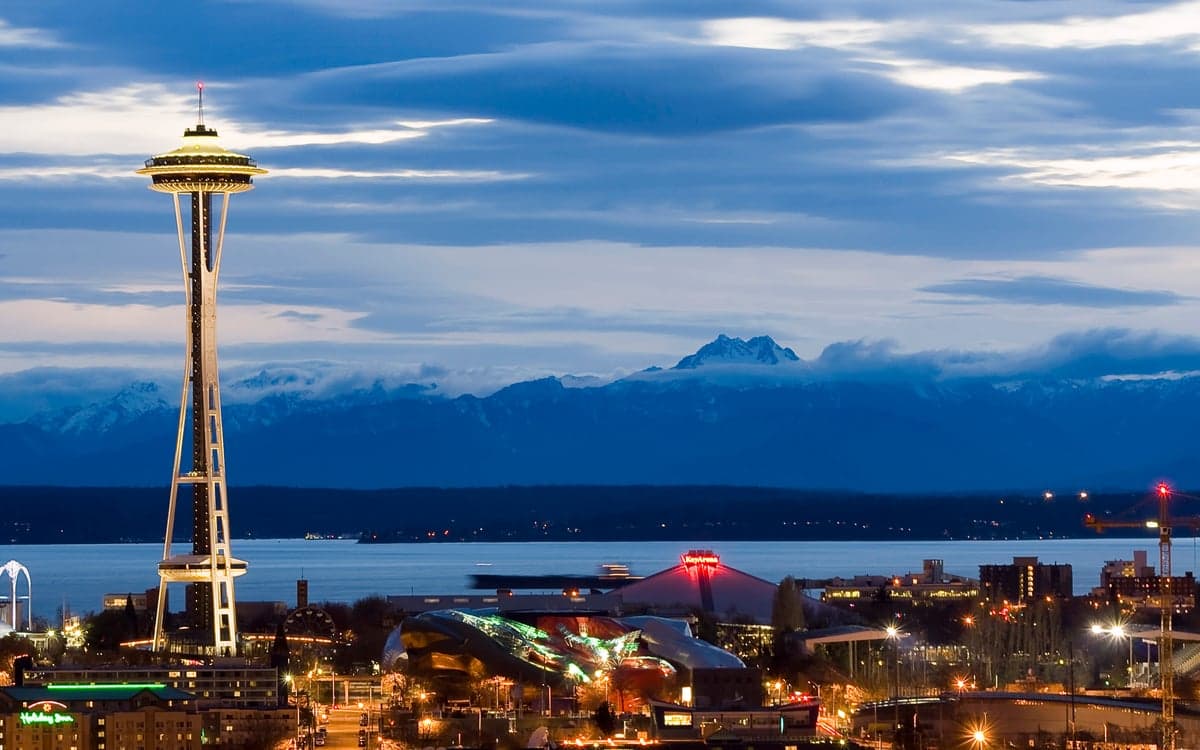
Photo: Wikipedia
Strategic Assessment of Seattle, WA
High tactical risk. This location is likely close to major population centers, strategic targets, or sits in a high-disaster corridor. A retreat property and careful exit planning is required.
What does the Strategic Assessment tell us?
Our Strategic Assessment grades tactical survivability of an area. Major population centers, military targets, fallout zones, natural disasters, and border exposure all drive risk — lower exposure means a more defensible position in a crisis.
This is heavily inspired by Joel Skousen's Strategic Relocation book. Highly recommended you checkout the book ($)What does this tell us?
Our Strategic Assessment grades tactical survivability of an area. Major population centers, military targets, fallout zones, natural disasters, and border exposure all drive risk — lower exposure means a more defensible position in a crisis.
This is heavily inspired by Joel Skousen's Strategic Relocation book. Highly recommended you checkout the book ($)Strategic Pillars

Key Distances
Regional Safe Places
Below is our recommended "safe zones" in Washington and the surrounding area based on our strategic heuristics. For most people, it's unrealistic to live in a “safe zone” full-time due to work, family or other personal reasons. They tend to be more rural. However, many of these areas are perfect for second homes and retreat properties that double as a vacation home or even a short-term rental.
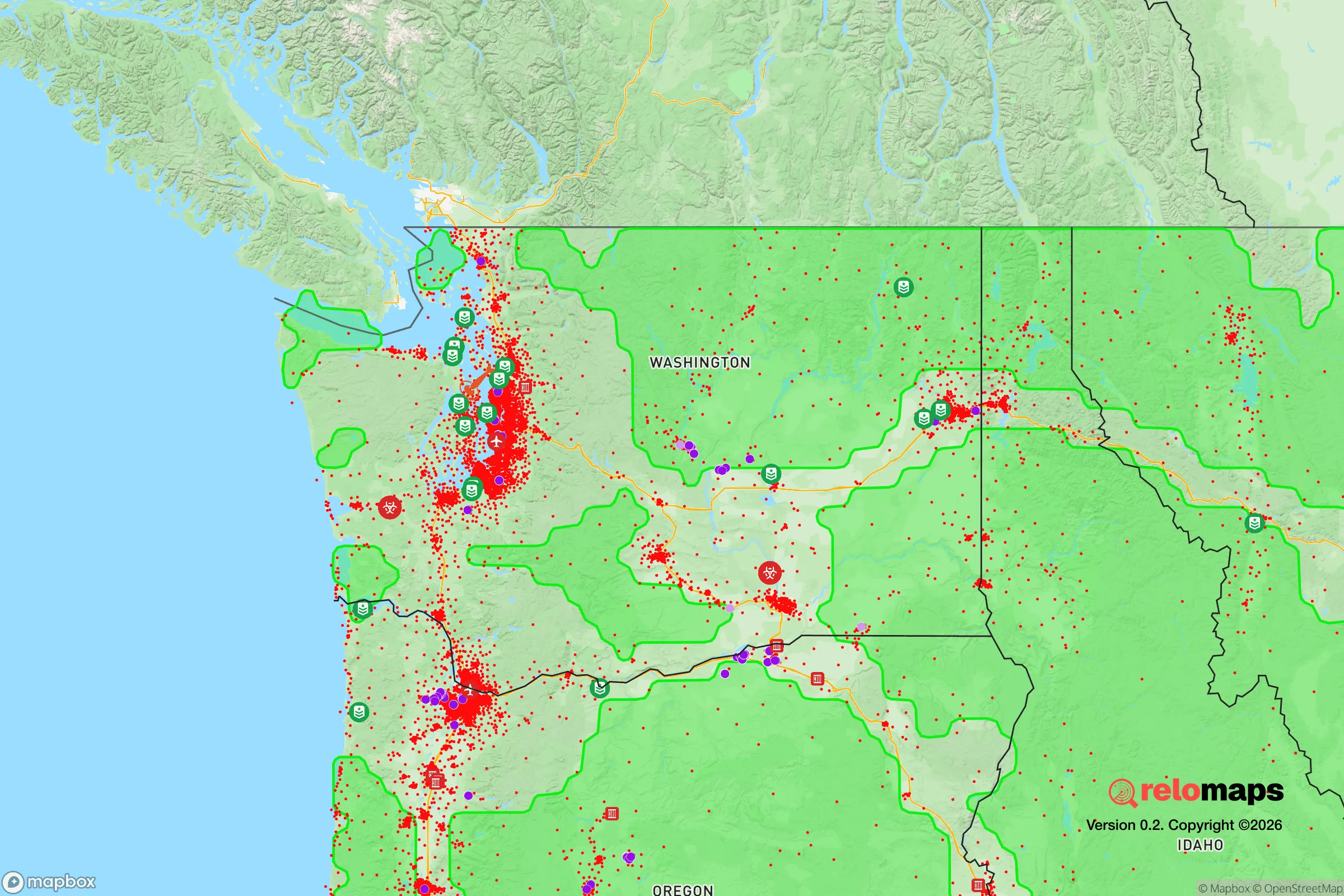
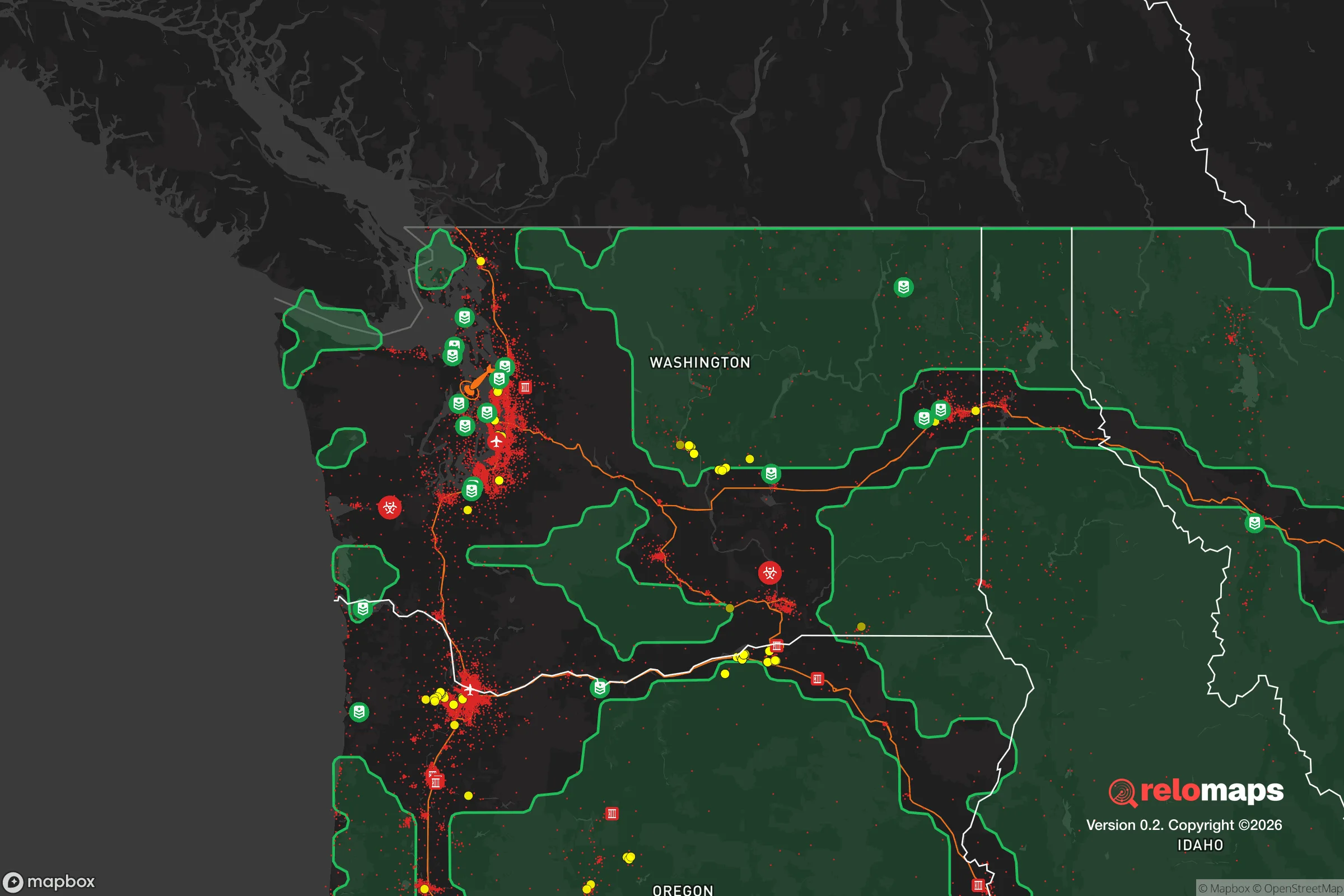


Important Note: For informational purposes only. This does not mean nothing bad ever happens in the green zones. Please use common sense. This is based on public data and modeled with AI. We tried to take a conservative approach but mistakes happen. We update this regularly as new information becomes available.
Solar Generator Recommendations
Backup power matters more here than in safer locations. We've picked three solar generators across budgets and capacity tiers — start with the budget unit if you only need a few essentials, or step up if you want to run a fridge and HVAC for days at a time.

Jackery Portable Power Station Explorer 300
Budget OptionPower on the Go: Weighing only 11 lbs, it's convenient to set up and store with book-sized foldable solar panels

BLUETTI Portable Power Station AC180
Designed for both indoor and outdoor scenarios, AC180 is highly capable as it has a robost capacity and continuous output power.

EF ECOFLOW DELTA Pro Ultra Power Station
Upgraded PickEcoFlow DELTA Pro Ultra is a whole-home energy system designed to grow with your family. Integrated with the Smart Home Panel 2, it scales to meet your evolving energy needs — keeping your home powered, intelligent, and secure through every stage of life.
We earn a commission, at no additional cost to you.
Strategic Assessment Analysis
Seattle presents a deeply contradictory picture for the conservative-leaning prepper or survivalist. On one hand, its geographic position offers genuine strategic depth—saltwater access, a temperate maritime climate, and proximity to vast, sparsely populated wilderness. On the other, the city itself is a dense, politically monolithic urban core that would become a catastrophic liability in any widespread crisis. For a relocator prioritizing long-term resilience, Seattle is less a destination and more a cautionary case study in how natural advantages can be squandered by dense, dependent populations and fragile infrastructure.
Geographic position and natural advantages for long-term survival
Seattle sits on the isthmus between Puget Sound and Lake Washington, a position that provides natural chokepoints and waterborne escape routes. The Cascade Range to the east and the Olympic Mountains to the west create a rain shadow effect that keeps the immediate area relatively mild—average winter lows hover around 37°F, summer highs rarely exceed 78°F. This climate eliminates the need for extreme heating or cooling infrastructure, a significant advantage for off-grid living. The surrounding region is one of the most water-abundant in the lower 48, with the Cedar and Tolt River watersheds providing municipal supply that, even in drought years, rarely dips below 90% of normal. For a relocator, the real prize isn't the city itself but the outer ring of the Puget Sound lowlands—areas like Kitsap Peninsula, the San Juan Islands, or the foothills of the North Cascades. These zones offer defensible terrain, ample rainfall, and soil that, with work, can support year-round food production. The maritime influence also means the region is largely free of the extreme weather events that plague the interior—no tornadoes, few wildfires (outside of eastern Cascade slopes), and no hurricane risk. For a prepper, the natural resource base is genuinely world-class.
Risks, exposures, and proximity to fallout-relevant landmarks
The downsides are severe and structural. Seattle is a prime target for any scenario involving civil unrest or state-level collapse. The city's political culture is overwhelmingly progressive, with a voter registration advantage of roughly 2-to-1 Democrat over Republican in King County. In a breakdown scenario, this ideological homogeneity can translate into rapid, unified mobilization of government and activist networks—not in your favor. The city's geography also creates a funnel effect: I-5, the only major north-south highway, runs through a narrow corridor between the Sound and Lake Washington, meaning any evacuation or supply movement can be easily interdicted. The Port of Seattle and Sea-Tac Airport are obvious chokepoints for federal response, but they're also targets. Boeing's Everett facility, just north of the city, is a major industrial complex that would be a high-value asset in any conflict scenario, drawing attention and potential kinetic action. The region also sits on the Cascadia subduction zone, capable of producing a magnitude 9.0 earthquake. A Cascadia event would collapse the region's infrastructure for months—bridges, fuel pipelines, and the single rail line through the Cascades would all be compromised. For a relocator, being within 50 miles of downtown Seattle means being inside the primary fallout zone for any of these scenarios. The city's density—over 8,000 people per square mile in the core—creates a humanitarian disaster risk that would overwhelm any local response capacity.
Practical resilience for a relocator: food, water, energy, and defensibility
If you're determined to locate in the broader Seattle region, the practical calculus shifts dramatically based on your exact position. Water is abundant but not universally accessible—well-drilling in the glacial till of the Puget Sound lowlands is expensive and often yields low volume. Rainwater catchment is viable, with the city averaging 37 inches of precipitation annually, but the dry season from July to September requires storage. Food production is possible but challenging: the growing season is short (roughly 150 frost-free days), and the soil is acidic and often heavy clay. Raised beds and greenhouses are almost mandatory for serious production. Energy is a bright spot—the region is powered by the Columbia River hydroelectric system, which is resilient and largely underground. However, the distribution grid is aging and vulnerable to windstorms and seismic activity. Solar is marginal here; the region averages only 152 sunny days per year, so any off-grid power plan must include wind or micro-hydro if you're near a stream. Defensibility is the hardest variable. The outer suburbs—places like North Bend, Enumclaw, or Port Orchard—offer rural density and natural barriers (rivers, ridges, forest) that can create a buffer. But the population of King County is over 2.2 million, and in any crisis, that mass will flow outward along the same roads you'd use. Your best bet is a property with a single access road, a reliable water source, and no line-of-sight to major highways. Even then, the proximity to a major population center means you're never truly isolated. The region's culture of preparedness is mixed—there's a strong outdoor recreation community, but the dominant political culture is not oriented toward self-reliance or firearms ownership, which can be a liability in a breakdown scenario.
The overall strategic picture for Seattle is one of high natural potential undermined by extreme human density and political fragility. The region's climate and water resources are genuinely enviable, and the surrounding wilderness offers escape routes that many inland cities lack. But the risks—seismic, political, logistical—are equally real. For a conservative relocator with a prepper mindset, the smart play is not Seattle itself but the outer ring of the Olympic Peninsula or the North Cascades foothills, where you can leverage the region's natural advantages while maintaining a 60- to 90-minute buffer from the urban core. Even then, you're betting that the city's collapse doesn't cascade outward faster than you can react. If you're looking for a place to ride out a long-term disruption, Seattle's region offers the raw materials but demands an exceptionally disciplined, low-profile, and well-stocked approach. It is not a beginner's location. It is a high-risk, high-reward environment for those who understand that the best survival strategy is to be where the crowd isn't—and in Seattle, the crowd is very, very large.

* Values derived from national, state, county, city and local statistics and may differ in a specific area. Last updated: 2026-04-21T10:00:39.000Z
Narrative content on this page is AI-generated and may contain mistakes. Verify any details that matter before acting on them.
ReloMaps may earn a commission from affiliate links at no extra cost to you.

