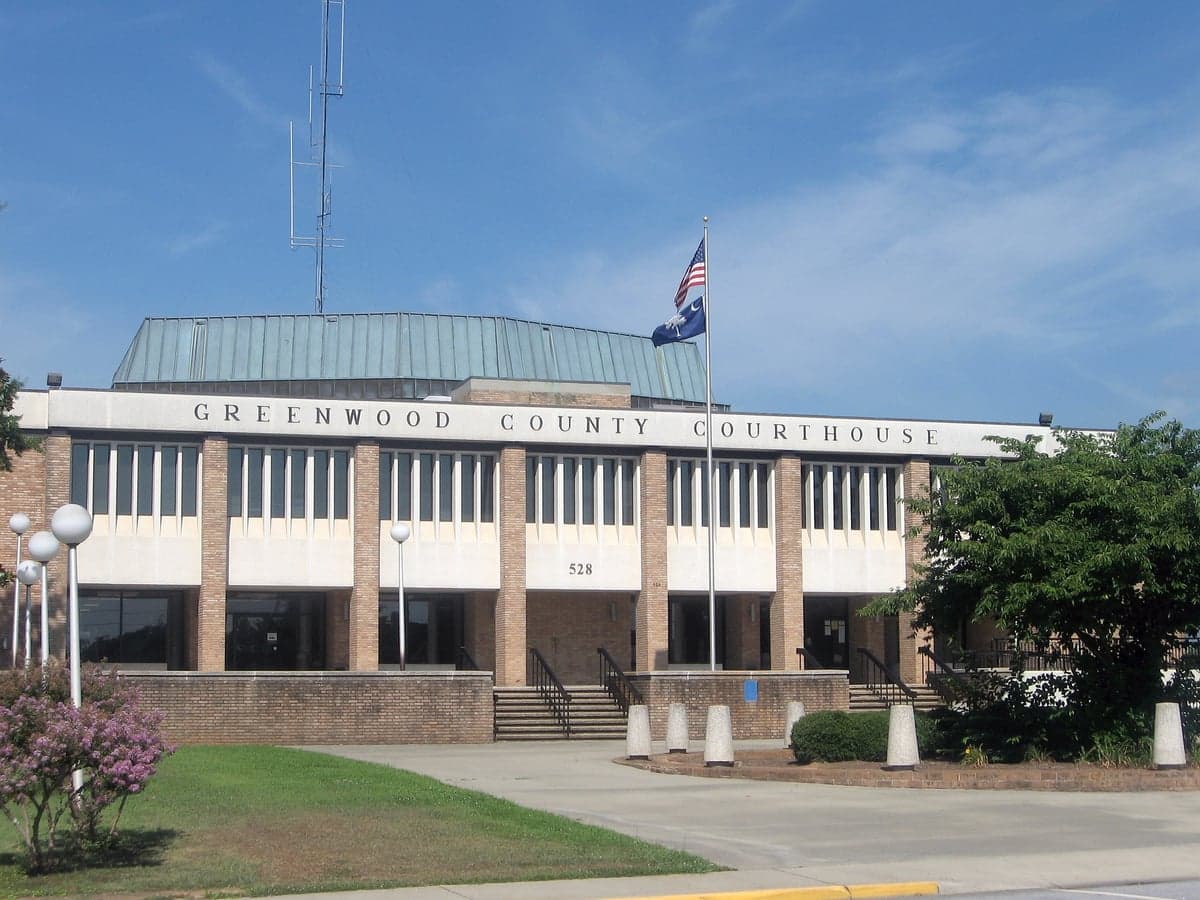
Photo: Wikipedia
Personal Sovereignty in Greenwood County
Viable for self-reliance. Generally workable, though some barriers may limit total independence.
What does Personal Sovereignty tell us?
Personal Sovereignty measures your capacity for self-reliance and independence with minimal government friction. Higher scores mean fewer barriers between you and the way you want to live... but it assumes you have the space you need and good neighbors.
What does this tell us?
Personal Sovereignty measures your capacity for self-reliance and independence with minimal government friction. Higher scores mean fewer barriers between you and the way you want to live... but it assumes you have the space you need and good neighbors.
State Policy
Energy independence: Importer (25% of energy produced in-state)
Personal Liberty
Homesteading

Personal Liberty Analysis
Greenwood County occupies a distinctive middle ground in the South Carolina upstate — close enough to the Greenville–Spartanburg growth corridor to feel connected, yet far enough removed to preserve a genuinely rural, low-regulation lifestyle. For the individual or family assessing personal sovereignty in a time of expanding federal and state mandates, the county offers meaningful breathing room in taxation, self-defense, property rights, and day-to-day autonomy. At the state level, South Carolina maintains a consistent posture against many forms of government overreach — no state income tax on Social Security benefits, a cap on property tax increases for homeowners, and a legal tradition that generally defers to private landowners and firearm owners. Greenwood County takes that baseline and makes it locally accessible, with lower land costs and fewer municipal entanglements than the congested upstate corridor.
Tax burden and regulatory climate in Greenwood County
South Carolina is already a comparatively low-tax state, and Greenwood County leans into that advantage. The state's property tax cap — commonly known as Act 388 — shields owner-occupied residences from volatile reassessments by tying school operating millage to a consumption-based formula. For a primary residence in the county, the effective property tax rate typically lands between 0.3% and 0.5% of fair market value, among the lowest in the Southeast. Counties impose no local income tax, and the state's flat 6.4% individual income tax continues to phase downward. Regulatory posture inside Greenwood County is bifurcated: the city of Greenwood itself enforces zoning, building permits, and rental inspections, but once you move outside city limits — into the unincorporated areas or smaller towns like Ninety Six, Ware Shoals, and Hodges — land-use rules are far more permissive. The county's comprehensive plan does not aggressively restrict agricultural or rural residential uses, meaning a property owner in Troy or Bradley can generally erect a shop, keep livestock, or park a camper without navigating a thicket of local ordinances. For the prepper-minded, that regulatory slack is one of the county's strongest assets.
Self-defense rights and South Carolina gun law specifics in Greenwood County
Greenwood County sits in a solidly firearm-friendly legal environment. South Carolina has been a constitutional carry state since March 2024, allowing any lawful adult to carry a concealed or open handgun without a permit. No license, no class, no government permission slip is required, and the county sheriff's office has publicly indicated support for the law. The state also maintains a strong Stand Your Ground statute, placing no duty to retreat before using deadly force in any place where the individual is lawfully present. Greenwood County's local culture mirrors that legal framework: hunting is a routine activity, gun shops and shooting ranges are scattered throughout the rural towns, and public opinion overwhelmingly favors the right to keep and bear arms. In the county seat of Greenwood, the Sheriff's Office processes concealed weapon permits (which some still obtain for reciprocity during travel) without notable delays or obstructionist tactics. Within the municipality of Ninety Six, firearm restrictions are virtually nonexistent beyond state and federal law, and the town's police force does not impose its own registration or storage mandates. For a gun owner relocating from a restrictive state like New York, Illinois, or Oregon, the shift in legal posture — from permission-based carry to right-based carry — is immediate and unambiguous.
Self-reliance and homesteading viability across Greenwood County
Land is still reasonably affordable in Greenwood County, especially compared to the rapidly pricing outlying suburbs of Greenville. A search through the rural stretches of Hodges, Troy, and Bradley routinely turns up 3- to 10-acre parcels under $10,000 per acre, and unimproved land can be even cheaper. County zoning in unincorporated areas generally allows for small-scale farming, livestock, and accessory dwelling units without the splashy permitting process common in the upstate's more urbanized corners. Ware Shoals and the area along the Saluda River offer a mix of wooded tracts and open pasture that play well to a self-reliant lifestyle — gardening, rainwater catchment, and limited off-grid power are all feasible within local building codes, provided the property's septic and well requirements are met. South Carolina's right-to-farm laws protect agricultural operations from nuisance complaints, a meaningful shield for anyone raising chickens, goats, or garden crops near a property line. The absence of a statewide building code mandate in unincorporated county areas further reduces bureaucratic friction; while electrical and plumbing work must follow state minimum safety standards, there is no requirement for a county permit to construct a simple homestead structure on your own land. For the off-grid prepper, Troy and Bradley are especially attractive for their distance from city services and their low densities, which keep government visibility to a minimum.
Personal liberties in Greenwood County for families and independent individuals
At the state level, South Carolina has codified strong parental rights in education — a 2024 law enshrines that parents have the fundamental right to direct the upbringing, education, and medical care of their children, and schools are legally bound to notify parents of changes to a student's mental or physical health. Greenwood County's school district, Greenwood School District 50, plus the smaller Ninety Six and Ware Shoals districts, operate under this framework without the friction seen in more progressive upstate systems. Medical autonomy remains a contested area nationally, but South Carolina has maintained a relatively conservative posture on vaccine mandates and emergency health orders; no local health department in Greenwood County has imposed the kind of prolonged business or school closures seen in other parts of the country. Free speech and assembly face no meaningful local restriction — public meetings in Greenwood and Ware Shoals allow citizen comment, and the county is not known for overzealous permitting of political or religious gatherings. Property rights are further protected by the state's Private Property Protection Act, which limits eminent domain to truly public uses and prevents governments from seizing land for private economic development. For a parent or individual who values keeping government out of the home and the classroom, Greenwood County provides a legal climate that aligns with that priority.
Relative to other parts of South Carolina — and certainly compared to the upstate's denser cities like Greenville, Anderson, and Spartanburg — Greenwood County offers a higher net level of personal sovereignty for the strategically minded relocator. The county lacks the coastal zoning wars of Charleston and Hilton Head, the municipal overreach of Columbia's urban core, and the crowding-driven regulation of the I-85 corridor. Its tax burden is lighter, its gun laws as permissive as any in the nation, its land-use rules forgiving, and its cultural orientation distinctly pro-liberty. For the individual or family seeking a base from which to exercise self-reliance, defend one's home, and raise children free from heavy-handed bureaucracy, Greenwood County holds up well against both the national backdrop and the broader Southeast.

* Values derived from national, state, county, city and local statistics and may differ in a specific area. Last updated: 2026-05-21T00:56:40.000Z
Narrative content on this page is AI-generated and may contain mistakes. Verify any details that matter before acting on them.
ReloMaps may earn a commission from affiliate links at no extra cost to you.

