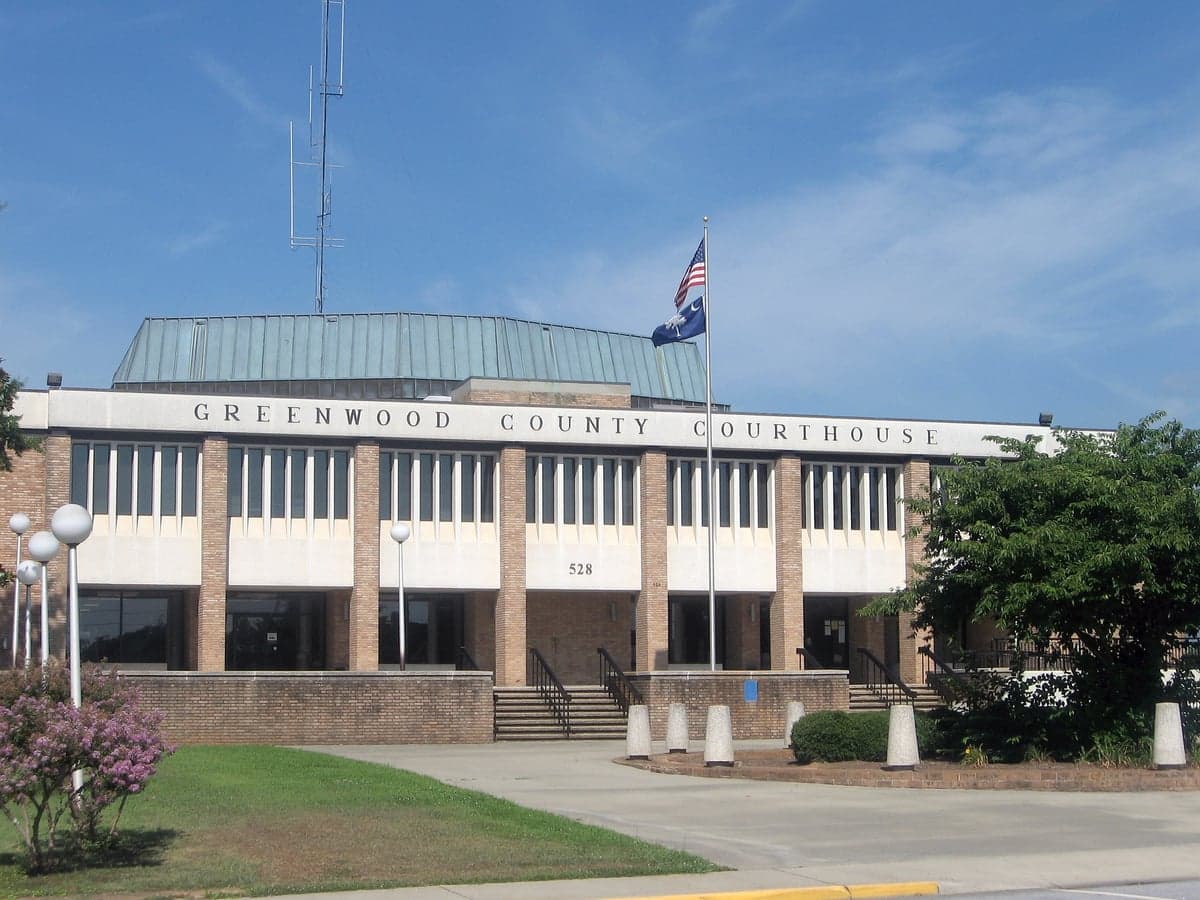
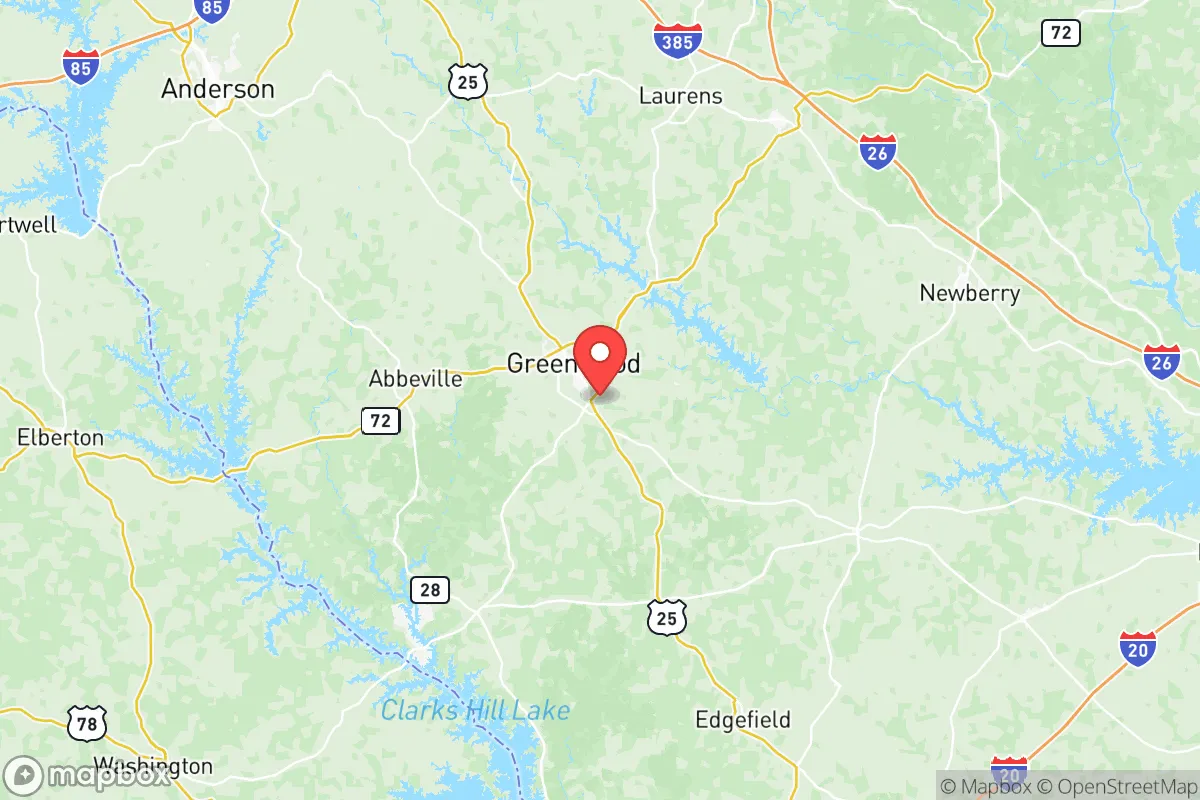
Photo: Wikipedia
Political ClimatePolitical Climate in Greenwood County
Showing district-level results — no local-only data available.
Local Political AnalysisPolitical Analysis of Greenwood County
Greenwood County has long been a rock-solid conservative stronghold, with a Cook PVI of R+21 that puts it deep in deep-red territory—far to the right of the state’s already R+8 rating. For decades, local elections here have been decided in Republican primaries rather than general contests, and that pattern isn’t showing any sign of loosening. The county seat, Greenwood city, leans Republican overall, though its downtown and university-area precincts have shown a slight Democratic uptick in recent cycles—nothing that flips a seat, but enough to keep locals watching the margins. Out in the smaller towns like Ninety Six, Ware Shoals, and Hodges, the voting patterns are even more pronouncedly conservative, with precincts routinely breaking 75-80% for GOP candidates. The trajectory is stable but not static: the county’s overall red hue hasn’t faded, but the suburbanization around Lake Greenwood and along the SC-72 corridor is bringing in new residents who tend to be conservative-leaning yet less tied to the old-line party machinery.
How it compares
South Carolina as a whole is solidly Republican, but Greenwood County sits roughly 13 points to the right of the state average on the Cook PVI scale. That gap matters—it means the county’s representatives in Columbia and Washington are among the most conservative voices in the delegation. For example, while the state has seen suburban pockets shift leftward in places like Charleston and Richland counties, Greenwood’s rural and small-town character has kept the local politics aligned with traditional values. Neighboring counties like Laurens and Abbeville are also red, but Greenwood’s R+21 is notably higher than the state PVI of R+8, making it a bellwether for how deep-red upstate politics operates. The comparison also shows up in legislative priorities: the county’s lawmakers consistently push for limited government, Second Amendment protections, and educational freedom, reflecting a community that views progressive policies elsewhere with skepticism.
What this means for residents
For folks living here, the political climate means less worry about government overreach into personal freedoms and local decisions. There’s no real appetite for broad progressive reforms—things like zoning overrides, mask mandates, or expansive social programs that might come from a more liberal state government. Residents can largely expect schools, law enforcement, and county services to operate with a light regulatory touch. That said, the growth around Lake Greenwood and new subdivisions is bringing younger families who may not share every cultural assumption of the older generation. So far they’ve aligned with the county’s conservative baseline, but the shift is gradual. The real tension isn’t between parties but within the GOP itself: between business-first growth advocates and those who want to preserve the area’s rural character. That’s a healthy debate, but one to watch as new precincts emerge around Greenwood city’s expanding edges.
Culturally, Greenwood County stands apart from the state’s coastal and midlands regions by its emphasis on localism and personal responsibility over top-down policy. You see it in the strong presence of churches, civic clubs, and volunteer fire departments—institutions that resist being replaced by government programs. Politically, that means any attempt to impose state-level progressive mandates (on energy, education, or health mandates) is met with organized pushback from county residents who feel their way of life is being challenged. It’s not that change doesn’t happen—it’s that it happens on local terms, not via directives from Columbia or Washington. That’s the Greenwood way: skeptical of distant authority, protective of local control, and quietly confident that the county’s conservative foundation will hold for the foreseeable future.

State Political ClimatePolitical Climate in South Carolina
State Political AnalysisPolitical Environment in the State
South Carolina has been a red state for a generation now, carrying a Cook PVI of R+8 that has only hardened over the last decade. Its dominant coalition is a mix of traditional Southern conservatives in the Upstate and Lowcountry, with a growing influx of out-of-state retirees and remote workers who are drawn to low taxes and a slower pace but often bring moderate or even blue-leaning suburban voting habits. Over the past 20 years, the state has shifted from a competitive swing state — it went for George W. Bush by 6 points in 2000 — to a reliably Republican stronghold, with Trump winning it by 12 points in 2016 and 11 in 2020. The political battleground is no longer statewide; it’s between fast-growing suburbs like Greenville and Charleston and the rural, deeply red counties like Oconee and Beaufort that anchor the party base.
Urban vs. rural divide
The political map of South Carolina splits pretty cleanly along the I-85 corridor and the coast. The Upstate, anchored by Greenville-Spartanburg, is a conservative powerhouse — Greenville County itself has voted Republican by double digits in every presidential election since 2000. Charleston is the most politically complex metro: the city proper has trended blue due to a booming hospitality economy and an influx of out-of-state professionals, but the surrounding suburbs in Dorchester and Berkeley counties remain solidly red. The classic example is Mount Pleasant, which votes like a classic affluent Republican suburb. Columbia, the capital, is the lone liberal outpost in the Midlands, driven by the University of South Carolina and state government workers, but Richland County's blue streak hasn't turned the broader region. The truly dark-red territory is the state's rural counties — places like Laurens, Edgefield, and Dillon — where you see 70% Republican margins. The Lowcountry around Hilton Head and Beaufort is a mixed bag: wealthy retirees lean red, but the coastal resort economy brings in transient workers and second-home owners who lean more moderate.
Policy environment
South Carolina has built a policy environment that reflects its conservative majority. The state has a flat income tax — currently 6.4%, with a legislative push to lower it further — and no state-level property tax on vehicles. The corporate tax rate is 5%, and the regulatory climate is one of the easiest in the country for starting a business. Education is a hot button: the state has a robust charter school sector and a voucher-like program for special needs students, but it lacks a universal school choice law. In healthcare, the state famously refused to expand Medicaid under the Affordable Care Act, a decision that remains intact as of 2026. Election laws have tightened: South Carolina requires a photo ID to vote, has limits on drop boxes, and conducts post-election audits. The state legislature is firmly Republican-controlled, with a veto-proof supermajority in the House and a near-supermajority in the Senate. Governor Henry McMaster (R) has been a steady hand, signing restrictions on abortion at six weeks and a permitless carry gun law in 2024.
Trajectory & freedom
On balance, South Carolina is moving toward more personal liberty in several key areas, but there are real concerns. In 2024, the state enacted permitless carry of handguns, joining a national trend toward firearm freedom. Parental rights in education have been a focus: the state passed a "Parents' Bill of Rights" in 2023, giving parents explicit authority over their children's medical records and curriculum content. The legislature has rejected intrusive CDC mandates and any form of vaccine passport system. However, there are two areas where freedom advocates are wary. On medical freedom, the state has maintained strict certificate-of-need laws that limit medical competition and restrict doctors from opening independent clinics. And in the realm of COVID-era overreach, there were localized school mask mandates in Richland County and Charleston County that lasted far longer than in the Upstate. The state also maintains a highly restrictive medical cannabis law that amounts to little more than CBD access. For conservatives who want to see government truly stay out of their lives, the trajectory is mostly positive on guns and parental rights, but less so on healthcare competition and medical autonomy.
Civil unrest & political movements
South Carolina has not seen the kind of sustained civil unrest you find in larger states, but there have been flashpoints. The 2015 Charleston church shooting led to a state-level debate over the Confederate battle flag flying at the Statehouse, and the flag was eventually removed by legislative action — a rare bipartisan moment. In 2020, Charleston and Columbia saw Black Lives Matter protests, some of which turned to property damage, and there was a brief, tense push to remove certain historical monuments. On the right, Moms for Liberty has a strong footprint in the Lowcountry and Upstate, organizing around school board races and library content. Immigration politics are relatively quiet: the state has no sanctuary cities, and Greenville and Spartanburg have seen local ordinances supporting ICE cooperation. There was a minor election integrity flare-up in 2024 over the use of drop boxes in Richland County, but it didn't escalate into widespread controversy. The most visible political movement a new resident would notice is the organized grassroots push for school choice, which has a strong presence at the Statehouse.
Projection
Over the next 5 to 10 years, South Carolina is likely to stay a solid red state, but there are demographic currents that could narrow the PVI. The fastest-growing counties are York (Rock Hill area), Berkeley (Charleston exurbs), and Anderson (Upstate), all of which are Republican-leaning, but the new arrivals come from out of state and often register as independents or "soft Republicans." If the state were to shift noticeably, it would be in the suburbs of Greenville and Charleston as they continue to fill with remote workers and retirees from blue states. That said, the in-migration is still overwhelmingly made up of people who are moving for lower cost of living, lower taxes, and a less regulatory environment — they aren't coming to turn the state blue. The 2026 midterms will be a test of how much cultural friction exists between the new arrivals and the traditional base. Realistically, you should expect the school choice movement to continue expanding, further tax cuts to be debated, and the state to remain a haven for gun owners. The biggest unknown is whether the influx of Northerners will moderate the state's stance on healthcare and education spending, or whether the native conservative culture will absorb the newcomers, as it has done for generations.
For someone moving to South Carolina right now, the practical takeaway is this: you will find a state that broadly respects individual liberty, keeps taxes low, and leaves you alone — provided you stick to the conservative Upstate or Lowcountry. If you land in Richland County or the city of Charleston, you'll encounter a small government machine with local officials who lean progressive on issues like diversity programming and zoning. But if you choose Greenville, Spartanburg, Beaufort, or the suburbs of Mount Pleasant and Summerville, the governing philosophy is one of personal responsibility and limited intervention in your life. It's a state you choose as much as the other way around — and one where your vote for freedom still counts decisively.
* Values derived from national, state, county, city and local statistics and may differ in a specific area. Last updated: 2026-05-21T00:56:40.000Z
Narrative content on this page is AI-generated and may contain mistakes. Verify any details that matter before acting on them.
ReloMaps may earn a commission from affiliate links at no extra cost to you.

