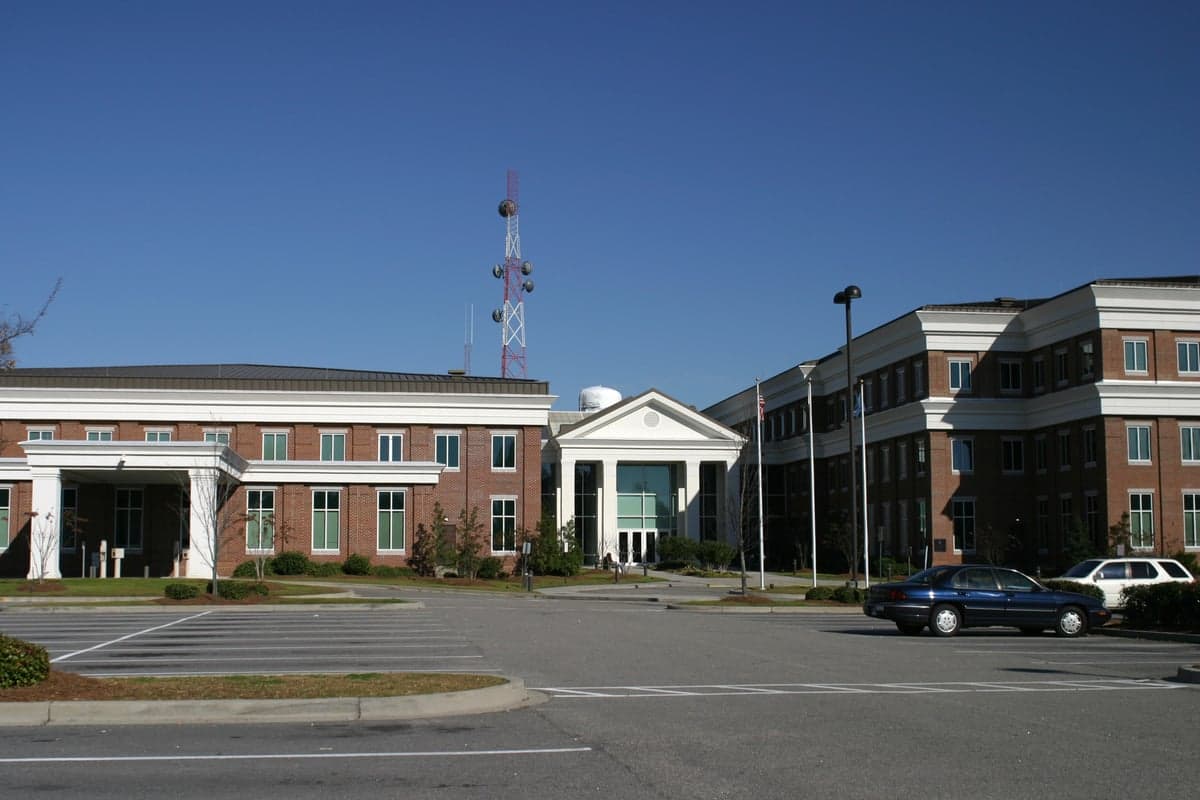
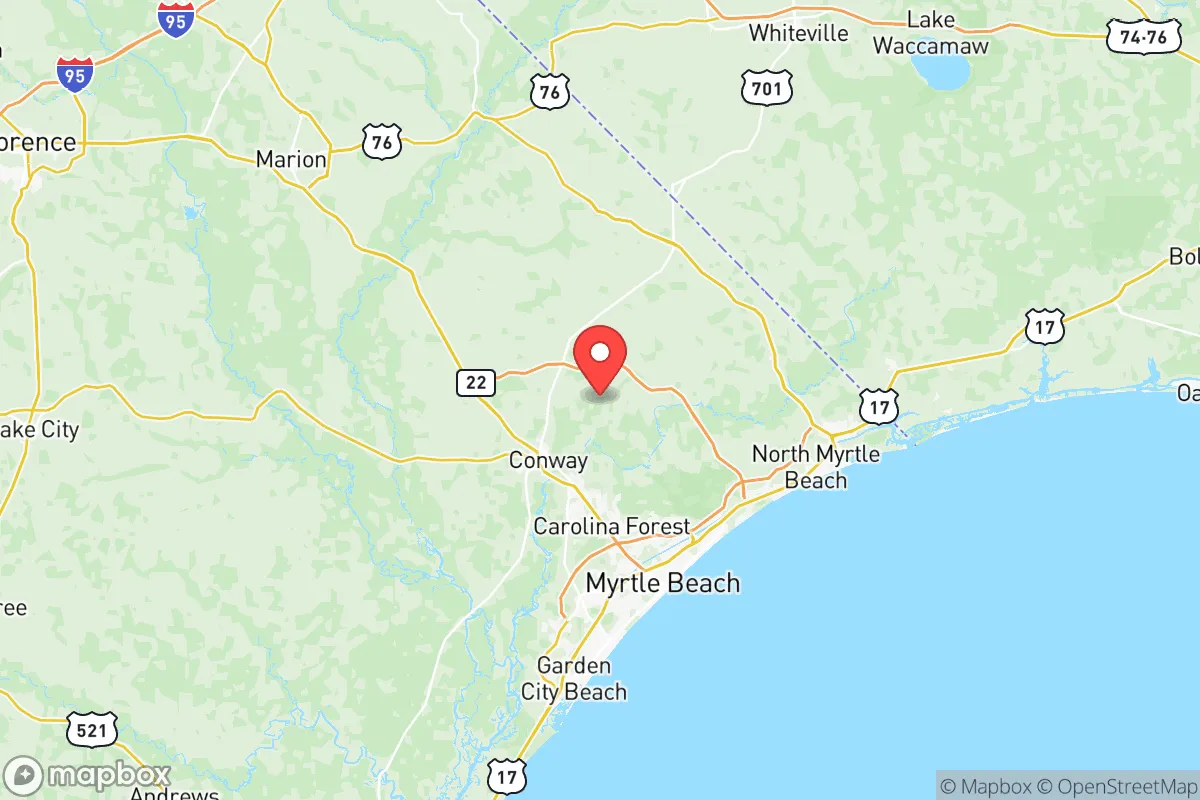
Photo: Wikipedia
Demographics of Horry County
Affluence Level in Horry County
A middle-class area roughly in line with national averages across income, home values, education, and employment.
People of Horry County
Horry County, South Carolina, home to 368,937 residents, is a rapidly growing coastal community defined by its blend of native-born Southerners and a wave of domestic migrants drawn to the Grand Strand. The population is predominantly White (75.9%) and native-born (only 3.5% foreign-born), with a significant Black minority (11.8%) and a growing Hispanic community (7.0%). The county’s identity is shaped by its historic roots in timber and agriculture, its transformation into a tourism and retirement destination centered on Myrtle Beach, and a cultural character that remains distinctly Southern and conservative, even as newcomers reshape its economy and politics.
Settlement & growth (pre-1960)
Long before European arrival, the area now known as Horry County was inhabited by the Waccamaw and Pee Dee Native American peoples, who lived along the rivers and coastal marshes, relying on fishing, hunting, and limited agriculture. Spanish explorers briefly touched the coast in the 16th century, but no permanent European settlement took hold until the British colonial era. The region was part of the vast Georgetown District, and its dense pine forests and swamps discouraged early large-scale plantation agriculture, keeping population sparse through the 1700s.
The first significant wave of European settlers arrived in the late 18th and early 19th centuries, primarily Scots-Irish and English migrants moving down from the North Carolina Piedmont. They were small-scale farmers and turpentine producers, drawn by cheap land and the promise of self-sufficiency. These settlers established the inland communities of Conway (originally called Kingston) and Galloway, which became early trading hubs. The county, named after Revolutionary War hero Peter Horry, was formally created in 1801, but its population remained small and rural through the antebellum period.
After the Civil War, the economy shifted toward timber and naval stores (turpentine and rosin), which attracted a second wave of domestic migrants: poor White farmers from the Carolinas and Georgia, and freed Black families who settled in rural enclaves like Socastee and Bucksport. The arrival of the railroad in the 1880s connected Horry County to outside markets and spurred the growth of Myrtle Beach, which was founded in 1901 as a resort destination. The railroad also brought a small number of Italian and Polish laborers to work in the timber camps, though their numbers were never large enough to form distinct ethnic enclaves.
Through the first half of the 20th century, Horry County remained overwhelmingly rural, poor, and isolated. The population was nearly entirely native-born White and Black, with the Black share hovering around 30% until the Great Migration drew many African Americans northward after World War II. The completion of Highway 17 in the 1930s and the rise of Myrtle Beach as a tourist destination began to slowly shift the economy, but the county’s population only reached about 68,000 by 1950, still heavily dependent on tobacco, timber, and fishing.
Modern era (post-1965)
The 1965 Hart-Cellar Act had little direct impact on Horry County, as the area attracted almost no international immigration compared to coastal metros like Charleston or Atlanta. Instead, the county’s modern demographic transformation has been driven almost entirely by domestic migration — specifically, the Sun Belt boom that accelerated after 1980. The opening of Myrtle Beach International Airport, the expansion of the tourism industry, and the construction of golf courses and retirement communities drew a massive influx of White retirees and service-sector workers from the Northeast, Midwest, and Mid-Atlantic states.
This domestic migration reshaped the county’s population centers. Myrtle Beach itself grew from a seasonal resort town of 8,000 in 1960 to a year-round city of over 35,000 by 2020, with its suburbs — Carolina Forest, Surfside Beach, and Garden City — absorbing much of the growth. These areas are overwhelmingly White and native-born, with a distinctly transient character: many residents are retirees, second-home owners, or workers in the hospitality industry. The inland towns of Conway and Aynor have retained more of the traditional Southern character, with longer-resident families and a stronger agricultural base.
The Hispanic population, now 7.0% of the county, began growing in the 1990s, driven by construction and agricultural labor demand. Most are of Mexican and Central American origin, and they have concentrated in Myrtle Beach and Conway, where they form small but visible communities. The Asian population (1.1%) is primarily Vietnamese and Korean, many connected to the restaurant and hospitality trades, with a small cluster in Myrtle Beach. The Indian-subcontinent population (0.2%) is negligible. The Black population, now 11.8%, has declined from its historic share due to out-migration and the influx of White newcomers, and remains concentrated in Socastee, Bucksport, and parts of Conway.
Suburbanization has been the dominant trend since 2000. The Carolina Forest area, a master-planned community west of Myrtle Beach, has exploded from a few hundred residents in the 1990s to over 25,000 today, almost entirely White and middle-class. This growth has pushed the county’s college-educated share to 26.6%, still below the national average but rising as professionals and remote workers move in. The political character has shifted from historically Democratic (rooted in rural populism) to reliably Republican, driven by the influx of conservative retirees and suburbanites.
The future
Horry County’s population is projected to continue growing rapidly, likely exceeding 450,000 by 2040, driven by continued domestic migration from the Northeast and Midwest. The county is not homogenizing into a single identity but rather tribalizing into distinct zones: the coastal strip (Myrtle Beach, Surfside Beach, Garden City) becoming a transient, service-economy zone with a mix of retirees and hospitality workers; the inland suburbs (Carolina Forest, Conway) solidifying as family-oriented, conservative, and predominantly White; and the rural fringes (Aynor, Loris, Green Sea) retaining older Southern farming communities.
The Hispanic community is likely to grow slowly, reaching perhaps 10-12% by 2040, but will remain concentrated in service-sector jobs and scattered across the county rather than forming a single enclave. The Black population is expected to hold steady or decline slightly as a share, as out-migration continues and White in-migration dominates. International immigration will remain minimal, keeping the foreign-born share below 5%. The county’s cultural identity will remain broadly Southern and conservative, but the influx of Northeastern and Midwestern retirees is softening some edges — for example, bringing more demand for cultural amenities and healthcare infrastructure, while leaving political leanings largely unchanged.
For someone moving in now, Horry County offers a place that is still deeply American in its demographic character — overwhelmingly native-born, with a strong sense of local tradition in the inland towns and a more transient, tourist-oriented culture along the coast. The growth is real and reshaping the landscape, but the fundamental identity of the county — conservative, family-oriented, and rooted in the land and sea — is likely to persist for at least another generation.

* Values derived from national, state, county, city and local statistics and may differ in a specific area. Last updated: 2026-05-27T16:55:40.000Z
Narrative content on this page is AI-generated and may contain mistakes. Verify any details that matter before acting on them.
ReloMaps may earn a commission from affiliate links at no extra cost to you.

