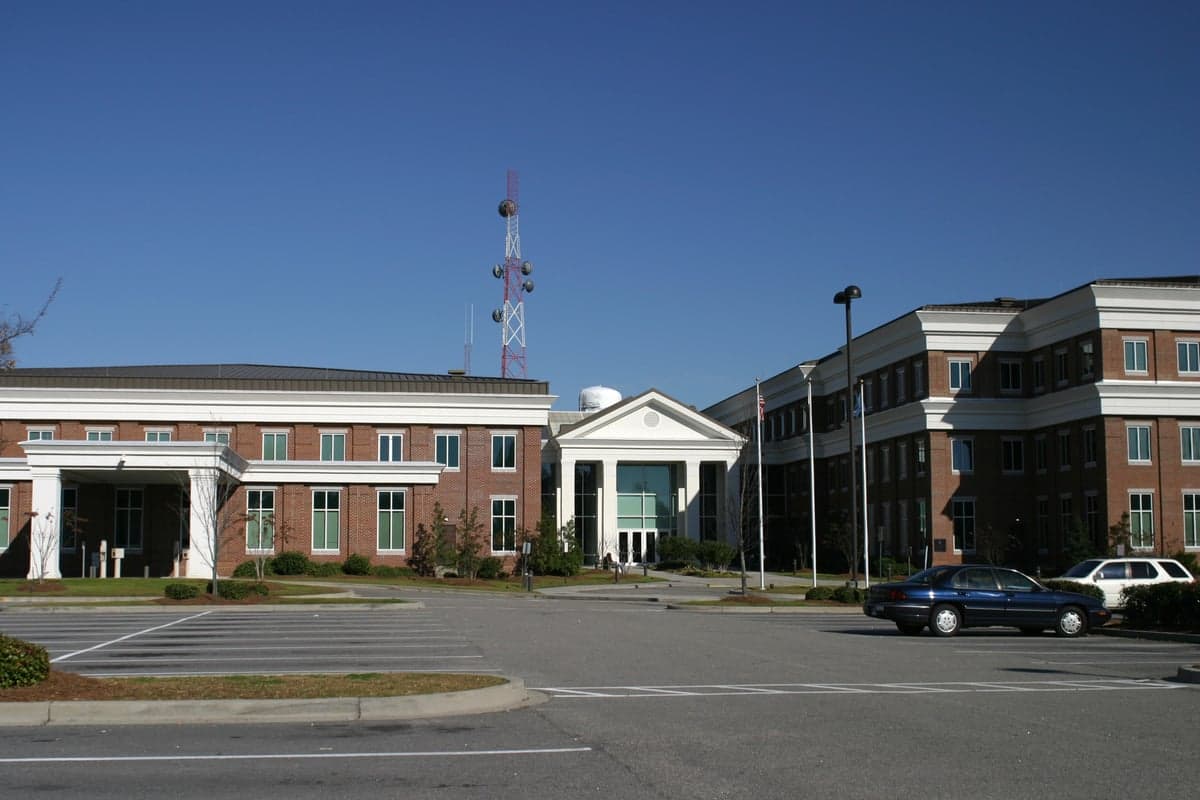
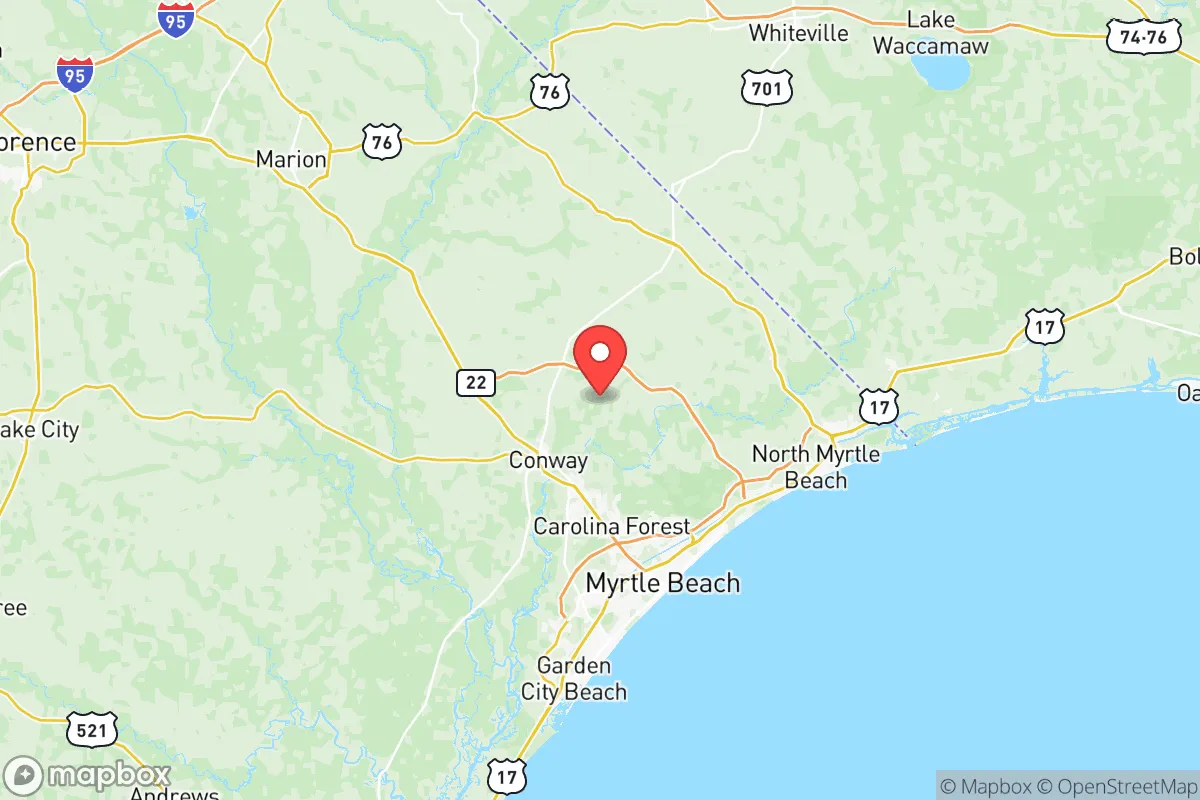
Photo: Wikipedia
Personal Sovereignty in Horry County
Viable for self-reliance. Generally workable, though some barriers may limit total independence.
What does Personal Sovereignty tell us?
Personal Sovereignty measures your capacity for self-reliance and independence with minimal government friction. Higher scores mean fewer barriers between you and the way you want to live... but it assumes you have the space you need and good neighbors.
What does this tell us?
Personal Sovereignty measures your capacity for self-reliance and independence with minimal government friction. Higher scores mean fewer barriers between you and the way you want to live... but it assumes you have the space you need and good neighbors.
State Policy
Energy independence: Importer (25% of energy produced in-state)
Personal Liberty
Homesteading

Personal Liberty Analysis
Horry County, South Carolina, offers a notably high degree of personal sovereignty compared to many coastal and metropolitan areas in the United States, largely due to South Carolina’s status as a Dillon’s Rule state with a strong tradition of local control and a state-level preemption of many municipal overreaches. While the county’s rapid growth—especially around Myrtle Beach and Conway—has introduced some friction, the regulatory environment remains far more permissive than in states like California, New York, or even parts of the Northeast. For individuals and families prioritizing autonomy, the key is understanding where within Horry County the balance tilts most favorably: rural pockets like Green Sea, Aynor, and Loris offer a distinctly different sovereignty profile than the more densely regulated tourist corridor of Myrtle Beach and Surfside Beach.
Tax burden and regulatory posture: how South Carolina’s structure protects your wallet and choices
South Carolina’s tax structure is a major draw for those seeking to minimize government extraction. There is no state income tax on Social Security benefits, and the state’s top marginal income tax rate is a flat 6.4% as of 2026, with a standard deduction of roughly $14,600 for single filers. Property taxes in Horry County are among the lowest in the nation for primary residences, with an effective rate around 0.57% of assessed value—roughly half the national average. Critically, South Carolina has strong state preemption laws that prevent local governments from enacting their own business licensing, zoning, or rental regulations that would exceed state standards. This means that in unincorporated areas of Horry County—such as the rural stretches near Galivants Ferry or the Pee Dee region—you can operate a home-based business, keep livestock, or build a workshop without the layers of permitting that plague cities like Charleston or Greenville. The county’s regulatory posture is best described as “live and let live” outside the Myrtle Beach city limits, where tourism-driven ordinances on noise, short-term rentals, and signage are more restrictive. For a prepper or homesteader, the unincorporated areas of Horry County are a clear win over the coastal strip.
Self-defense and gun law specifics: what the Second Sanctuary status means for your rights
Horry County is a Second Amendment Sanctuary county, a designation that carries real weight in terms of local law enforcement policy. The county council passed a resolution in 2020 affirming that no county resources will be used to enforce federal gun laws that infringe on the right to keep and bear arms. This means that in practice, local sheriffs and police in areas like Conway, Aynor, and Loris are not cooperating with federal agencies on background check expansions, magazine bans, or red flag orders. South Carolina is a permitless carry state as of 2024, allowing any law-abiding adult 18 or older to carry a concealed firearm without a permit. There is no state-level registry, no waiting period for long guns, and no ban on standard-capacity magazines. The only real friction points are in Myrtle Beach, where city ordinances prohibit open carry on the beach and in certain public parks—but these are local, not county-wide, restrictions. For a survivalist mindset, the key takeaway is that Horry County’s rural and suburban areas are among the most gun-friendly in the Southeast, with a sheriff’s office that publicly prioritizes the Second Amendment over federal overreach. If you live in Green Sea or Loris, you can expect zero local interference with your firearm ownership or carry practices.
Self-reliance and homesteading viability: lot sizes, zoning, and off-grid feasibility across the county
Horry County’s zoning code is remarkably permissive for those seeking a self-sufficient lifestyle, but the feasibility varies dramatically by location. In unincorporated areas, minimum lot sizes for agricultural use are typically 2 to 5 acres, with no county-wide ban on keeping chickens, goats, or even larger livestock like cattle or horses. The county does not require building permits for structures under 200 square feet, which means you can erect a shed, workshop, or small cabin without government approval. Off-grid living is legally viable: there is no county ordinance requiring connection to municipal water or sewer, and rainwater collection is explicitly permitted by state law. Solar panels are allowed without special permitting, and composting toilets are legal in rural zones. However, within the Myrtle Beach city limits and in Surfside Beach, zoning is far more restrictive—minimum lot sizes are smaller, livestock is banned, and building codes are enforced strictly. The sweet spot for homesteading is the northern and western parts of the county: Aynor, Loris, and Green Sea offer affordable land (often under $10,000 per acre), minimal HOA interference, and a culture of self-reliance. The Pee Dee River corridor near Galivants Ferry is particularly attractive for off-grid setups, with large tracts of timberland and low population density. For a prepper, the message is clear: avoid the coastal strip and head inland.
Personal liberties: parental rights, medical autonomy, speech, and property protections
South Carolina has some of the strongest parental rights protections in the country, with a state law that explicitly affirms parents’ “fundamental right” to direct the upbringing, education, and healthcare of their children. This means no mask mandates, no vaccine passports, and no school-based medical screenings without parental consent. Horry County’s school board has been consistently conservative on these issues, with a policy of not enforcing any federal or state health directives that conflict with parental authority. Medical autonomy is similarly robust: there is no state-level vaccine mandate for adults, no prescription drug monitoring program that restricts access to medications, and no state-run health insurance exchange that penalizes private choices. Freedom of speech is protected by state law that prohibits local governments from restricting political speech on public property, and Horry County has no “hate speech” ordinances that would chill expression. Property rights are further strengthened by South Carolina’s “right to farm” law, which protects agricultural operations from nuisance lawsuits—a critical protection for homesteaders who want to raise animals or operate a small farm without fear of litigation from new neighbors. The only real erosion of liberty is in the Myrtle Beach city limits, where short-term rental restrictions and noise ordinances can feel intrusive, but these are easily avoided by choosing a rural or suburban location.
Overall, Horry County ranks among the top 10% of U.S. counties for personal sovereignty, especially when compared to the heavily regulated environments of the Northeast, West Coast, or even the urban corridors of the Southeast like Atlanta or Charlotte. The combination of low taxes, strong Second Amendment protections, permissive zoning for self-reliance, and robust parental rights creates a legal environment where a survivalist or prepper can operate with minimal government interference. The key strategic decision is location: Myrtle Beach and Surfside Beach are tourist zones with some municipal overreach, while Aynor, Loris, Green Sea, and Galivants Ferry offer a near-total freedom to live as you see fit. For a family or individual prioritizing autonomy above all else, the inland parts of Horry County are a strong contender for relocation.

* Values derived from national, state, county, city and local statistics and may differ in a specific area. Last updated: 2026-05-27T16:55:40.000Z
Narrative content on this page is AI-generated and may contain mistakes. Verify any details that matter before acting on them.
ReloMaps may earn a commission from affiliate links at no extra cost to you.

