Photo: Wikipedia
Demographics of Fall River County
Affluence Level in Fall River County
A middle-class area roughly in line with national averages across income, home values, education, and employment.
People of Fall River County
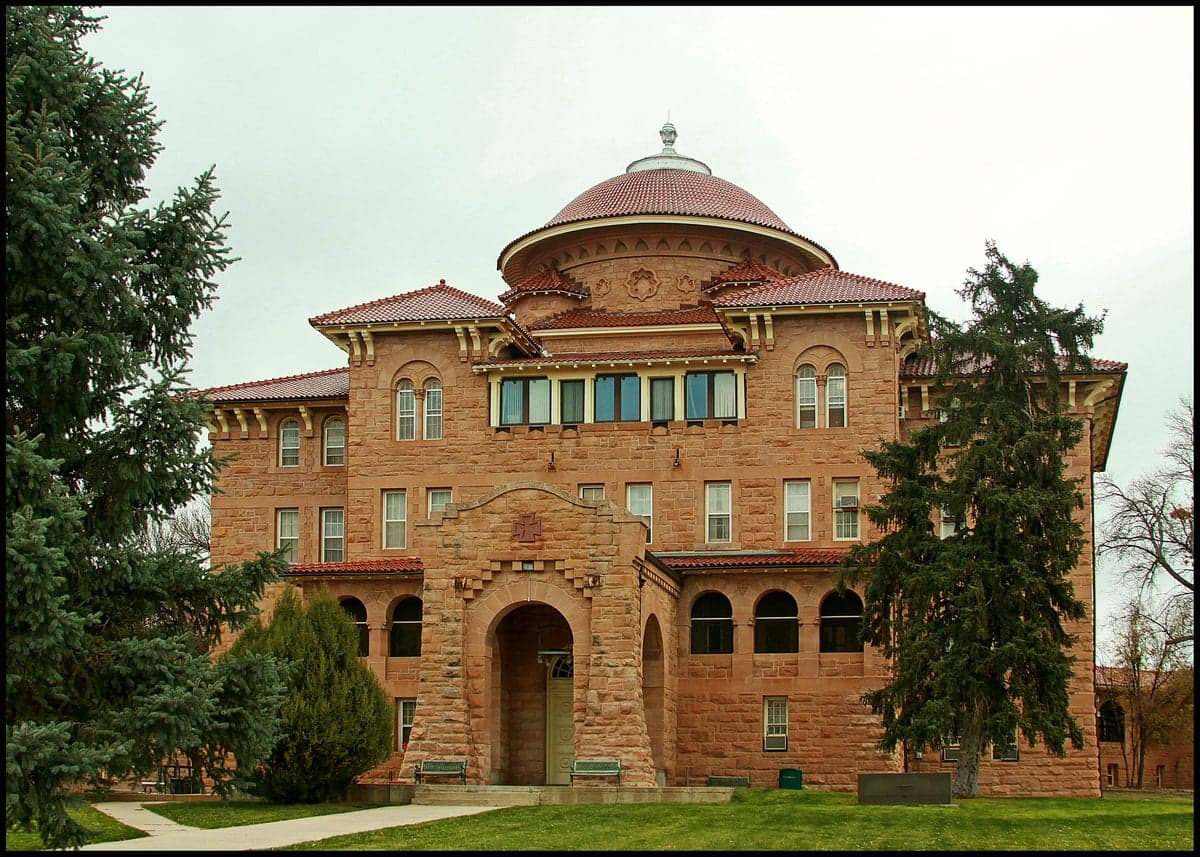
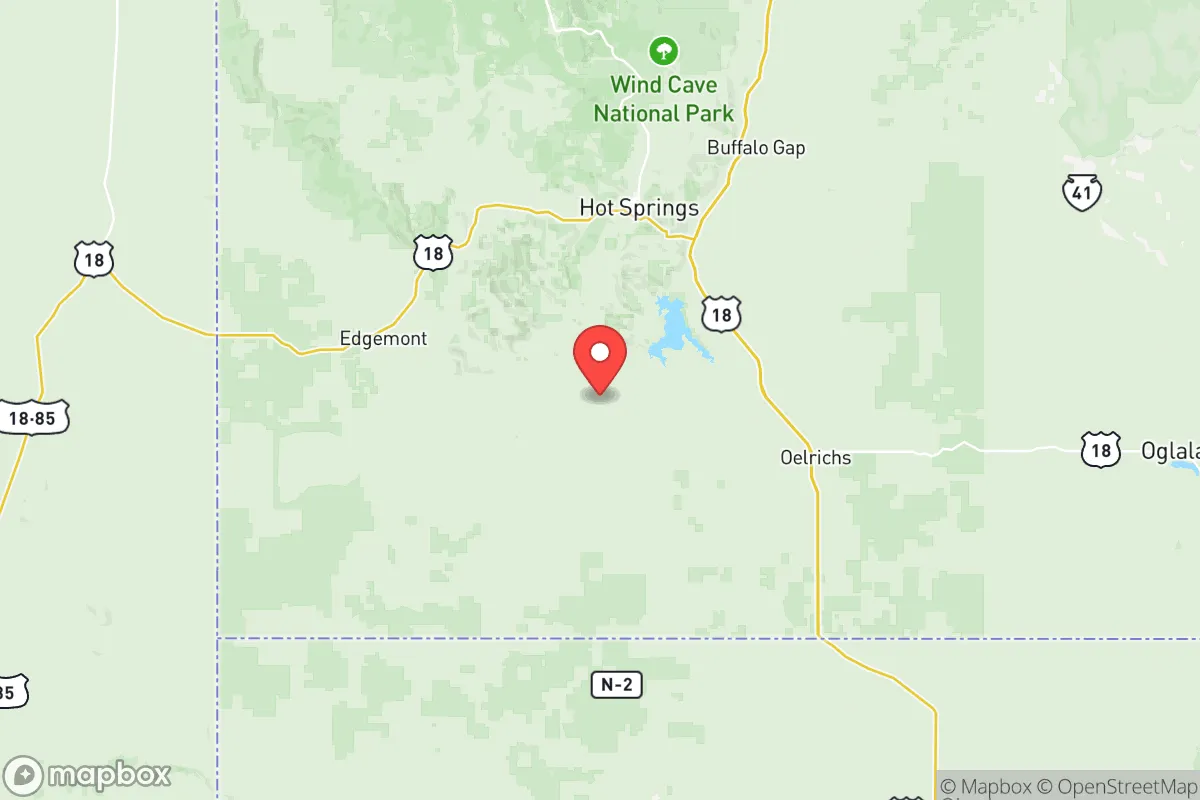
Fall River County, South Dakota, is home to 7,179 residents, making it one of the state's more sparsely populated counties, with a population density of just over 4 people per square mile. The county is overwhelmingly white (84.4%) and native-born (99.0% U.S.-born), with a small Hispanic community (3.3%) and negligible Black, Asian, or Indian-subcontinent populations. Its identity is rooted in the rural West — a landscape of cattle ranches, the Black Hills foothills, and the historic towns of Hot Springs (the county seat) and Edgemont, where a conservative, self-reliant culture predominates.
Settlement & growth (pre-1960)
Long before European settlement, the area that is now Fall River County was part of the seasonal hunting grounds of the Lakota Sioux, particularly the Oglala and Sicangu bands. The French and Spanish claimed the region nominally during the 18th century, but no permanent European settlements took hold until after the United States acquired the territory via the Louisiana Purchase in 1803. The first sustained American presence came with the U.S. Army and fur traders in the mid-19th century, but the real influx began after the 1874 Custer Expedition confirmed gold in the Black Hills, triggering a rush of white prospectors and settlers.
The county was formally organized in 1883, carved from the Great Sioux Reservation after the federal government pressured the Lakota onto smaller reservations. The Chicago, Burlington and Quincy Railroad arrived in the 1880s, establishing depots at Hot Springs, Edgemont, and Oelrichs, which became the county's first permanent towns. These rail stops attracted a wave of homesteaders from the Midwest and Northern Plains — primarily of German, Scandinavian, and British Isles stock — who took up 160-acre claims under the Homestead Act. The town of Hot Springs grew quickly as a health resort, drawing visitors to its warm mineral springs, while Edgemont became a railroad and cattle-shipping center. Smaller settlements like Maverick Junction and Smithwick served as ranching and farming outposts.
By 1900, the county's population had reached roughly 5,000, almost entirely white and native-born. The Dust Bowl and Great Depression of the 1930s hit the region hard, driving many homesteaders off the land. The population declined from a peak of around 8,000 in the 1920s to about 6,000 by 1940. The post-World War II era saw modest stabilization, as returning veterans and their families settled in Hot Springs, drawn by the Veterans Administration hospital (now the Hot Springs VA Medical Center) and the nearby Black Hills National Forest. No major new immigrant groups arrived during this period; the county remained overwhelmingly white, rural, and native-born through 1960.
Modern era (post-1965)
The 1965 Hart-Cellar Act, which reshaped U.S. immigration, had virtually no impact on Fall River County. The county's foreign-born population stands at just 1.0% in 2026, far below the national average, and that share has not meaningfully increased in the last 60 years. The county did not experience the post-1965 waves of Asian, Latin American, or other immigrant groups that transformed many U.S. regions. Instead, the modern demographic story is one of slow decline and gradual aging.
Since 1960, the county's population has fluctuated between roughly 7,000 and 8,000, with a slight downward trend. The largest town, Hot Springs, has held steady at around 3,500 residents, while Edgemont has shrunk from about 1,200 to under 800. The Hispanic population, now 3.3%, grew modestly from near-zero in 1990, largely through domestic migration of Hispanic workers into ranching and meatpacking-adjacent jobs in the broader region, but no concentrated enclave has formed. The county's Black population is effectively zero (0.0%), and East/Southeast Asian residents (0.5%) and Indian-subcontinent residents (0.1%) are present only in trace numbers, mostly professionals at the VA hospital or in healthcare.
The most significant modern shift has been the growth of the retirement and second-home population. Hot Springs has attracted retirees from the Midwest and Mountain West, drawn by the mild climate (by South Dakota standards), the VA medical facilities, and the scenic setting near the Black Hills. This has made the county older than the state average — the median age is roughly 50, compared to South Dakota's 37. The county has also seen a small influx of conservative-leaning remote workers and homesteaders seeking lower taxes and fewer regulations, a trend accelerated by the post-2020 work-from-home shift. These newcomers tend to settle in Hot Springs or on rural acreages near Oral and Maverick Junction.
The future
Fall River County's population is projected to remain stable or decline slightly over the next 10-20 years, barring a major economic shift. The county is not becoming more diverse: the white share (84.4%) is likely to remain high, with the Hispanic share possibly rising to 5-6% through natural increase and continued domestic migration, but no other racial or ethnic group is expected to grow significantly. The county's foreign-born share will likely stay below 2%.
The aging trend will continue, as the county attracts retirees but struggles to retain young adults, who leave for college and jobs in Rapid City, Sioux Falls, or out of state. The school-age population in Hot Springs and Edgemont has been declining for decades, and school consolidations are a recurring topic. The county's cultural identity — conservative, rural, white, and native-born — is likely to persist, reinforced by the in-migration of like-minded retirees and remote workers. The small but growing presence of remote workers and homesteaders may bring modest economic diversification, but the county will remain primarily a ranching, retirement, and outdoor-recreation destination.
For someone moving in now, Fall River County offers a stable, low-density, culturally homogeneous environment with a strong sense of local identity and minimal demographic change. It is not a place of rapid growth or diversification, but rather a place where the population is aging in place, with a steady trickle of newcomers who share the county's existing values. The county's future is one of continuity, not transformation.

* Values derived from national, state, county, city and local statistics and may differ in a specific area. Last updated: 2026-10-13T16:20:22.000Z
Narrative content on this page is AI-generated and may contain mistakes. Verify any details that matter before acting on them.
ReloMaps may earn a commission from affiliate links at no extra cost to you.

