Photo: Wikipedia
Personal Sovereignty in Fall River County
Viable for self-reliance. Generally workable, though some barriers may limit total independence.
What does Personal Sovereignty tell us?
Personal Sovereignty measures your capacity for self-reliance and independence with minimal government friction. Higher scores mean fewer barriers between you and the way you want to live... but it assumes you have the space you need and good neighbors.
What does this tell us?
Personal Sovereignty measures your capacity for self-reliance and independence with minimal government friction. Higher scores mean fewer barriers between you and the way you want to live... but it assumes you have the space you need and good neighbors.
State Policy
Energy independence: Importer (35% of energy produced in-state)
Personal Liberty
Homesteading

Personal Liberty Analysis
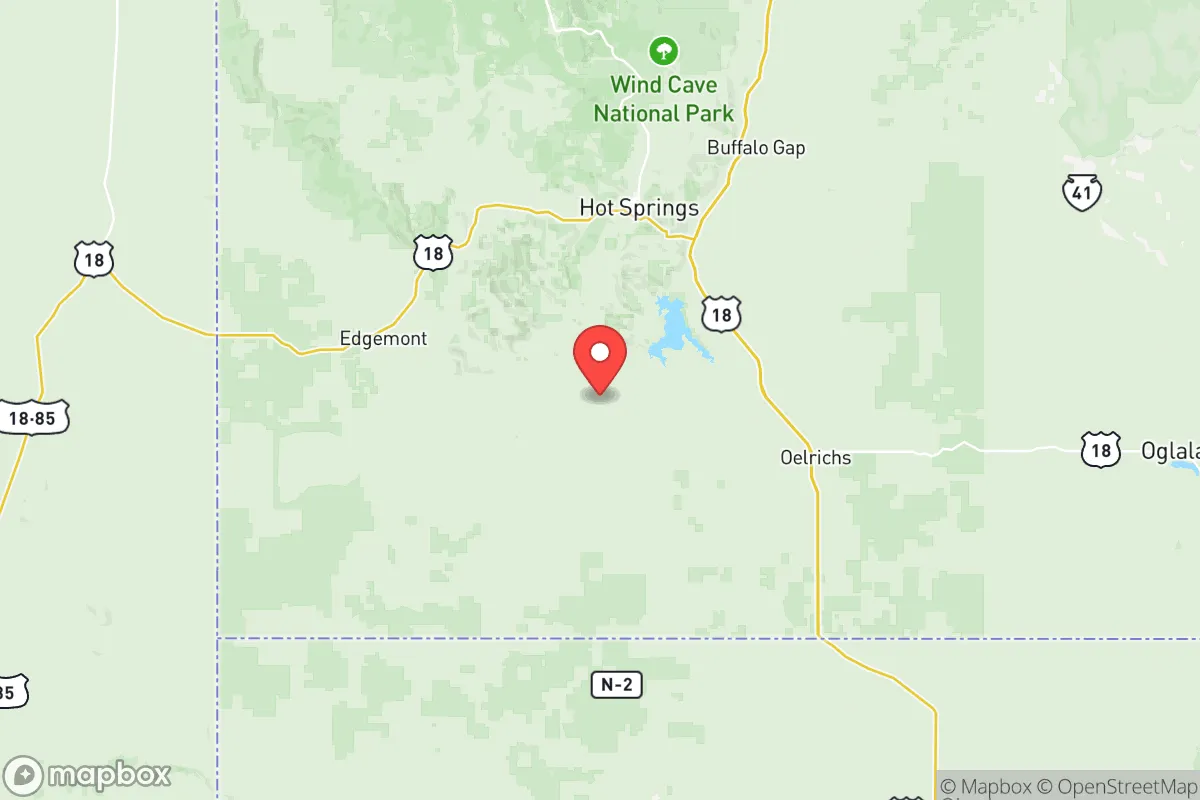
Fall River County, South Dakota, offers one of the most robust personal sovereignty environments in the northern Plains, anchored by South Dakota’s absence of a state income tax, a permissive regulatory climate, and strong constitutional protections for gun rights and property use. The county’s roughly 7,000 residents, spread across the county seat of Hot Springs and smaller communities like Edgemont, Oelrichs, and Oral, operate under a light-touch local governance structure that rarely intrudes on daily life. For individuals and families who prioritize autonomy—whether through self-defense, off-grid living, or minimal tax exposure—Fall River County presents a legal and cultural landscape that consistently ranks among the most freedom-oriented in the region.
Tax burden and regulatory posture in Fall River County
South Dakota’s lack of a personal or corporate income tax is the cornerstone of Fall River County’s low-tax environment, and the county itself imposes no additional income or inventory taxes. Property taxes in Fall River County are moderate, with the 2025 effective rate averaging roughly 1.1% of assessed value, slightly below the state median. The county’s regulatory posture is notably light: there is no county-wide building code for most rural residential construction, and zoning is minimal outside the incorporated towns of Hot Springs and Edgemont. Hot Springs enforces basic land-use ordinances—setbacks, lot coverage, and commercial permitting—but these are far less restrictive than those in larger South Dakota cities like Rapid City or Sioux Falls. In unincorporated areas, such as the rural stretches near Cascade Springs or along the Cheyenne River, property owners face virtually no permitting delays for fences, sheds, or accessory dwellings. The county’s approach to business regulation is similarly hands-off: no local business license is required for most sole proprietorships, and home-based enterprises operate freely as long as they do not generate excessive traffic or noise complaints. This combination of no income tax, moderate property taxes, and minimal red tape makes Fall River County attractive for those seeking to keep more of their earnings and avoid bureaucratic friction.
Self-defense and gun law specifics in a constitutional carry state
South Dakota is a constitutional carry state, meaning no permit is required to carry a concealed firearm for any law-abiding adult 18 or older, and Fall River County fully reflects that legal framework. The county has no additional firearm-specific ordinances beyond state law, so residents in Hot Springs, Edgemont, and all unincorporated areas can carry openly or concealed without a license. Stand-your-ground and castle-doctrine protections are codified in state statute (SDCL 22-18-4 and 22-18-5), providing broad legal cover for the use of deadly force in self-defense, with no duty to retreat in any place where the individual is lawfully present. Background checks are required only for purchases from licensed dealers; private sales between individuals require no paperwork. The county sheriff’s office in Hot Springs issues concealed carry permits for reciprocity purposes, but these are optional and processed quickly—typically within 30 days. Gun culture in Fall River County is deeply embedded: the Black Hills Shooting Sports Association range near Hot Springs is active, and hunting is a primary recreational activity across the county’s 1,740 square miles. For a reader prioritizing self-defense rights, Fall River County offers one of the most permissive legal environments in the country, with no local restrictions that would complicate firearm ownership or carry.
Self-reliance and homesteading viability across the county
Fall River County’s land-use policies strongly support self-reliance and homesteading, particularly outside the town limits of Hot Springs and Edgemont. In unincorporated areas, minimum lot sizes for rural residential parcels are typically 1 to 5 acres, depending on the subdivision plat, but there is no county-wide minimum that prevents smaller homesteads. Zoning is essentially absent in the open county, so residents can keep livestock—chickens, goats, cattle, horses—without special permits, and there are no restrictions on gardening, composting, or rainwater collection. Off-grid living is fully feasible: South Dakota has no state law requiring connection to a utility grid, and Fall River County does not mandate electrical hookups for rural dwellings. Solar panels, wind turbines, and propane systems are common in areas like Oral and the Angostura Reservoir vicinity. Water access is a practical consideration—well drilling is permitted with a state water-rights permit, which is straightforward to obtain, and many rural properties already have existing wells. Septic systems require a county permit and inspection, but the process is routine and not burdensome. In contrast, Hot Springs proper enforces building codes for new construction and requires utility connections within town limits, so homesteaders seeking maximum autonomy should target parcels in the unincorporated areas south of Hot Springs or near the Nebraska border. Edgemont, with a population under 800, offers a middle ground: basic town ordinances but a permissive attitude toward small-scale agriculture and alternative energy. For families wanting to grow their own food, generate their own power, and minimize reliance on municipal services, Fall River County’s regulatory posture is among the most accommodating in the Black Hills region.
Personal liberties: parental rights, medical autonomy, speech, and property
South Dakota’s legal framework extends strong protections for parental rights, medical autonomy, and property use, and Fall River County’s local governance does not erode those protections. Parental rights in education are explicitly protected under state law (SDCL 13-1-70), which requires school districts—including the Hot Springs and Edgemont districts—to obtain parental consent before administering surveys or providing instruction on sensitive topics. The county has no local ordinances that override these state-level safeguards. Medical autonomy is similarly broad: South Dakota has no vaccine mandate for adults, no mask mandates in effect, and no state-level restrictions on alternative or complementary medicine. The county’s healthcare infrastructure is limited—Hot Springs has a critical-access hospital (Fall River Health Services) and a few clinics—but residents are free to choose their own treatments without government interference. Free speech protections are robust, with no local hate-speech or social-media ordinances that would chill expression. Property rights are strongly protected under South Dakota’s eminent domain laws, which require just compensation and a demonstrated public purpose, and Fall River County has not pursued aggressive condemnation actions in recent memory. The county’s approach to land use is permissive: no rent control, no short-term rental bans outside of Hot Springs’ limited zoning, and no moratoriums on new construction. For a reader who values the ability to make personal medical decisions, direct their children’s education, and use their property without government overreach, Fall River County aligns closely with a high-sovereignty lifestyle.
Overall, Fall River County ranks among the top autonomy-friendly counties in the Great Plains, offering a legal and cultural environment that consistently prioritizes individual choice over collective regulation. The absence of income tax, constitutional carry, minimal zoning, and strong parental and property rights create a cohesive framework for personal sovereignty that is rare even by South Dakota’s already freedom-oriented standards. Compared to counties in neighboring states—such as Nebraska’s Dawes County or Wyoming’s Niobrara County—Fall River County offers a slightly lighter regulatory touch on homesteading and a more permissive gun law environment. For the single individual or family seeking a place where self-reliance is not just tolerated but structurally supported, Fall River County delivers a high degree of personal sovereignty with few practical trade-offs.

* Values derived from national, state, county, city and local statistics and may differ in a specific area. Last updated: 2026-10-13T16:20:22.000Z
Narrative content on this page is AI-generated and may contain mistakes. Verify any details that matter before acting on them.
ReloMaps may earn a commission from affiliate links at no extra cost to you.

