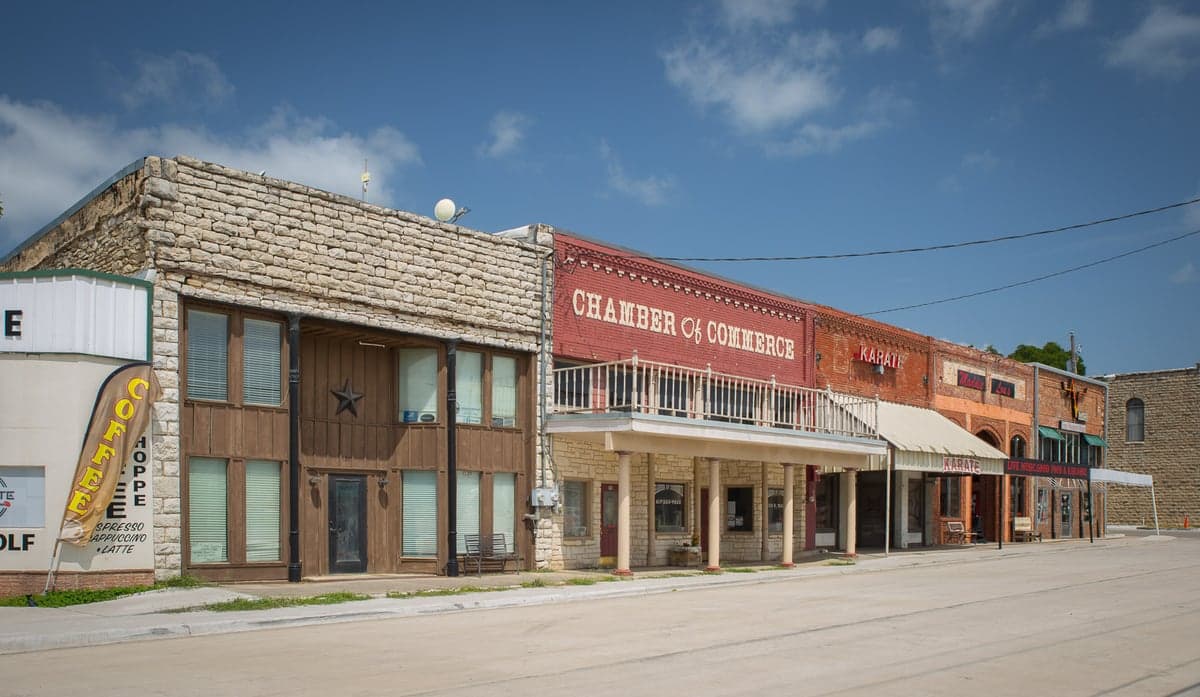
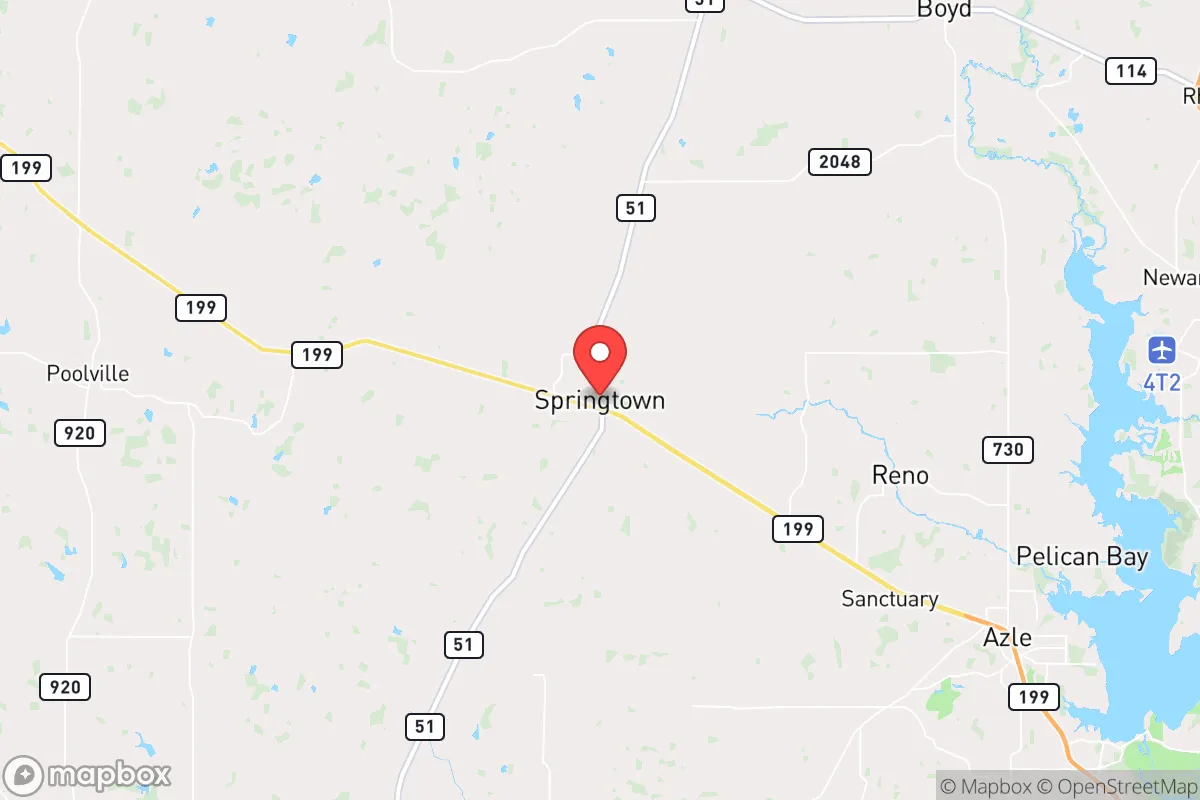
Photo: Wikipedia
Demographics of Springtown, TX
Affluence Level in Springtown, TX
A middle-class area roughly in line with national averages across income, home values, education, and employment.
People of Springtown, TX
Springtown, Texas, is a small, predominantly white community of 3,493 residents where 80.5% of the population identifies as white alone, and the foreign-born share sits at just 1.5%. The city’s character is deeply rural and conservative, shaped by generations of families who have lived in Parker and Wise counties for decades, with a growing Hispanic minority (13.8%) now forming the only significant non-white presence. With a college-educated rate of only 12.4%, the population skews toward blue-collar and agricultural roots, and the city remains notably homogeneous—Black, Asian, and Indian populations are each recorded at 0.0%. Springtown is not a destination for newcomers from outside the region; it is a place where people stay, and where the few who arrive tend to come from nearby Texas communities rather than from other states or countries.
How the city was settled and grew
Springtown was founded in the 1850s by Anglo-American settlers moving west from the older cotton and plantation counties of East Texas. The original population was drawn by the promise of cheap land for subsistence farming and cattle grazing, with the spring-fed creeks providing reliable water in an otherwise dry prairie. The town’s first wave of settlers built homes in what is now the Old Town Springtown district, centered around the intersection of Farm-to-Market Road 51 and Springtown’s main square. A second wave arrived after the Civil War, when Confederate veterans and their families took up land grants in the surrounding countryside, establishing the Veal Station and Briar communities that remain unincorporated but are culturally tied to Springtown. By 1900, the population was almost entirely native-born white, with a handful of Black families working as sharecroppers on the outskirts—though the 2020 census shows the Black population has since fallen to zero. The town incorporated in 1884, but growth remained slow through the Great Depression and World War II, as the area’s thin soils and distance from major rail lines limited economic opportunity.
Modern era (post-1965)
After the 1965 Immigration and Nationality Act, Springtown saw virtually no influx of foreign-born residents—the foreign-born share today is 1.5%, far below the Texas average of 17%. Instead, the post-1965 period was defined by domestic out-migration of young adults to Dallas-Fort Worth, which is about 40 miles southeast, and a slow trickle of white retirees and working-class families from Tarrant County seeking cheaper land. The Lake Weatherford area, just east of Springtown, attracted some of these newcomers in the 1970s and 1980s, though the lake itself is in Parker County and not within city limits. The Hispanic population began to grow in the 1990s, driven by labor demand in the region’s oil and gas fields and in construction for the expanding DFW metroplex. Today, most Hispanic residents live in the West Springtown neighborhood, near the intersection of FM 51 and FM 1886, where older mobile home parks and rental properties have become the primary entry point. The Asian and Indian populations remain at zero, reflecting the city’s lack of professional-sector jobs or higher education institutions that would attract skilled immigrants. The college-educated share of 12.4% is less than half the Texas average of 31%, underscoring that Springtown is not a bedroom community for white-collar DFW commuters but a working-class enclave for those in trades, agriculture, and local services.
The future
Springtown’s population is projected to grow modestly over the next decade, driven by spillover from the fast-growing cities of Weatherford and Azle, but the demographic profile is unlikely to change dramatically. The white share will likely decline slowly as the Hispanic share rises, mirroring trends across rural Texas, but the city’s lack of rental housing stock, low immigration, and absence of ethnic enclaves mean that Hispanic growth will come primarily from natural increase among existing families rather than new arrivals. The Springtown Estates subdivision, a newer development of single-family homes on the city’s north side, is attracting a few white families from Tarrant County, but these are overwhelmingly native-born and conservative. The Black, Asian, and Indian populations are expected to remain near zero, as the city offers no economic or social pull for these groups. The most likely scenario is that Springtown becomes slightly more Hispanic over time—perhaps reaching 20% by 2040—while remaining a culturally and politically homogeneous community where the dominant identity is white, rural, and Christian.
For someone moving in now, Springtown offers a stable, low-diversity environment where the population is aging slowly and the social fabric is built around church, family, and local sports. The city is not becoming more cosmopolitan or diverse; it is slowly shifting from overwhelmingly white to white-majority with a growing Hispanic minority, but without the ethnic tensions or rapid change seen in larger Texas cities. New residents should expect a place where nearly everyone is native-born, English is the universal language, and the pace of life remains tied to the land and the seasons.

* Values derived from national, state, county, city and local statistics and may differ in a specific area. Last updated: 2026-04-14T23:47:27.000Z
Narrative content on this page is AI-generated and may contain mistakes. Verify any details that matter before acting on them.
ReloMaps may earn a commission from affiliate links at no extra cost to you.

