Photo: Wikipedia
Strategic Assessment of Springtown, TX
Meaningful friction. Expect exposure to either population pressure, blast zones, or natural disaster risk. Consider buying a retreat property.
What does the Strategic Assessment tell us?
Our Strategic Assessment grades tactical survivability of an area. Major population centers, military targets, fallout zones, natural disasters, and border exposure all drive risk — lower exposure means a more defensible position in a crisis.
This is heavily inspired by Joel Skousen's Strategic Relocation book. Highly recommended you checkout the book ($)What does this tell us?
Our Strategic Assessment grades tactical survivability of an area. Major population centers, military targets, fallout zones, natural disasters, and border exposure all drive risk — lower exposure means a more defensible position in a crisis.
This is heavily inspired by Joel Skousen's Strategic Relocation book. Highly recommended you checkout the book ($)Strategic Pillars

Key Distances
Regional Safe Places
Below is our recommended "safe zones" in Texas and the surrounding area based on our strategic heuristics. For most people, it's unrealistic to live in a “safe zone” full-time due to work, family or other personal reasons. They tend to be more rural. However, many of these areas are perfect for second homes and retreat properties that double as a vacation home or even a short-term rental.

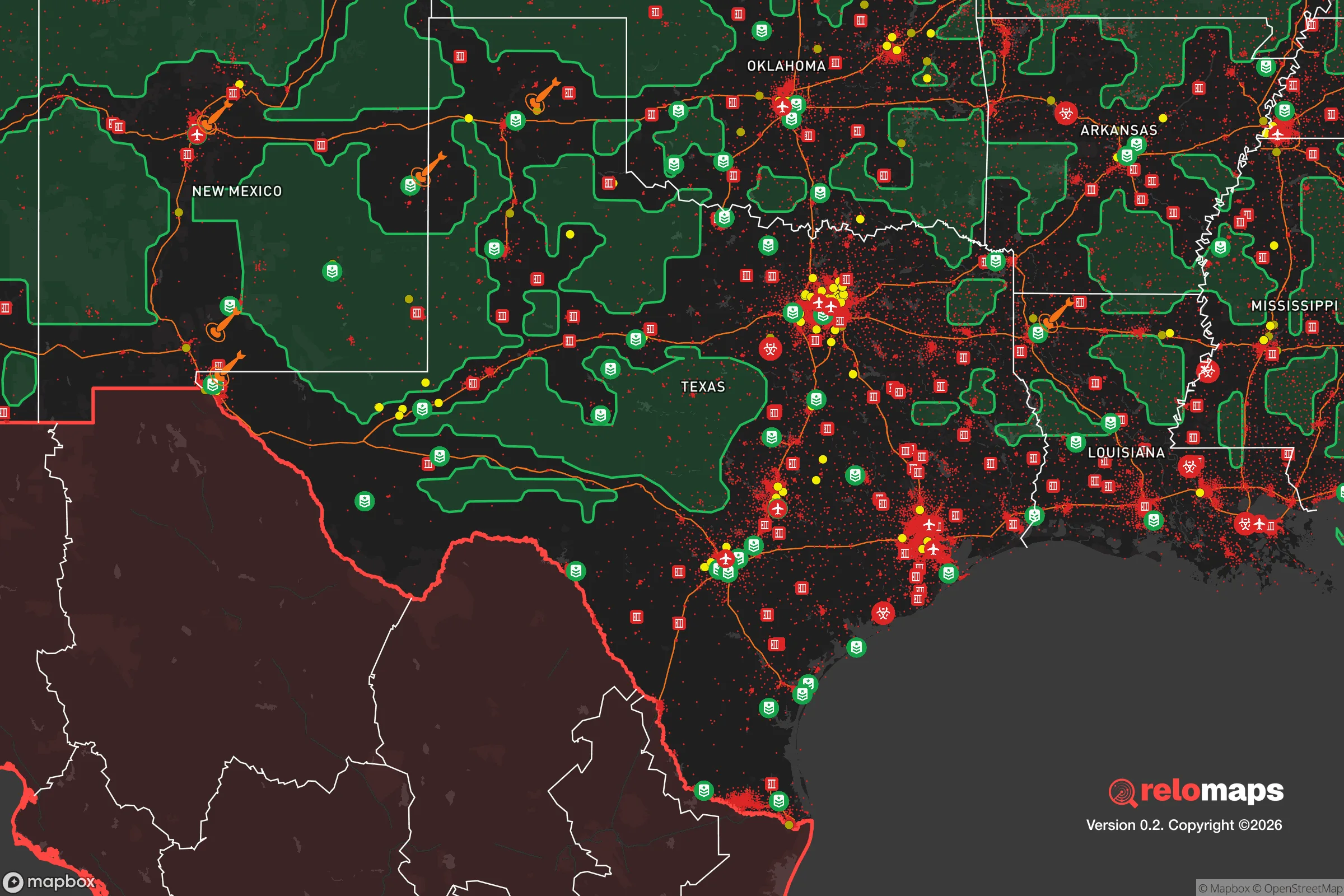


Important Note: For informational purposes only. This does not mean nothing bad ever happens in the green zones. Please use common sense. This is based on public data and modeled with AI. We tried to take a conservative approach but mistakes happen. We update this regularly as new information becomes available.
Solar Generator Recommendations
Backup power matters more here than in safer locations. We've picked three solar generators across budgets and capacity tiers — start with the budget unit if you only need a few essentials, or step up if you want to run a fridge and HVAC for days at a time.

Jackery Portable Power Station Explorer 300
Budget OptionPower on the Go: Weighing only 11 lbs, it's convenient to set up and store with book-sized foldable solar panels

BLUETTI Portable Power Station AC180
Designed for both indoor and outdoor scenarios, AC180 is highly capable as it has a robost capacity and continuous output power.

EF ECOFLOW DELTA Pro Ultra Power Station
Upgraded PickEcoFlow DELTA Pro Ultra is a whole-home energy system designed to grow with your family. Integrated with the Smart Home Panel 2, it scales to meet your evolving energy needs — keeping your home powered, intelligent, and secure through every stage of life.
We earn a commission, at no additional cost to you.
Strategic Assessment Analysis
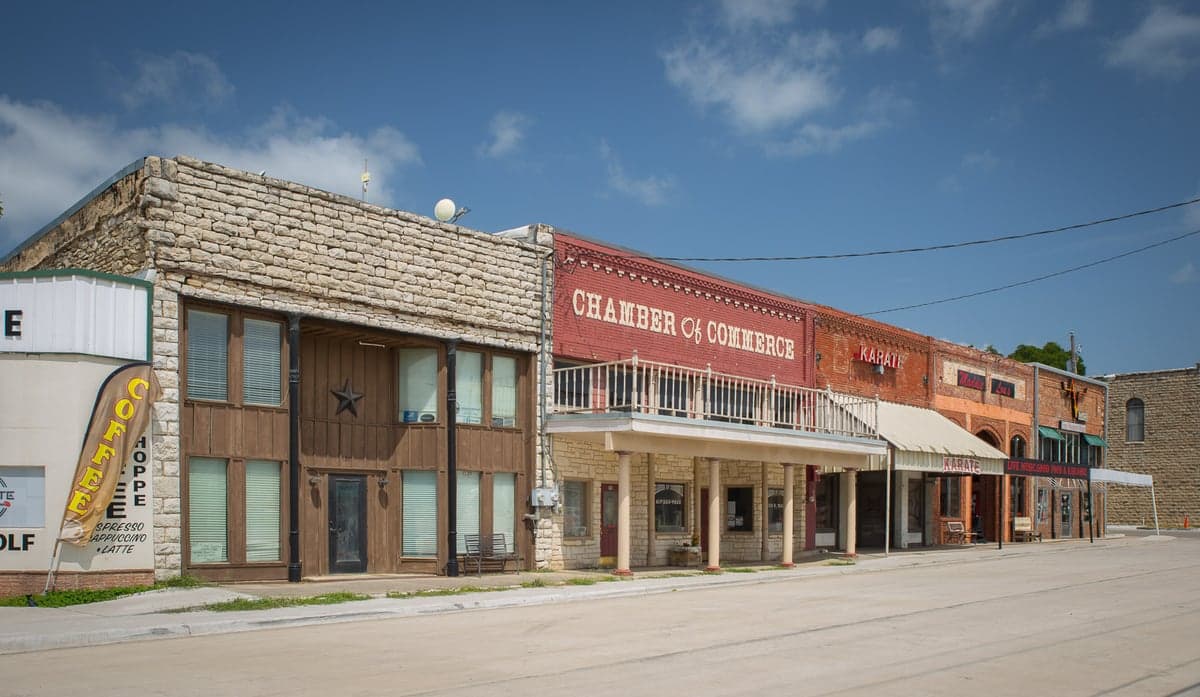
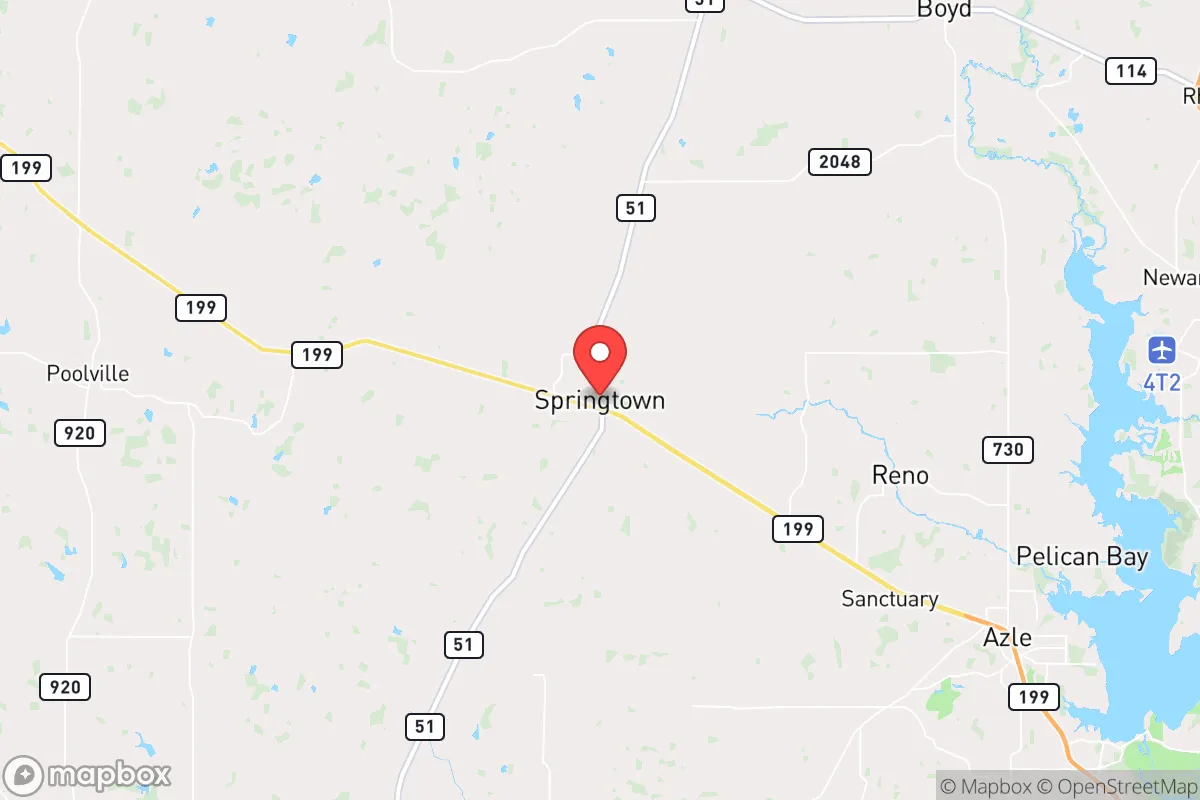
Springtown, Texas, offers a compelling mix of strategic depth and quiet resilience for those looking to put distance between themselves and the chaos of a major metro, without being completely cut off from supply lines and medical infrastructure. Sitting roughly 30 miles northwest of Fort Worth, this Parker County community benefits from being just far enough from the DFW metroplex to avoid the worst of a potential urban collapse—think civil unrest, grid failure, or a mass casualty event—while still being close enough to access resources if you have the vehicle and the nerve. The area’s low population density, agricultural base, and relative obscurity on the national radar make it a solid candidate for a relocation focused on long-term preparedness, especially for conservative-minded individuals and families who value self-reliance and community cohesion over convenience and spectacle.
Geographic position and natural advantages for long-term security
Springtown sits on the edge of the Cross Timbers region, a transitional zone between the rolling plains and the more rugged hill country to the south and west. This geography provides a few underrated perks for a prepper. The terrain is a mix of oak and mesquite woodlands, offering natural cover and defensible positions if you’re on a few acres, while the underlying geology includes decent groundwater potential—important if municipal supplies get disrupted. The area is also far enough from the Balcones Fault line to avoid major earthquake risk, and while tornadoes are a seasonal reality, the local topography doesn’t funnel storms the way flatter parts of North Texas do. Springtown’s elevation (roughly 1,000 feet) and distance from the coast mean it’s largely immune to hurricane storm surge and the kind of flooding that hits Houston or Galveston, though flash flooding in low-lying creeks is a periodic nuisance. For a relocator, the key advantage is that you’re not in a natural disaster bullseye, and the land is affordable enough to buy a few acres with a well and septic—something that’s getting harder to do closer to Fort Worth.
Risks, exposures, and proximity to fallout-relevant landmarks
No place is a fortress, and Springtown has its share of vulnerabilities. The most obvious is its proximity to the DFW metroplex—specifically, the potential for a mass evacuation or civil unrest in Fort Worth to spill westward along US-199 and US-81/287. If a major event hits the city—think a grid-down scenario, a terrorist attack, or a pandemic-driven breakdown of order—Springtown sits directly in the path of anyone fleeing west, which means you could see a surge of desperate people passing through or settling in. The town itself has a population of around 3,000, but Parker County as a whole is growing fast, and that growth brings more eyes on the area. Another concern is the proximity to the Eagle Mountain Lake area and the associated infrastructure—dams, water treatment plants, and power substations—that could be targets for sabotage or simply fail under stress. There’s also the matter of the nearby natural gas fields and pipelines in the Barnett Shale region; a rupture or intentional attack could create a localized disaster zone. For a survivalist, the biggest red flag is that Springtown is within a 45-minute drive of the Fort Worth Stockyards and the downtown core, which means it’s close enough to be affected by a dirty bomb or a large-scale conventional attack on the city, but far enough that you’d have time to react if you have a good intelligence network and a bug-out plan.
Practical resilience for a relocator: food, water, energy, and defensibility
This is where Springtown shines for the prepared individual. The area is still agricultural, with working ranches and farms that produce cattle, hay, and some row crops. That means local food sources are available if you build relationships with neighbors—something that’s easier to do in a small town where conservative values and mutual aid are still the norm. Water is the real asset here: the Trinity Aquifer underlies much of Parker County, and many rural properties have wells that produce decent-quality water at depths of 200-400 feet. If the grid goes down, a well with a hand pump or a solar-powered pump keeps you in business while the suburbs are dry. Energy resilience is also achievable; the area gets plenty of sun for solar panels, and the prevailing winds are strong enough for small-scale wind turbines if you have the space. Wood for heating and cooking is abundant in the oak-juniper forests, and the local climate means you’re not dealing with extreme cold that would kill you without power—though winters can dip into the teens, so a wood stove is a smart investment. Defensibility is a mixed bag: the open pastures and rolling hills offer good lines of sight, but the wooded draws and creek bottoms can provide cover for anyone approaching. If you buy a property with a good vantage point and a perimeter that’s not easily approached by vehicle, you can create a solid defensive position. The town itself has a small police force and a volunteer fire department, but in a major event, you’re largely on your own—which is exactly the mindset you want to have.
Overall, Springtown presents a balanced strategic picture for the conservative relocator who wants to be prepared for the worst without living like a hermit. It’s not a hardened bunker location—it’s too close to a major population center and too dependent on regional infrastructure for that—but it offers a realistic middle ground: affordable land, decent water, a like-minded community, and enough distance from the urban core to give you a fighting chance. The key is to treat it as a base of operations, not a final redoubt. Build your supplies, establish your network, and have a plan for the first 72 hours of any crisis. If you do that, Springtown can be a solid anchor for a life that’s both prepared and livable, even as the world gets shakier.

* Values derived from national, state, county, city and local statistics and may differ in a specific area. Last updated: 2026-04-14T23:47:27.000Z
Narrative content on this page is AI-generated and may contain mistakes. Verify any details that matter before acting on them.
ReloMaps may earn a commission from affiliate links at no extra cost to you.

