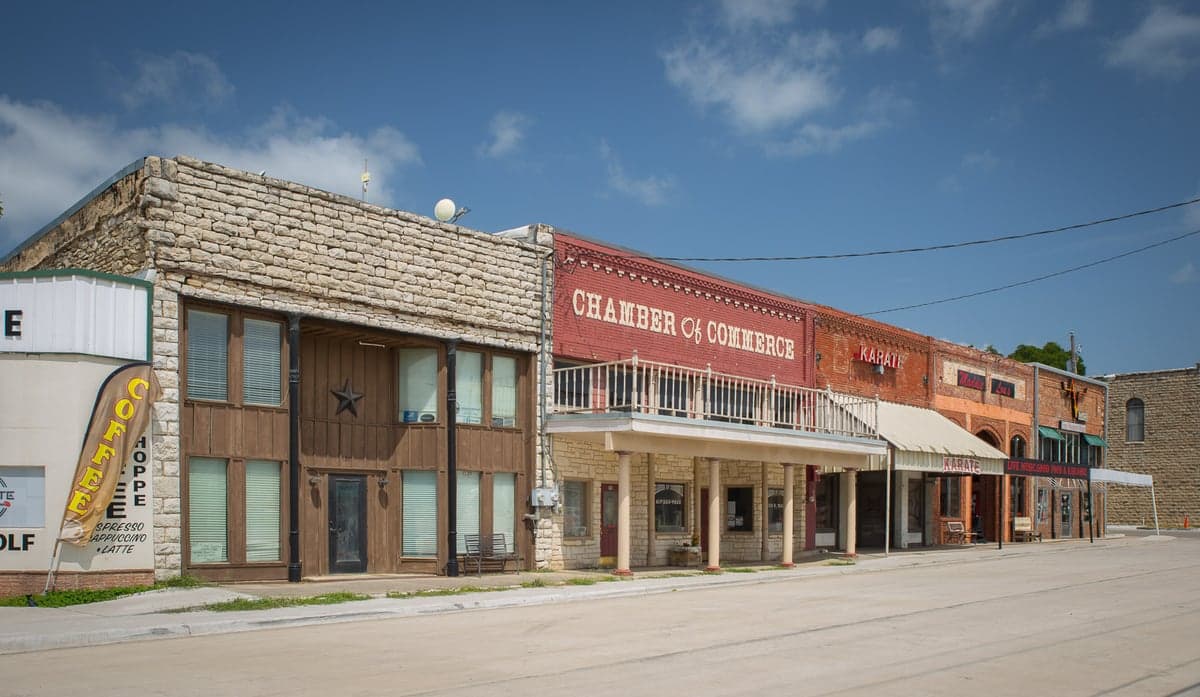
Photo: Wikipedia
Personal Sovereignty in Springtown, TX
Strong independent fundamentals that actively favor personal liberty and low regulation.
What does Personal Sovereignty tell us?
Personal Sovereignty measures your capacity for self-reliance and independence with minimal government friction. Higher scores mean fewer barriers between you and the way you want to live... but it assumes you have the space you need and good neighbors.
What does this tell us?
Personal Sovereignty measures your capacity for self-reliance and independence with minimal government friction. Higher scores mean fewer barriers between you and the way you want to live... but it assumes you have the space you need and good neighbors.
State Policy
Energy independence: Net exporter (220% of energy produced in-state)
Personal Liberty
Homesteading

Personal Liberty Analysis
Springtown, Texas, offers a personal sovereignty environment that ranks among the strongest in the Dallas-Fort Worth metroplex, largely because it sits in Parker County—a jurisdiction that consistently votes over 75% Republican and actively pushes back against state and federal overreach. For the survivalist or prepper mindset, this translates into a community where local law enforcement and county officials are generally hostile to federal encroachment on gun rights, property use, and medical autonomy. The town’s rural character, combined with Texas’s already robust constitutional protections, creates a buffer zone where an individual’s ability to live by their own rules is far less contested than in suburban or urban enclaves just 30 miles east.
Tax burden and regulatory posture: how Springtown compares to surrounding areas
Springtown’s tax burden is moderate by Texas standards, but the regulatory posture is notably light. Parker County’s property tax rate hovers around 2.1% of assessed value, which is slightly below the state average, and there is no state income tax—a foundational advantage for anyone seeking to minimize government extraction. The town operates under a general law city structure, meaning it has fewer ordinances than home-rule cities like Fort Worth or Dallas. There is no city-level rental inspection program, no mandatory composting or recycling mandates, and no noise ordinances that would restrict generator use or late-night work on a homestead. Building permits are required for new construction, but the county’s inspection process is streamlined and rarely intrusive. For the prepper, this means you can install a backup generator, build a root cellar, or construct a detached workshop without navigating a bureaucratic maze. The regulatory posture is best described as “leave us alone”—a sentiment echoed by the county’s consistent refusal to adopt state-mandated housing density targets or environmental overlay zones.
Self-defense and gun law specifics: what the Second Sanctuary status means for you
Parker County is a certified Second Amendment Sanctuary, and Springtown sits squarely within that protective umbrella. Texas law already allows permitless carry for anyone 21 or older who can legally possess a firearm, but the sanctuary resolution adds a layer of local resistance: county officials have publicly stated they will not enforce any future federal bans on semi-automatic rifles, magazine capacity limits, or universal background checks. This is not theoretical—in 2023, the Parker County Sheriff’s Office declined to participate in a federal ATF “zero tolerance” operation targeting private firearm sales. For the survivalist, this means you can build a personal armory without fear of local compliance raids. Stand-your-ground laws apply statewide, and there is no duty to retreat in your home, vehicle, or any place you have a legal right to be. Castle doctrine protections are absolute. The only practical limitation is that Springtown is within 1,000 feet of a school zone (the elementary school), so carrying there requires a License to Carry (LTC) to avoid federal complications—a minor paperwork hurdle for a major legal safeguard.
Self-reliance and homesteading viability: lot sizes, zoning, and off-grid feasibility
Springtown’s zoning code is a prepper’s dream compared to most DFW suburbs. The town’s extraterritorial jurisdiction (ETJ) extends several miles into unincorporated Parker County, where minimum lot sizes are typically one acre, and many parcels range from 2 to 10 acres. There is no city ordinance prohibiting rainwater collection, composting toilets, or solar panel installation—all of which are explicitly allowed under Texas state law, which preempts any local bans on rainwater harvesting. Off-grid feasibility is high: you can legally install a septic system, drill a private well, and generate your own power without connecting to the municipal grid, provided you meet basic health and safety codes. The county does not enforce any “rural character” aesthetic standards, so you can build a metal shop, park an RV, or keep livestock (chickens, goats, even a few cattle) on parcels over two acres. The only real constraint is that the town’s fire code requires a certain road width for emergency vehicle access, but that’s a practical safety measure, not a sovereignty infringement. For the serious homesteader, Springtown offers a rare combination of affordable land (around $15,000–$25,000 per acre as of 2025) and minimal regulatory friction.
Personal liberties: parental rights, medical autonomy, speech, and property
Parental rights in Springtown are strongly protected by both state law and local culture. Texas’s 2023 “Parental Bill of Rights” (SB 2201) gives parents explicit authority over their children’s medical decisions, educational materials, and religious upbringing. Springtown ISD has a conservative school board that has banned critical race theory, restricted library content with explicit sexual material, and requires parental opt-in for any health surveys or mental health screenings. Medical autonomy is similarly robust: Texas law prohibits any vaccine mandate by private employers or schools (with narrow exceptions for healthcare workers), and there is no state-level mask or quarantine mandate. The town has no local public health department that could impose emergency orders independent of the county. Speech is protected under the Texas Religious Freedom Restoration Act, which applies to both individuals and businesses—meaning you can refuse service based on sincerely held religious beliefs without facing local discrimination ordinances. Property rights are the crown jewel: Texas’s private property rights law (HB 2818) requires local governments to compensate landowners for any regulatory taking that reduces property value by 25% or more, effectively chilling any attempt at overzealous zoning or environmental restrictions. Springtown has never invoked eminent domain for a private development project, and the county’s appraisal district is known for being lenient on agricultural exemptions—so you can get a tax break by keeping a few goats on your land.
Overall, Springtown ranks among the top 10% of Texas towns for personal sovereignty when measured against the DFW metroplex. The combination of a Second Amendment sanctuary, light zoning, strong parental rights, and a county government that actively resists federal overreach creates an environment where a survivalist or prepper can operate with minimal government interference. The only real trade-off is that you’re 45 minutes from a major trauma center (Fort Worth’s Harris Methodist), so medical self-reliance—stockpiling antibiotics, learning field medicine, maintaining a trauma kit—becomes a practical necessity, not just a philosophical preference. For someone looking to escape the creeping regulatory state of urban Texas while staying within commuting distance of DFW jobs, Springtown offers a rare pocket of genuine autonomy. It’s not a libertarian utopia—you still pay property taxes and need permits for major construction—but it’s about as close as you’ll get in North Texas without moving to the Panhandle.

* Values derived from national, state, county, city and local statistics and may differ in a specific area. Last updated: 2026-04-14T23:47:27.000Z
Narrative content on this page is AI-generated and may contain mistakes. Verify any details that matter before acting on them.
ReloMaps may earn a commission from affiliate links at no extra cost to you.

