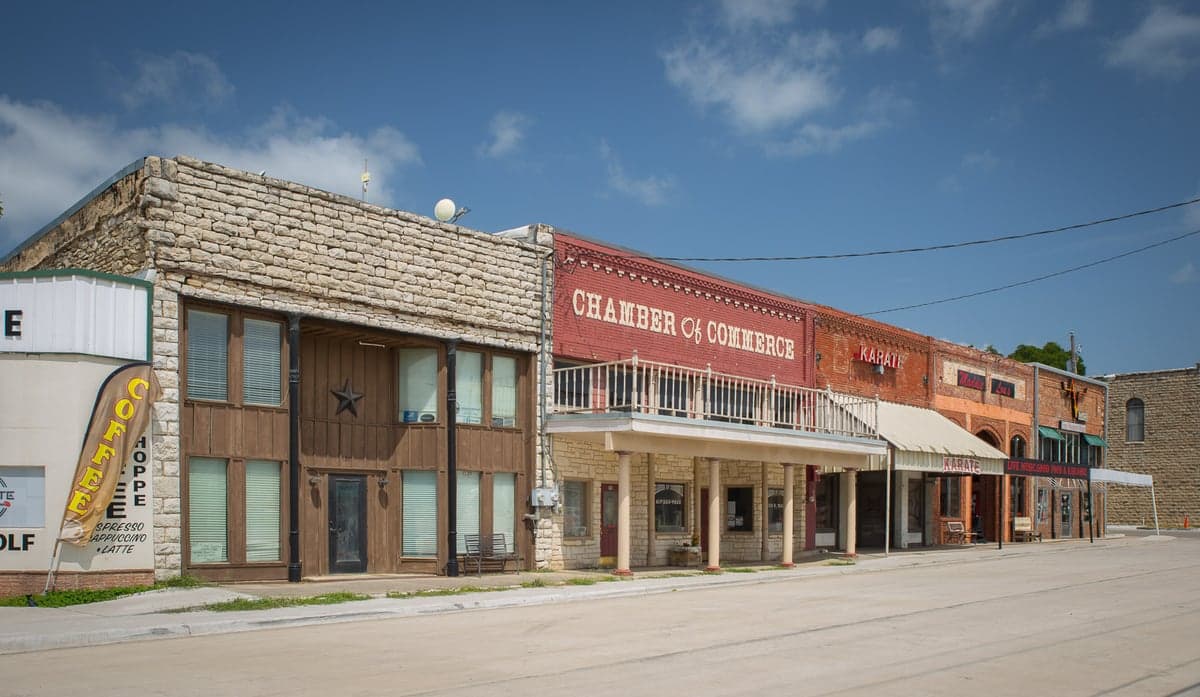
Photo: Wikipedia
Political ClimatePolitical Climate in Springtown, TX
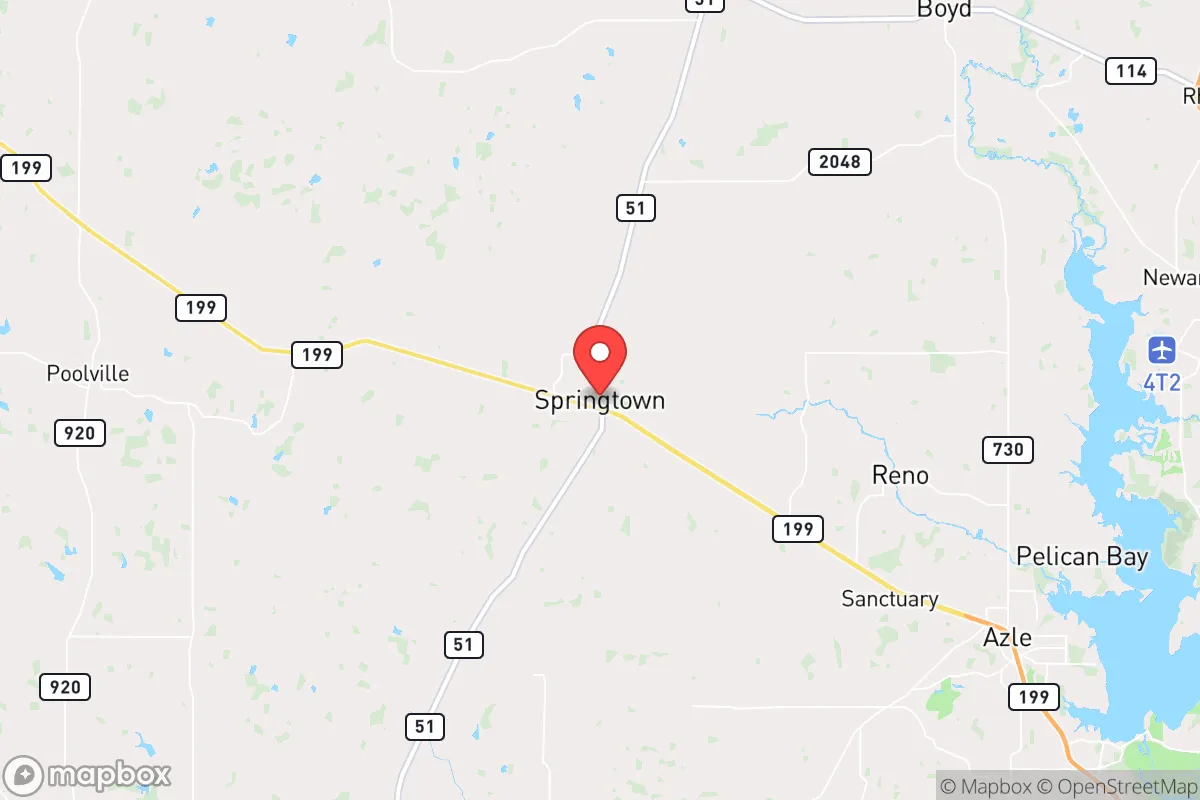
District shown is the primary district for this city’s centroid. Cities may span multiple districts.
Local Political AnalysisPolitical Analysis of Springtown, TX
Springtown, Texas, leans solidly conservative, with a Cook PVI of R+11 that reflects a deep-rooted preference for limited government and personal responsibility. This isn't a recent shift—it's the bedrock of the community, where folks have long valued the freedom to live their lives without excessive interference from Austin or Washington. Over the past decade, the area has held steady, even as nearby cities like Fort Worth (R+9) and Weatherford (R+15) have seen their own political dynamics evolve. The trajectory here is one of cautious stability: new residents are drawn by the promise of lower taxes and fewer regulations, but there's a growing unease about outside influences creeping in from the Metroplex.
How it compares
Compared to its neighbors, Springtown stands out as a reliably conservative anchor in a region that's seeing some ideological drift. To the east, Fort Worth has become a battleground, with its urban core leaning left while the suburbs hold the line. Weatherford, just west, is even more conservative, but Springtown's R+11 rating puts it squarely in the camp of places like Azle (R+13) and Aledo (R+12). The real contrast is with Denton (D+5) to the north, where a university-driven progressive wave has reshaped local politics. Springtown residents see that as a cautionary tale—a reminder of what happens when government overreach and progressive policies take root. The county-level voting patterns here have been consistent: in 2024, Parker County voted +24 R for president, and local races rarely see serious Democratic challengers. This isn't a place that flips; it's a place that holds the line.
What this means for residents
For the people who call Springtown home, this political climate means a daily life built on local control and common-sense governance. You won't find the kind of zoning battles or tax hikes that plague more progressive areas. The school board stays focused on core academics, not social experiments, and the city council keeps its hands off your property rights. Property taxes, while not low by Texas standards, are kept in check by a county that prioritizes fiscal restraint. The downside? If you're looking for rapid change or big-city amenities, you'll be disappointed—but that's the point. The trade-off is freedom from the kind of overreach that's become common in places like Austin or Dallas. Residents here value the ability to run a business without a mountain of permits, to own firearms without apology, and to raise kids in a community where traditional values aren't treated as outdated. The biggest concern for the long term is the influx of newcomers from blue states who might not share these priorities, but so far, the local culture has absorbed them without losing its character.
Culturally, Springtown is defined by its independence. There's no city-wide noise ordinance, no strict sign codes, and the annual rodeo is a bigger deal than any political rally. The biggest policy distinction is the county's stance on Second Amendment rights—Parker County is a "Second Amendment Sanctuary" area, meaning local officials have pledged not to enforce any state or federal gun laws they see as unconstitutional. That's not just a symbol; it's a practical commitment to resisting government overreach. The local sheriff's office is known for focusing on violent crime, not petty regulations. As for the future, the concern is that as the Metroplex expands, so will the pressure to adopt more progressive policies—higher impact fees, stricter environmental rules, and the like. But for now, Springtown remains a place where the government stays small, the neighbors look out for each other, and the biggest political debate is whether to widen the main road or keep it two lanes. That's the kind of freedom worth protecting.

State Political ClimatePolitical Climate in Texas
State Political AnalysisPolitical Environment in the State
Texas has been a reliably Republican state for decades, with no Democrat winning statewide office since 1994, but the political climate is far from static. The dominant coalition remains conservative, anchored by rural and suburban voters who prioritize limited government, gun rights, and traditional values, yet the state is undergoing a slow but steady shift driven by explosive growth in its major metros. Over the last 10-20 years, the GOP’s grip has tightened in the legislature and on the state level, even as the presidential margin has narrowed from a 16-point Romney win in 2012 to a 5.5-point Trump win in 2024, signaling a realignment that newcomers need to understand.
Urban vs. rural divide
The political map of Texas is a tale of two landscapes. The vast rural expanse—places like Lubbock, Amarillo, and the Panhandle—votes overwhelmingly Republican, often by 70-80% margins. These areas are the backbone of the state’s conservative identity, with deep roots in agriculture, oil, and evangelical Christianity. Meanwhile, the major metros tell a different story. Austin is the state’s progressive stronghold, consistently voting 70%+ Democrat, while El Paso and the Rio Grande Valley have historically leaned blue, though the Valley has been trending right in recent cycles. Dallas and Houston are battlegrounds within themselves: their suburban rings—like Collin County north of Dallas and Fort Bend County southwest of Houston—were once GOP bastions but are now competitive. Collin County, for example, went from a 27-point Romney win in 2012 to a 9-point Trump win in 2024, driven by an influx of college-educated professionals and minority voters. The urban cores of these cities are deep blue, but the surrounding exurbs like Katy and Frisco remain reliably red, creating a patchwork that makes Texas a state of political islands.
Policy environment
Texas’s policy environment is a model of limited government, which is why many conservatives relocate here. There is no state income tax, a constitutional cap on property tax growth (Proposition 4, passed in 2023, which increased the homestead exemption to $100,000), and a regulatory climate that favors business over bureaucracy. Education policy is a flashpoint: the state has a school choice voucher program (the Texas Education Savings Account, signed in 2025) that allows parents to use public funds for private or homeschool expenses, a major win for parental rights. Healthcare is largely deregulated, with no state-run exchange and a refusal to expand Medicaid under the ACA, keeping government out of medical decisions. Election laws were tightened in 2021 with Senate Bill 1, which banned 24-hour and drive-through voting, required ID for mail ballots, and empowered poll watchers—a move critics called voter suppression but supporters say restored integrity. The state also has a near-total abortion ban (trigger law from 2021, effective after Dobbs) and permitless carry for handguns (2021), reflecting a deep commitment to individual liberty. However, property taxes remain high despite caps, and the state’s reliance on sales and property taxes means homeowners feel the pinch—something to budget for.
Trajectory & freedom
On the freedom front, Texas has been moving in a decidedly more liberty-oriented direction over the past five years, but with some concerning caveats. The 2021 legislative session was a landmark: permitless carry (HB 1927) expanded Second Amendment rights, the Heartbeat Act (SB 8) banned abortions after six weeks with a private enforcement mechanism, and the election integrity bill (SB 1) tightened voting rules. In 2023, the legislature passed a ban on gender transition procedures for minors (SB 14) and a law requiring public school libraries to remove books deemed “sexually explicit” (HB 900), both of which were framed as protecting children from government overreach. However, the state also saw a crackdown on local control: the “bathroom bill” debate resurfaced in 2025 with a law restricting transgender access to school facilities, and the governor has used the Texas National Guard to bus migrants to sanctuary cities, asserting state sovereignty over immigration enforcement. On the positive side, property rights were strengthened with the 2023 law limiting eminent domain for private projects, and the 2025 school choice expansion gives families more control over education. The trajectory is toward more personal freedom in most areas, but the state is also asserting more authority over local governments, which some see as a double-edged sword.
Civil unrest & political movements
Texas has seen its share of political flashpoints, particularly around immigration and racial justice. The 2020 Black Lives Matter protests in Austin and Houston were large and occasionally violent, leading to property damage and a police reform backlash that saw the Austin City Council cut the police budget—only to restore it after a public outcry. The border crisis has been a constant source of tension: Governor Abbott’s Operation Lone Star, launched in 2021, deployed state troopers and National Guard to the border, bused migrants to Democrat-run cities, and installed razor wire along the Rio Grande, sparking legal battles with the Biden administration. In 2024, the state passed a law (SB 4) allowing state police to arrest and deport illegal immigrants, which was temporarily blocked by courts but signaled a major assertion of state power. On the right, the Texas GOP has become more populist and nationalist, with the 2022 party platform calling for a referendum on secession—a largely symbolic move that reflects growing frustration with federal overreach. Election integrity remains a hot-button issue: the 2020 election saw lawsuits over Harris County’s drive-through voting, and the 2024 cycle was marked by intense scrutiny of mail ballots. A new resident in San Antonio or Fort Worth will notice the political activism is real—yard signs, bumper stickers, and local news coverage of school board meetings are common, but the state is not in a state of constant unrest. The flashpoints are localized and often tied to specific policies.
Projection
Over the next 5-10 years, Texas will likely remain a Republican-controlled state, but the margin will continue to shrink as the population grows and diversifies. The 2024 election showed that Dallas and Houston suburbs are trending left, while the Rio Grande Valley is swinging right—a net effect that keeps the state competitive but not yet purple. In-migration from California and other blue states is a double-edged sword: many newcomers are conservatives fleeing high taxes and regulation, but a significant minority bring progressive voting habits, especially in the tech hubs of Austin and Dallas. The GOP is responding by doubling down on cultural issues—school choice, border security, and parental rights—which energize the base but may alienate moderate suburbanites. Expect more preemption laws that strip power from blue cities like Austin and Houston, particularly on housing, policing, and environmental regulations. The state’s economy remains a magnet, with job growth in energy, tech, and manufacturing, but the political climate will become more polarized as the two sides dig in. For a conservative moving in now, the next decade will feel like a holding action: the state will stay red, but the battles will be fought at the local level, especially in school boards and city councils.
For a new resident, the bottom line is that Texas offers a political environment that is still broadly aligned with conservative values—low taxes, gun rights, school choice, and a pro-business climate—but it’s not a monolith. You’ll find deep red in the Panhandle and exurbs, competitive purple in the suburbs, and deep blue in the urban cores. The key is to choose your location wisely: if you want a reliably conservative community, look at Lubbock, Katy, or Frisco. If you’re okay with a more mixed environment, San Antonio and Fort Worth offer a balance. The state is not becoming California, but it is becoming more contested, and the culture wars are real. Plan to be engaged in local politics if you want to preserve the freedoms that drew you here.
* Values derived from national, state, county, city and local statistics and may differ in a specific area. Last updated: 2026-04-14T23:47:27.000Z
Narrative content on this page is AI-generated and may contain mistakes. Verify any details that matter before acting on them.
ReloMaps may earn a commission from affiliate links at no extra cost to you.

