Photo: Wikipedia
Demographics of Tacoma, WA
Affluence Level in Tacoma, WA
A middle-class area roughly in line with national averages across income, home values, education, and employment.
People of Tacoma, WA
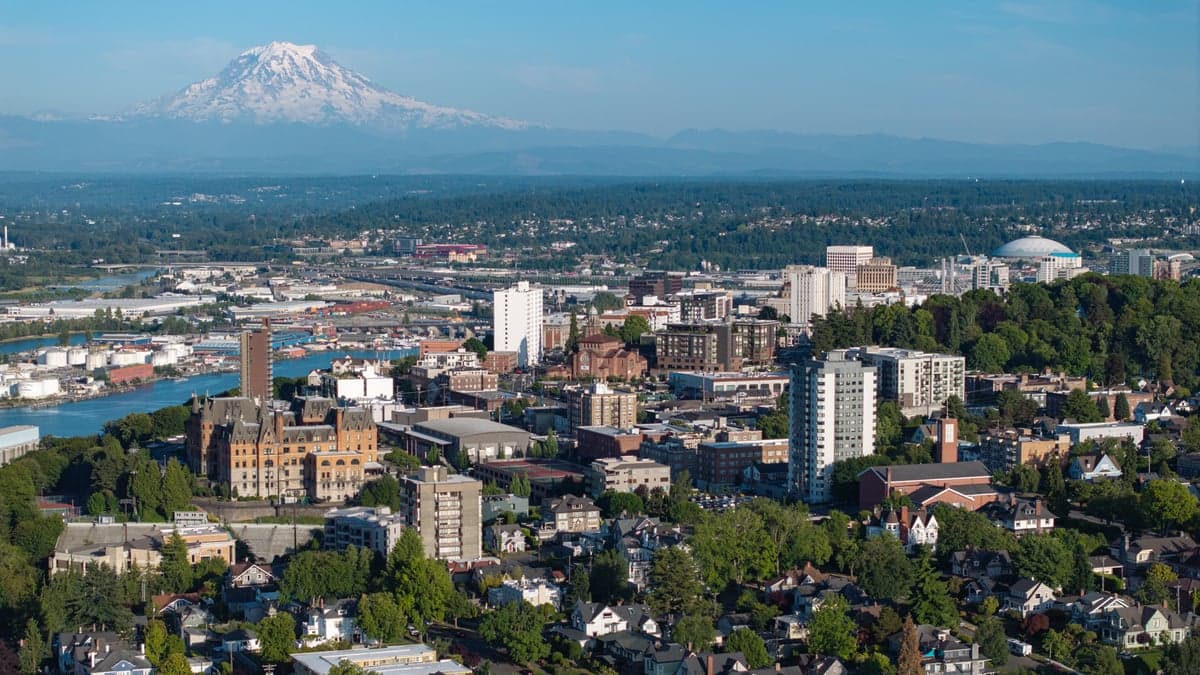
Tacoma, Washington, is a city of 220,482 residents defined by its working-class roots, a growing diversity, and a strong sense of place shaped by its industrial past. The city is less transient than nearby Seattle, with a higher share of long-term residents and a population that is 56.1% white, 13.1% Hispanic, 10.0% Black, and 8.3% East/Southeast Asian. Its character is a blend of blue-collar resilience and a slow-burning cultural revival, anchored by neighborhoods that remain distinct enclaves for different waves of settlement.
How the city was settled and grew
Tacoma’s human history begins with the Puyallup Tribe, who inhabited the Commencement Bay area for millennia before Euro-American settlement. The city’s modern population was drawn by the transcontinental railroad—the Northern Pacific Railway chose Tacoma as its western terminus in 1873. This decision sparked a land rush and a boom in lumber, shipping, and smelting. The original white settlers, largely of Northern European descent (Scandinavian, German, and British), built the city’s core neighborhoods like Stadium District and North End, where grand Victorian homes still stand. By the early 20th century, Tacoma’s industrial economy—led by the Weyerhaeuser timber company and the Tacoma Smelter—attracted a wave of immigrant laborers. Japanese and Filipino workers arrived to build railroads and work in the lumber mills, settling in the Hilltop neighborhood, which became a multiethnic working-class hub. The Great Migration brought Black families from the South to Tacoma’s shipyards and rail yards, with many putting down roots in Salishan and the East Side. By 1950, Tacoma was a majority-white, blue-collar city of about 144,000, with small but established Black, Japanese, and Filipino communities.
Modern era (post-1965)
The 1965 Immigration and Nationality Act reshaped Tacoma’s demographics, though less dramatically than in Seattle. The city’s foreign-born population remains low at 5.4%, but the composition shifted. East/Southeast Asian communities—particularly Vietnamese and Filipino—grew through family reunification and refugee resettlement after the Vietnam War. These groups concentrated in the South Tacoma and Lincoln District neighborhoods, where Vietnamese restaurants and grocery stores now anchor commercial strips. The Hispanic population, now 13.1%, expanded steadily from the 1980s onward, driven by Mexican and Central American migrants seeking work in warehousing, construction, and food processing. They settled across the East Side and Hilltop, areas that also saw an influx of Pacific Islander families (Samoan and Tongan) drawn by military connections to nearby Joint Base Lewis-McChord. The Black population, at 10.0%, has remained stable but slightly declined as some families moved to suburban Pierce County. The white population, while still a majority at 56.1%, has aged and shrunk relative to the city’s growth, with younger white residents often drawn to the Stadium District and Proctor neighborhoods for their walkability and historic housing stock.
The future
Tacoma’s population is heading toward greater ethnic diversity, but it is not homogenizing. Instead, the city is tribalizing into distinct enclaves. The East/Southeast Asian population (8.3%) is growing slowly through immigration and second-generation retention, with the Lincoln District becoming a more defined Asian commercial and residential core. The Hispanic population (13.1%) is the fastest-growing segment, driven by both immigration and higher birth rates, and is spreading from the East Side into previously white-majority neighborhoods like South Tacoma. The Indian-subcontinent population remains negligible at 0.3%, with no significant enclave forming. The Black population is plateauing, with some out-migration to suburbs like Lakewood and Spanaway. The white population is declining as a share but remains the majority; younger white residents are increasingly childless or have fewer children, while older white homeowners age in place. Over the next 10–20 years, Tacoma will likely become a majority-minority city, with Hispanic and East/Southeast Asian communities forming the largest non-white blocs. The city’s character will remain working-class, but the cultural texture will shift toward a more Latino and Asian-influenced identity, particularly in the southern and eastern neighborhoods.
For someone moving to Tacoma now, the city offers a stable, family-oriented environment with distinct ethnic neighborhoods that are neither fully assimilated nor segregated. The population is becoming more diverse and younger, but the pace is gradual—Tacoma is not experiencing the rapid demographic churn of Seattle or Portland. It remains a place where a newcomer can find a defined community, whether in the historic white-majority North End, the Hispanic and Black East Side, or the Asian-influenced Lincoln District.

* Values derived from national, state, county, city and local statistics and may differ in a specific area. Last updated: 2026-04-21T11:00:53.000Z
Narrative content on this page is AI-generated and may contain mistakes. Verify any details that matter before acting on them.
ReloMaps may earn a commission from affiliate links at no extra cost to you.

