Photo: Wikipedia
Political ClimatePolitical Climate in Tacoma, WA
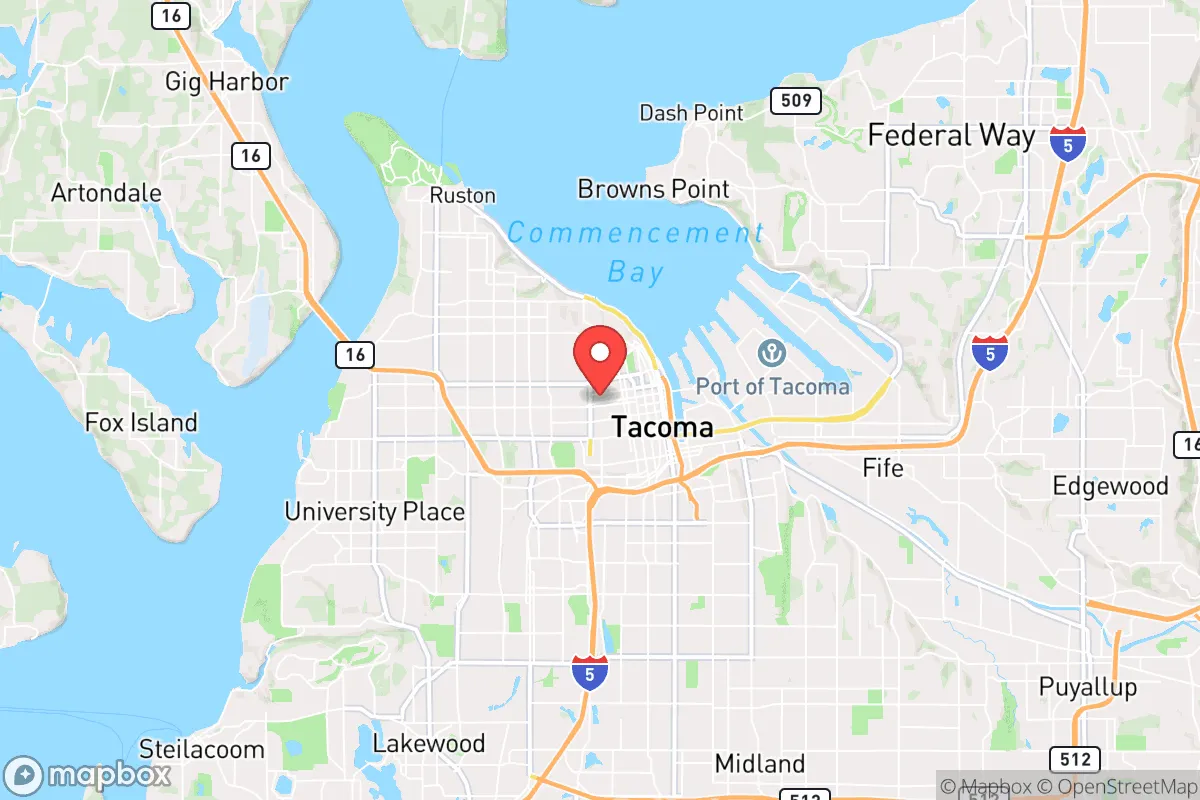
District shown is the primary district for this city’s centroid. Cities may span multiple districts.
Local Political AnalysisPolitical Analysis of Tacoma, WA
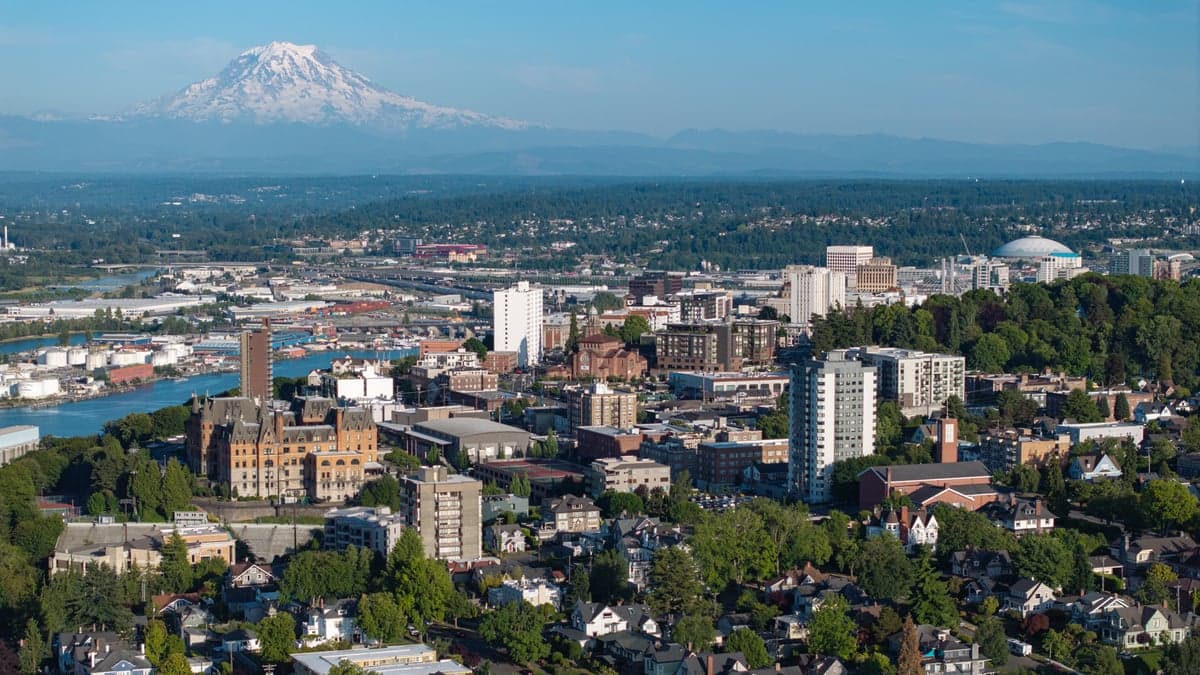
Tacoma leans heavily Democratic, with a Cook PVI of D+10, meaning the city votes about ten points more Democratic than the national average. That wasn't always the case—I remember when this was a solid blue-collar, union town where folks voted for the person, not the party. Over the last decade, though, the shift has been dramatic. The city council and county commissions are now firmly in progressive hands, and the policy agenda has moved noticeably left on everything from policing to land use. If you're looking at Tacoma from a conservative perspective, the trajectory is concerning: what was once a pragmatic, working-class city is increasingly adopting the same top-down, government-knows-best approach you see in Seattle, just on a smaller scale.
How it compares
To understand Tacoma's politics, you have to look at the surrounding areas. Drive 15 minutes south to Puyallup or Graham, and you're in reliably red territory—those areas vote Republican by wide margins. Head east across the bridge to Gig Harbor, and you'll find a mix of fiscal conservatives and moderate Republicans. Even University Place, just west of Tacoma, is more balanced. The contrast is stark: Tacoma's D+10 rating puts it in the same league as Seattle (D+30) and Olympia (D+20), while the rest of Pierce County is much more purple. What this means is that Tacoma's politics are out of step with the broader region. The city's progressive majority often pushes policies—like defunding police initiatives or strict rent control—that would never fly in the surrounding suburbs. It creates a real cultural divide, and frankly, a lot of us feel like our voices don't count in city hall anymore.
What this means for residents
For the average resident, the political climate translates into tangible changes in daily life. Property taxes and utility fees have climbed steadily as the city funds new programs—homeless services, climate action plans, equity initiatives—that sound good on paper but hit your wallet hard. The city council has also moved to restrict short-term rentals and impose stricter zoning rules, which limits what you can do with your own property. Government overreach into personal freedoms is a real concern here. During the pandemic, Tacoma was one of the first cities in the state to impose mask mandates and business closures, and it kept them in place longer than most. More recently, there's been talk of a city income tax, which would be a first in Washington. If you value keeping more of what you earn and making your own choices about your home and business, Tacoma's direction is worrying.
Culturally, Tacoma still has a lot going for it—great parks, a working waterfront, and a sense of community that Seattle lost years ago. But the political drift is real. The city's leadership seems more focused on national progressive talking points than on the nuts-and-bolts issues that matter to families: public safety, school quality, and keeping the streets clean. If the trend continues, Tacoma risks becoming a smaller version of Seattle, with all the same problems—homelessness, crime, and high taxes—but without the tax base to support it. For now, it's still a place where you can find your people and live your life, but you'll have to keep an eye on what the city council is doing. The long-term outlook? Unless there's a political realignment, expect more of the same: more regulation, higher costs, and less personal freedom.

State Political ClimatePolitical Climate in Washington
State Political AnalysisPolitical Environment in the State
Washington State has shifted from a purple swing state to a solidly blue stronghold over the past two decades, with Democrats controlling every statewide office and both legislative chambers since 2012. The state hasn’t voted Republican for president since 1984, and the 2024 election saw Kamala Harris carry it by roughly 19 points. That said, the political landscape is anything but uniform — the massive population centers of King County (Seattle) and Pierce County (Tacoma) drive the statewide leftward tilt, while vast stretches east of the Cascades remain deeply conservative. For a conservative considering relocation, the key question isn’t whether Washington is red or blue — it’s whether you can find a pocket of freedom that fits your values.
Urban vs. rural divide
The political map of Washington is a tale of two states separated by the Cascade Range. The western third, dominated by the Seattle metropolitan area, is one of the most progressive regions in the country. King County alone accounts for roughly 30% of the state’s population and delivers margins of 70% or more for Democratic candidates. Seattle, Bellevue, and Redmond are the epicenters of this blue wave, fueled by tech wealth, a highly educated workforce, and a culture that embraces progressive social policies. To the south, Olympia and Vancouver (the latter just across the Columbia from Portland) also lean heavily left, though Vancouver has seen some in-migration from more conservative Californians. East of the Cascades, the story flips entirely. Spokane, the state’s second-largest city, is a conservative stronghold in a county that voted for Trump by 12 points in 2024. The rural counties of Yakima, Walla Walla, and Grant are reliably red, with agriculture and ranching driving a libertarian-leaning, small-government ethos. The Tri-Cities (Kennewick, Pasco, Richland) are a fascinating microcosm — Richland, home to the Hanford nuclear site, is more moderate, while Kennewick and Pasco are solidly conservative. The divide isn’t just geographic; it’s cultural. A resident of Spokane Valley will have almost nothing in common politically with someone from Capitol Hill in Seattle.
Policy environment
Washington’s state-level policies are a mixed bag for conservatives. The good news: there is no state income tax, which is a major draw for high earners and business owners. The bad news: the state relies heavily on a regressive sales tax (currently 6.5% state rate, with local add-ons pushing it to 10% in some cities) and high property taxes. In 2021, the state enacted a 7% capital gains tax on profits over $250,000, which was upheld by the state Supreme Court in 2023 — a move many conservatives see as a slippery slope toward a full income tax. On education, Washington has a robust public school system, but parental rights have become a flashpoint. The state’s 2023 “shield law” for gender-affirming care and its 2024 expansion of LGBTQ+ curriculum mandates have sparked backlash, particularly in conservative districts like Spokane County and Yakima. Election laws are among the most liberal in the nation: universal mail-in voting, same-day registration, and no voter ID requirement at the polls (though a signature is required on the ballot envelope). For conservatives concerned about election integrity, this is a red flag. The regulatory environment is heavy — Washington has some of the strictest environmental and land-use regulations in the country, which can make building or expanding a business a multi-year ordeal.
Trajectory & freedom
Over the past decade, Washington has moved decisively toward greater government control in several key areas of personal liberty. Gun rights have been significantly curtailed: in 2023, the legislature passed a ban on certain semi-automatic firearms (HB 1240), a high-capacity magazine ban, and a requirement for a 10-day waiting period and safety training for all firearm purchases. These laws were challenged in court but remain in effect. On medical freedom, Washington was one of the first states to mandate COVID-19 vaccines for state employees and healthcare workers, and it maintains some of the strictest vaccine requirements for schoolchildren in the nation. Parental rights took a hit in 2023 with the passage of the “Shield Law” (SB 5599), which allows minors to receive gender-affirming care without parental consent in certain circumstances — a law that has driven some conservative families to consider leaving the state. Property rights are also under pressure: the state’s Growth Management Act gives local governments broad authority to limit development, and a 2023 law (HB 1110) effectively eliminated single-family zoning in cities over 25,000, allowing duplexes and fourplexes in most neighborhoods. For conservatives who value local control and property autonomy, these trends are deeply concerning.
Civil unrest & political movements
Washington has a history of visible political activism, both left and right. The 2020 protests in Seattle, including the CHAZ/CHOP occupation in Capitol Hill, were a national flashpoint that many conservatives still cite as a symbol of lawlessness. Seattle and Portland remain hubs for Antifa-aligned activism, though the intensity has waned since 2021. On the right, the Washington State Republican Party has struggled to gain traction, but grassroots movements like the Spokane County Republican Party and the Yakima Valley Tea Party remain active. Immigration politics are a major fault line: Washington is a sanctuary state (since 2019’s SB 5497), meaning local law enforcement cannot cooperate with federal immigration authorities. This has led to tensions in border-adjacent communities like Vancouver, where illegal crossings from Oregon have increased. Election integrity remains a hot-button issue — the 2020 and 2024 elections saw widespread allegations of irregularities in King County, though no major fraud was proven. The “Secession of Eastern Washington” movement, while not serious, reflects the deep cultural divide — a 2024 poll found that 40% of eastern Washington residents support forming a separate state.
Projection
Looking ahead 5-10 years, the trajectory is clear: Washington will continue to move left, driven by in-migration from California and Oregon, the growth of the tech sector, and the increasing political engagement of younger, more progressive voters. King County’s population is projected to grow by another 200,000 by 2035, cementing Democratic dominance. However, there are countercurrents. The Tri-Cities and Spokane Valley are seeing an influx of conservatives fleeing high taxes and regulation in California and Oregon, which could strengthen the red vote in those regions. The state’s housing crisis — driven by the very regulations conservatives criticize — may eventually force a political realignment, as even progressive voters grow frustrated with the cost of living. But for now, the state legislature is unlikely to reverse course on gun control, parental rights, or tax policy. A conservative moving to Washington should expect to live in a state where their political views are increasingly marginalized at the state level, even if they find a like-minded community in a red pocket.
Bottom line for a new resident: If you’re a conservative considering Washington, your best bet is to target the eastern half of the state — Spokane, the Tri-Cities, or Yakima — where you’ll find lower taxes, more affordable housing, and a community that shares your values. But be prepared for a constant political fight at the state level. You’ll be voting in a state where your vote for governor or senator is almost certainly going to the losing side, and where state laws will increasingly conflict with your personal beliefs. If that sounds exhausting, you might be happier in Idaho or Montana. But if you’re willing to dig in and fight for your freedoms, Washington’s red pockets offer a beautiful landscape, a strong economy, and a community of like-minded neighbors who feel the same way.
* Values derived from national, state, county, city and local statistics and may differ in a specific area. Last updated: 2026-04-21T11:00:53.000Z
Narrative content on this page is AI-generated and may contain mistakes. Verify any details that matter before acting on them.
ReloMaps may earn a commission from affiliate links at no extra cost to you.

