
Photo: Wikipedia
Demographics of Tea, SD
Affluence Level in Tea, SD
An upper-middle-class area. Household wealth, education levels, and homeownership run ahead of national benchmarks.
People of Tea, SD
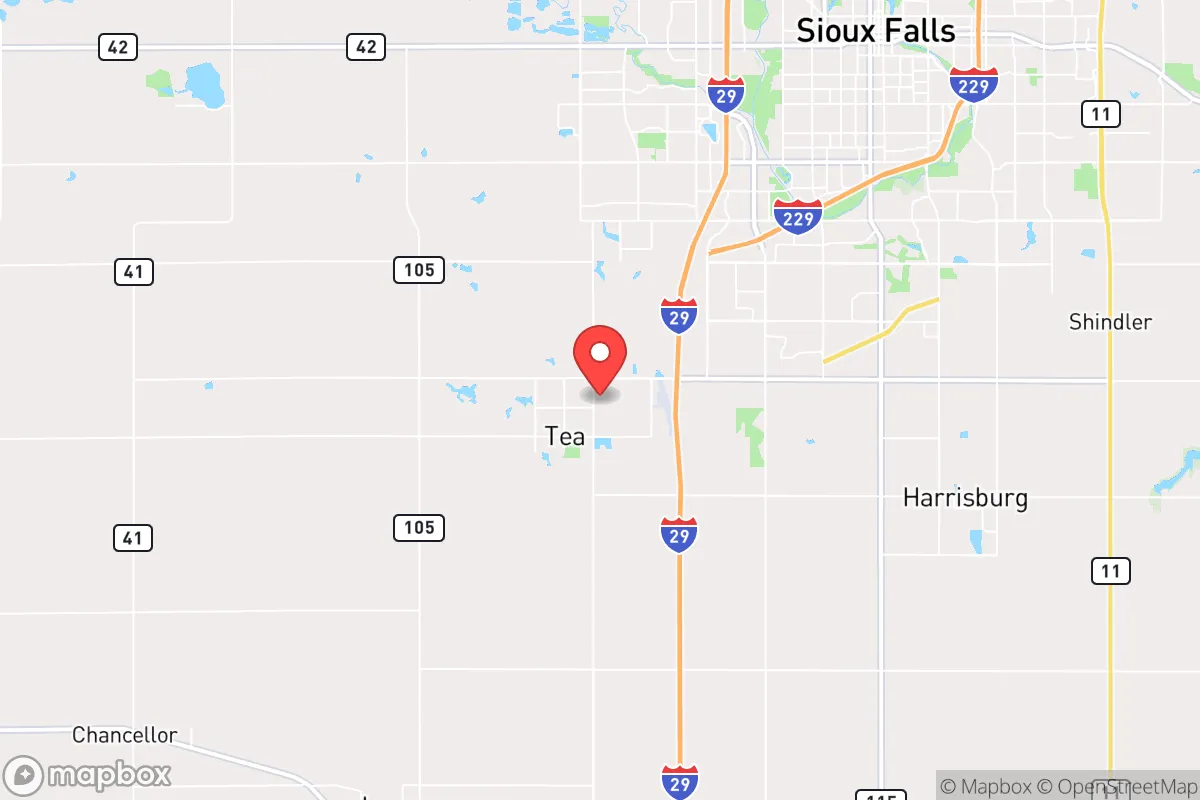
The people of Tea, South Dakota, today form a predominantly white, family-oriented community of 6,339 residents, characterized by rapid suburban growth and a notably high college attainment rate of 41.4%. The city is overwhelmingly native-born, with a foreign-born population of 0.0%, and its demographic profile is 92.1% white, 4.1% Black, 0.9% East/Southeast Asian, and 0.2% Hispanic. Distinctive identity markers include a strong sense of local governance, a reputation as a bedroom community for nearby Sioux Falls, and a population that skews younger and more educated than the state average.
How the city was settled and grew
Tea was founded in the late 19th century as a railroad town along the Chicago, Milwaukee, St. Paul and Pacific Railroad, with the first plat filed in 1893. The original population was drawn by the promise of fertile farmland and the railroad's need for service stops. The earliest settlers were primarily of Northern European stock—Germans, Norwegians, and Dutch—who established homesteads and small businesses near the depot. The historic Downtown Tea district, centered around the original rail line, was built by these families and remains the city's oldest residential and commercial core. A second wave of growth occurred in the 1910s and 1920s, when a small number of Scandinavian farmers moved into the surrounding township, settling in what is now the North Tea Addition, a neighborhood of larger lots and older farmhouses. The city remained a tiny agricultural hamlet through the mid-20th century, with a population that barely exceeded 200 until the 1970s.
Modern era (post-1965)
The modern transformation of Tea began in earnest after the 1965 Immigration and Nationality Act, though the city's population remained overwhelmingly native-born. The real driver was domestic suburbanization: as Sioux Falls expanded southward, Tea became a prime destination for young families seeking affordable housing, good schools, and a slower pace of life. The Tea Hills subdivision, developed in the 1980s, absorbed the first wave of these commuters—mostly white professionals and tradespeople. A second, larger wave arrived in the 2000s and 2010s, spurred by the construction of the Prairie Creek and Sunset Ridge neighborhoods, which offered new single-family homes on cul-de-sacs. These subdivisions attracted a mix of white-collar workers from Sioux Falls and a small but notable number of Black families, who now make up 4.1% of the population—a share higher than many comparable South Dakota towns. The South Tea Estates area, developed after 2015, has become the most diverse pocket, with a handful of East/Southeast Asian and Hispanic households. No significant Indian-subcontinent or Arab communities have formed, reflecting the city's 0.0% foreign-born rate.
The future
Tea's population trajectory points toward continued, moderate growth driven by domestic in-migration from Sioux Falls and other parts of the Upper Midwest. The city is not homogenizing into a single enclave; rather, it is tribalizing into distinct neighborhoods by housing age and price point. The older Downtown Tea and North Tea Addition areas are stable, with aging homeowners, while Prairie Creek and Sunset Ridge are filling with young families. The South Tea Estates area is likely to see the most demographic change, as new construction attracts a slightly more diverse buyer pool. The Black population share (4.1%) may grow modestly as Sioux Falls' Black community expands outward, but the East/Southeast Asian and Hispanic shares are expected to remain very low due to the absence of employer-sponsored migration or refugee resettlement programs. The foreign-born population will likely stay near zero. Over the next 10–20 years, Tea will become a more established, slightly older suburb, but its core identity as a white, native-born, family-oriented community will persist.
For someone moving in now, Tea is becoming a stable, low-diversity suburb where the primary demographic story is not immigration but domestic relocation—specifically, the outward spread of Sioux Falls' workforce. The city offers a predictable, safe environment with strong schools and a high share of college-educated neighbors, but little ethnic or cultural variety. New arrivals will find a community that is growing in size but not in complexity, with neighborhoods that reflect income and life stage more than heritage.

* Values derived from national, state, county, city and local statistics and may differ in a specific area. Last updated: 2026-04-19T08:07:44.000Z
Narrative content on this page is AI-generated and may contain mistakes. Verify any details that matter before acting on them.
ReloMaps may earn a commission from affiliate links at no extra cost to you.

