Photo: Wikipedia
Political ClimatePolitical Climate in Tea, SD
District shown is the primary district for this city’s centroid. Cities may span multiple districts.
Inherited from parent state — no local data available.
Local Political AnalysisPolitical Analysis of Tea, SD
Tea, South Dakota, is about as solidly conservative as it gets, and that's not changing anytime soon. The Cook PVI of R+15 tells you the math, but the real story is the culture—this is a place where folks still believe in minding their own business and keeping the government out of your backyard. You won't find much appetite for progressive experiments here; the local elections and school board races tend to reflect that same no-nonsense, limited-government mindset. If anything, the trajectory has been a slow but steady hardening of that conservative identity, especially as more people move out from Sioux Falls looking for a quieter life with lower taxes and fewer regulations.
How it compares
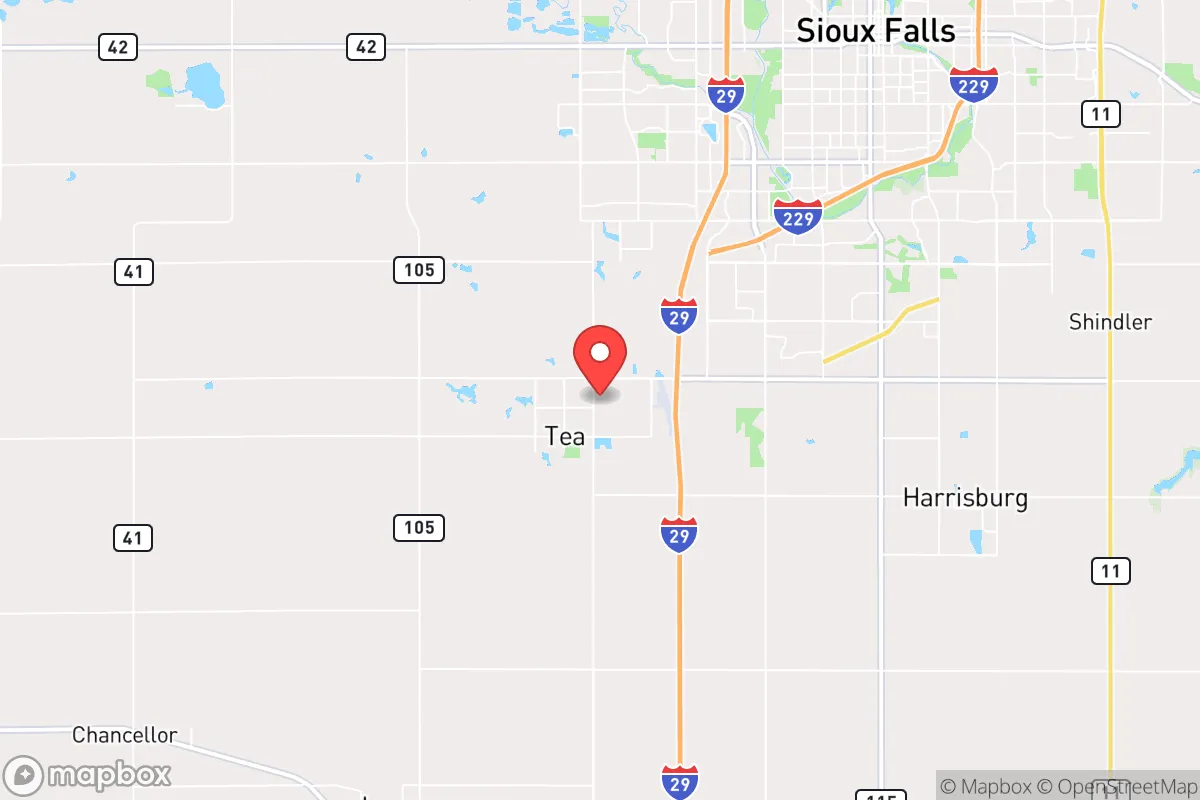
Drive ten minutes north into Sioux Falls, and you'll feel the difference immediately. That city has been trending more moderate and even left-leaning in recent years, especially among younger transplants and the growing service-sector workforce. Tea, by contrast, has stayed stubbornly old-school. The surrounding Lincoln County is reliably red, but towns like Harrisburg and Lennox have seen a bit more political mixing as they grow. Tea remains the anchor of the area's conservative base—fewer chain stores, more pickup trucks, and a general suspicion of any politician who talks too much about "transformation" or "equity." The contrast is stark: in Sioux Falls you might see a pride flag on a downtown lamppost; in Tea, you're more likely to see a "Don't Tread on Me" sticker on a mailbox.
What this means for residents
For the people who live here, it means you can generally count on local government to stay out of your hair. Zoning is minimal, property taxes are low compared to the national average, and there's no real push for the kind of overreach you see in bigger cities—no mask mandates that last forever, no heavy-handed business closures, no school curriculum battles over things that don't belong in a classroom. The school board here still focuses on reading, writing, and arithmetic, not social engineering. That said, there's a quiet worry among longtime residents that as Tea grows—and it is growing fast, with new subdivisions popping up every year—some of that small-town independence could get diluted. The concern is that new arrivals might bring big-city ideas about "community standards" that end up looking a lot like government control.
One cultural distinction that sets Tea apart is the strong sense of personal responsibility that runs through everything. You won't find a lot of hand-wringing over income inequality or calls for the county to step in and fix every problem. People here tend to solve their own problems, whether that's fixing a fence or helping a neighbor haul firewood. The local gun culture is alive and well, and the Second Amendment isn't a talking point—it's a way of life. If you're looking for a place where the government trusts you to make your own decisions, Tea is it. But keep an eye on the growth. If the political winds shift even a little, this town could become a battleground between the old guard who want to keep things free and the newcomers who think more rules mean a better life. For now, though, the conservative foundation is holding strong.

State Political ClimatePolitical Climate in South Dakota
State Political AnalysisPolitical Environment in the State
South Dakota is one of the most reliably Republican states in the nation, with a straight-ticket conservative tilt that has only deepened over the past two decades. The state hasn’t voted for a Democratic presidential candidate since 1964, and in 2024, Donald Trump carried it by a massive 30-point margin. The dominant coalition is a mix of rural ranchers, small-town business owners, and a growing number of freedom-minded transplants from California and the Midwest, all united by a fierce distrust of federal overreach. Over the last 10-20 years, the state has shifted from a moderate, live-and-let-live conservatism to a more assertive, culturally conservative posture—driven largely by the influx of remote workers and retirees who chose South Dakota specifically for its low taxes and light regulation.
Urban vs. rural divide
The political map is starkly divided between a handful of small urban centers and the vast, deeply red rural expanse. Sioux Falls, the state’s largest city (pop. ~210,000), is the only real blue-leaning area—Minnehaha County went for Trump by just 8 points in 2024, a far cry from the statewide margin. The city’s growth has brought a younger, more diverse population, and you’ll find pockets of progressive activism around downtown and the university district. Rapid City, in the west, is reliably Republican but with a libertarian streak—Pennington County voted +18 for Trump, but local politics often focus on property rights and gun access rather than social issues. The real conservative strongholds are the small towns and farming communities: Brookings (home to South Dakota State University) is a bit of a purple outlier thanks to the student vote, but places like Mitchell, Watertown, and Yankton routinely deliver 70-80% Republican margins. The Pine Ridge Indian Reservation (Oglala Lakota County) is the only reliably Democratic area outside Sioux Falls, voting +50 for Biden in 2020, but its population is small and its turnout low. The rural-urban divide isn’t as bitter as in some states—most folks in Sioux Falls still lean right—but the cultural gap between the capital city of Pierre (a sleepy, conservative town) and the more cosmopolitan Sioux Falls is growing.
Policy environment
South Dakota’s policy environment is a conservative dream: no state income tax, no personal property tax, and a flat 4.2% sales tax that keeps the government lean. The state has a right-to-work law, and the regulatory climate is among the most business-friendly in the country—permitting for a new home or business can take weeks, not months. On education, the state passed a robust school choice program in 2023, allowing education savings accounts (ESAs) for families, though it’s still limited to lower-income households. Healthcare is a mixed bag: the state expanded Medicaid under the Affordable Care Act via a 2022 ballot initiative (a rare progressive win), but the legislature has since tightened work requirements for able-bodied adults. Election laws are solid—voter ID is required, no-excuse absentee voting is allowed, but mail-in ballot drop boxes are banned. The state also passed a constitutional carry law in 2019, meaning no permit is needed to carry a concealed firearm. Property rights are strongly protected, with no statewide zoning and a “takings” law that requires compensation for any regulation that reduces property value by more than 30%. The overall vibe is: the government stays out of your wallet, your business, and your gun safe.
Trajectory & freedom
The state is becoming more free in several key areas, but there are warning signs. On the plus side, the 2023 “Parents’ Bill of Rights” (HB 1105) guarantees parental access to curriculum and medical records, and prohibits schools from hiding a child’s gender identity from parents. The 2024 “Medical Freedom Act” bans vaccine mandates for employment and school attendance, and prohibits discrimination based on vaccination status. Gun rights expanded in 2021 with the “Second Amendment Preservation Act”, which nullifies any federal gun law that doesn’t exist in state statute—a direct challenge to federal overreach. On the concerning side, the state has seen a creep in property tax increases at the local level, especially in Sioux Falls and Rapid City, where rapid growth has driven up assessments. The 2023 “Transgender Sports Ban” (HB 1080) and the 2024 “Gender-Affirming Care Ban” for minors are popular with conservatives but have drawn federal lawsuits and negative media attention. The biggest freedom concern is the state’s growing reliance on federal funds—about 40% of the budget comes from Washington, which creates a vulnerability if the feds ever tighten strings. Overall, though, the trajectory is toward more personal autonomy, especially for parents and gun owners.
Civil unrest & political movements
South Dakota is remarkably stable compared to coastal states. The most visible political flashpoint in recent years was the 2020-2021 protests at Mount Rushmore, where Indigenous activists and left-wing groups clashed with Trump supporters over land rights and the monument’s symbolism. The state also saw a “Freedom Rally” in Pierre in 2021, where thousands protested COVID-19 mandates—Governor Kristi Noem never imposed a lockdown, so the protest was more about solidarity than necessity. On the right, the South Dakota Freedom Caucus has grown in influence, pushing for school choice expansion, further tax cuts, and nullification of federal environmental regulations. On the left, the South Dakota Democratic Party is nearly extinct—they hold no statewide offices and only a handful of legislative seats. Immigration politics are quiet; the state has a small but growing Hispanic population in Sioux Falls, but there’s no sanctuary city movement. The Pine Ridge Reservation occasionally sees protests over tribal sovereignty and police jurisdiction, but these rarely spill into state politics. The biggest ongoing controversy is the “Noem vs. the Legislature” dynamic—the governor has clashed with her own party over spending and transparency, but it’s a family squabble, not a civil war.
Projection
Over the next 5-10 years, South Dakota will likely become more conservative, but with a libertarian flavor. The in-migration of remote workers and retirees—many from California, Colorado, and Minnesota—is accelerating, and these newcomers tend to be fiscally conservative but socially moderate. That could create a tension: the old guard wants to keep the state a rural, agricultural haven, while the newcomers want more amenities, better schools, and faster internet. Expect the Sioux Falls metro to continue its blueward drift, but the rural areas will double down on red. The state’s population is aging—the median age is 37, and the under-30 population is shrinking—which could make the electorate even more conservative on social issues. The biggest wildcard is federal funding: if Washington cuts Medicaid or infrastructure dollars, the state will face a budget crisis that could force tax increases or service cuts. But for now, the trajectory is clear: more school choice, more gun rights, more parental control, and a government that stays small. A new resident moving in today should expect to find a state that values personal responsibility over collective action, and that will fight federal overreach tooth and nail.
For a conservative-leaning individual or family, South Dakota offers a rare combination of low taxes, strong property rights, and a culture that respects personal freedom. The trade-offs are real: winters are brutal, healthcare options are limited outside Sioux Falls, and the social scene can feel isolated if you’re not into hunting or church. But if you want a state where the government trusts you to make your own decisions—about your health, your kids’ education, and your money—South Dakota is one of the last places where that’s still the default. Just be prepared for the cold, and know that the nearest Whole Foods is probably a four-hour drive away.
* Values derived from national, state, county, city and local statistics and may differ in a specific area. Last updated: 2026-04-19T08:07:44.000Z
Narrative content on this page is AI-generated and may contain mistakes. Verify any details that matter before acting on them.
ReloMaps may earn a commission from affiliate links at no extra cost to you.

