Photo: Wikipedia
Demographics of Tempe, AZ
Affluence Level in Tempe, AZ
A middle-class area roughly in line with national averages across income, home values, education, and employment.
People of Tempe, AZ
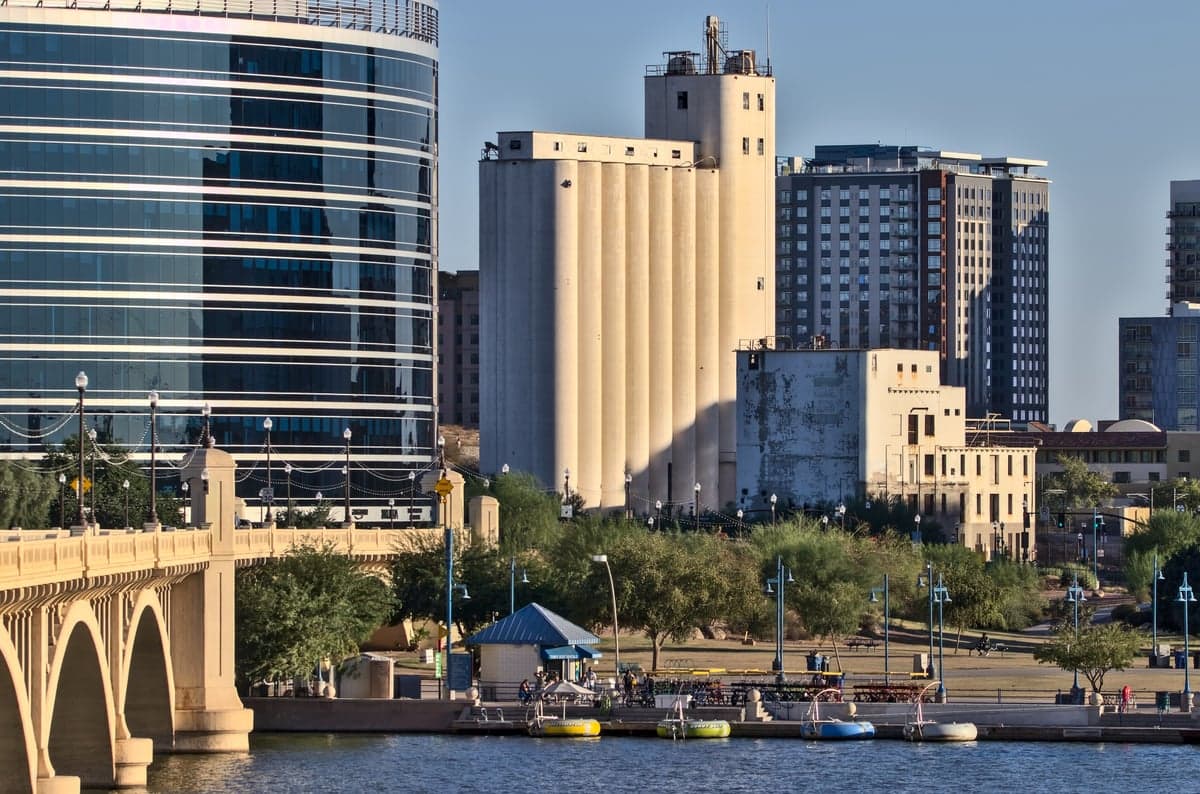
Tempe, Arizona, is a dense, youthful city of 186,419 residents where nearly half the population holds a college degree, a direct legacy of Arizona State University's presence. The city's character is defined by a blend of historic Hispanic neighborhoods, a growing professional class, and significant East/Southeast Asian and Indian communities. It is a compact, walkable urban center within the sprawling Phoenix metro, distinct for its high concentration of students and young professionals, yet retaining working-class roots in its older wards.
How the city was settled and grew
Tempe was founded in the 1870s by Charles Trumbull Hayden, a merchant who established a ferry crossing on the Salt River. The original Anglo settlers were farmers drawn by the Hayden Canal, which irrigated the fertile valley. The city's first major population wave came from Mexican laborers who built the canal and worked the fields, settling in what is now Espanola and the area around Mitchell Park, creating the historic Barrio de Tempe. These neighborhoods remain the heart of the city's Hispanic community today. By the early 20th century, the establishment of the Tempe Normal School (later Arizona State University) began attracting a small but steady stream of educators and students, though the city remained a small agricultural town of fewer than 5,000 people until after World War II. The post-war boom brought a second wave of Anglo migrants from the Midwest and Northeast, who filled new suburban tracts like the Maple-Ash neighborhood and the Broadmor area, drawn by defense-related jobs at Williams Air Force Base and the growing university.
Modern era (post-1965)
The 1965 Immigration and Nationality Act reshaped Tempe's demographics significantly. The city's foreign-born population stands at 8.1%, a moderate share for the metro, but the composition shifted dramatically. The 1970s and 1980s saw an influx of East/Southeast Asian immigrants, particularly Vietnamese and Chinese families, who established roots in the University Drive corridor and the neighborhoods near Rural Road, drawn by affordable housing and proximity to ASU. The Indian subcontinent community, now 4.0% of the population, grew rapidly after 1990, concentrated in the Lakes area and the newer developments around Warner Road, where tech and engineering jobs at ASU and nearby firms provided a pathway. The Hispanic population, while still substantial at 23.1%, has seen its share decline relative to the city's overall growth, as higher housing costs have pushed some working-class families to outlying suburbs like Mesa and Chandler. The Black population, at 7.4%, is largely concentrated in the Escalante neighborhood and the southern parts of the city, reflecting a mix of long-standing families and newer arrivals drawn to ASU and the service economy.
The future
Tempe's population is trending toward greater educational attainment and professionalization, with the college-educated share at 49.5% and rising. The city is not homogenizing but rather tribalizing into distinct enclaves: the historic Hispanic barrios around Mitchell Park remain stable, while the Lakes area is becoming a dense hub for Indian and East/Southeast Asian professionals. The Asian (East/Southeast) population, at 5.3%, is plateauing as families age in place, while the Indian community continues to grow through tech-sector migration. The white population, at 52.4%, is increasingly concentrated among students and young professionals in the downtown and ASU precincts, with families often moving to suburban Tempe or neighboring cities. The next decade will likely see continued densification around the light-rail corridor and the new ASU Innovation Zone, attracting more international graduate students and tech workers, while the city's affordable housing stock shrinks, potentially slowing Hispanic and Black in-migration.
Tempe is becoming a denser, more educated, and more globally connected city, but one where economic stratification is sharpening. For a conservative-leaning individual or family moving in, the city offers a stable, walkable urban environment with strong schools and low crime in its core neighborhoods, but the cultural and political character is increasingly shaped by the university and a professional class that leans left. The historic working-class and Hispanic identity of Tempe persists in its older wards, but the city's future is being written by the tech and education sectors that draw a diverse, highly skilled population from across the world.

* Values derived from national, state, county, city and local statistics and may differ in a specific area. Last updated: 2026-05-01T20:30:26.000Z
Narrative content on this page is AI-generated and may contain mistakes. Verify any details that matter before acting on them.
ReloMaps may earn a commission from affiliate links at no extra cost to you.

