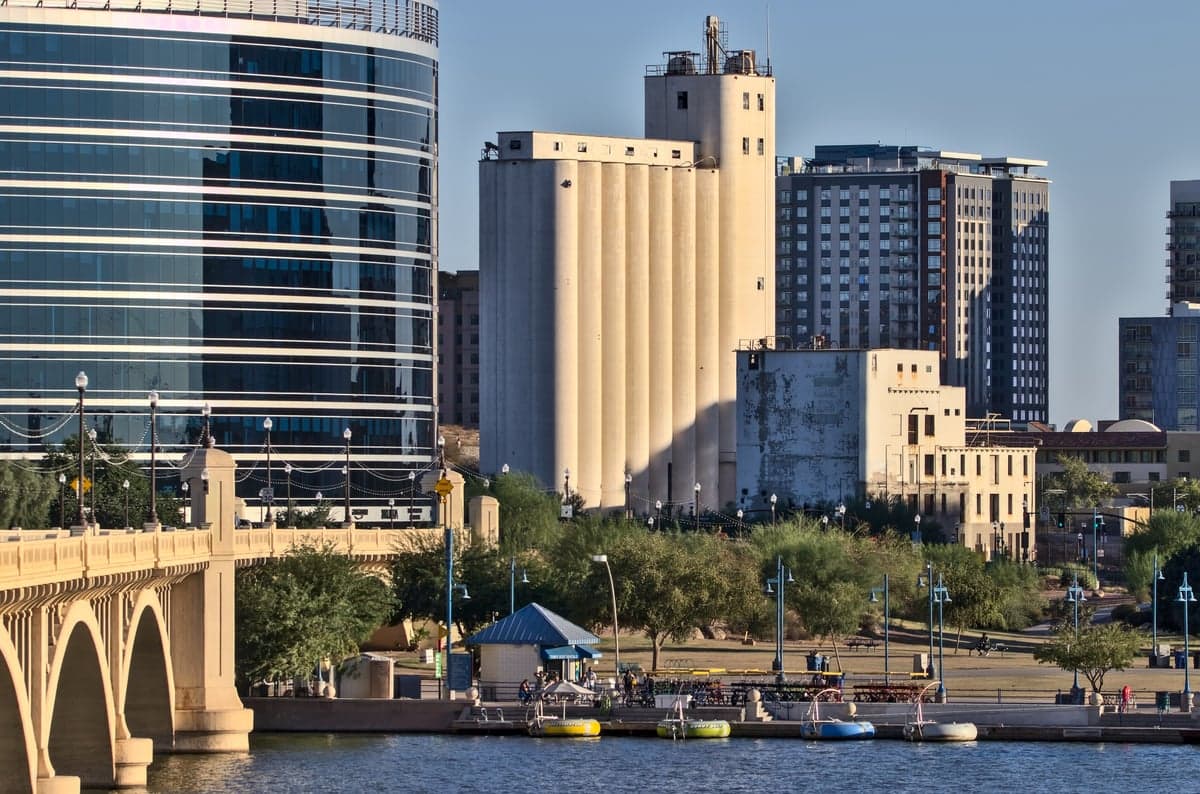
Photo: Wikipedia
Personal Sovereignty in Tempe, AZ
Viable for self-reliance. Generally workable, though some barriers may limit total independence.
What does Personal Sovereignty tell us?
Personal Sovereignty measures your capacity for self-reliance and independence with minimal government friction. Higher scores mean fewer barriers between you and the way you want to live... but it assumes you have the space you need and good neighbors.
What does this tell us?
Personal Sovereignty measures your capacity for self-reliance and independence with minimal government friction. Higher scores mean fewer barriers between you and the way you want to live... but it assumes you have the space you need and good neighbors.
State Policy
Energy independence: Importer (20% of energy produced in-state)
Personal Liberty
Homesteading

Personal Liberty Analysis
Tempe, Arizona, offers a mixed bag for those prioritizing personal sovereignty, with the state's generally strong preemption laws and constitutional carry providing a solid foundation, but local governance and the broader Maricopa County political machine introduce notable friction. For the survivalist or prepper, the city's dense urban core and strict zoning present significant challenges to self-reliance, while the state's tax structure and regulatory climate offer more breathing room than coastal alternatives. This analysis breaks down the specific levers of autonomy—taxes, guns, land use, and personal liberties—so you can judge whether Tempe's trade-offs align with your strategic relocation goals.
Tax burden and regulatory posture: How Arizona's state framework limits local overreach
Arizona's tax environment is a net positive for sovereignty-minded individuals, but Tempe's municipal add-ons require attention. The state imposes a flat income tax rate of 2.5% as of 2025, with no estate or inheritance taxes, and property taxes are capped by the state constitution at a combined rate typically under 1% of assessed value. In Tempe, the total property tax rate hovers around 0.85%, which is competitive nationally but slightly higher than rural Arizona counties. Sales tax is where the city flexes its revenue muscle: Tempe's combined rate is 8.6% (state 5.6% + county 0.7% + city 2.3%), which is above the state average and funds local programs that may not align with conservative priorities. Regulatory posture is generally business-friendly at the state level—Arizona is a right-to-work state with minimal occupational licensing burdens—but Tempe's city council has a history of pushing zoning overlays and environmental ordinances that can complicate property use. For a prepper, the key takeaway is that the state's preemption laws on firearms and land use provide a ceiling against the worst local overreach, but Tempe's municipal code still requires careful reading before committing to a property.
Self-defense and gun law specifics: Constitutional carry and the reality of urban restrictions
Arizona is a constitutional carry state, meaning no permit is required to carry a concealed firearm for anyone legally allowed to possess one, and this applies fully within Tempe city limits. The state also has strong preemption laws—A.R.S. § 13-3108 explicitly prohibits cities from enacting their own gun ordinances, so Tempe cannot ban carry in parks, restaurants, or other public spaces beyond what state law allows. This is a major win for personal sovereignty. However, the practical reality in Tempe is that the city is dense and urban, with a high concentration of "gun-free zone" signage at private businesses, ASU campus buildings, and event venues. Stand-your-ground laws are in effect statewide, but the legal aftermath of a defensive shooting in Maricopa County can be expensive and drawn out due to the county attorney's office's track record. For the prepper, Tempe offers the legal right to carry and store firearms without a permit, but the environment demands situational awareness—you're more likely to encounter anti-gun sentiment in local politics than in rural Arizona. Magazine capacity and NFA items (suppressors, SBRs) are unrestricted at the state level, which is a plus for those building a serious capability.
Self-reliance and homesteading viability: Lot sizes, zoning, and off-grid feasibility in a desert city
This is Tempe's weakest category for the sovereignty-minded. The city is built out, with typical residential lot sizes ranging from 5,000 to 8,000 square feet in older neighborhoods, and newer developments squeezing into 3,500-square-foot lots. Zoning is strict: raising chickens is allowed on lots under 10,000 square feet only with a permit and neighbor notification, and livestock (goats, pigs) is effectively banned in all residential zones. Rainwater harvesting is legal and even encouraged with rebates, but the average annual rainfall in Tempe is only 8 inches, making true off-grid water independence impractical without a deep well—which is prohibited in most of the city due to groundwater management rules. Solar panels are permitted and net metering is available through the local utility (Salt River Project), but SRP is a quasi-governmental entity with rate structures that can change annually. For a prepper seeking a bug-in location with food production and water security, Tempe is a poor fit. The city's urban heat island effect (summer highs routinely exceed 110°F) also complicates gardening and livestock keeping. The strategic play here is to use Tempe as a base for employment and supply caching, while maintaining a secondary property in a less restrictive county like Gila or Pinal for actual homesteading.
Personal liberties: Parental rights, medical autonomy, speech, and property rights in practice
Parental rights in Arizona are relatively strong compared to blue states. The state has a Parents' Bill of Rights (A.R.S. § 1-601) that affirms the fundamental right of parents to direct their children's education and healthcare, and Tempe public schools have not been at the center of the most aggressive curriculum battles seen in districts like Tucson or Phoenix. However, the city's proximity to Arizona State University means a heavy progressive cultural influence, and local school board elections have seen contentious races over critical race theory and LGBTQ policies. Medical autonomy is a mixed bag: Arizona has no vaccine mandate for adults, but employers and private businesses can impose their own rules. The state banned mask and vaccine mandates for government entities in 2022, but Tempe's city council has occasionally pushed back with symbolic resolutions. Property rights are protected by Arizona's strong eminent domain laws (post-Kelo reforms), but Tempe's zoning code is dense and can be weaponized against non-conforming uses—for example, running a home-based prepping business or storing large quantities of supplies may trigger code enforcement. Free speech is protected by the First Amendment, but Tempe has designated "free speech zones" on ASU campus that have been challenged in court, and the city's noise ordinances can be used to shut down gatherings. For the conservative individual, the legal framework is generally favorable, but the cultural climate in Tempe requires a thick skin and a willingness to engage in local politics to protect those rights.
Overall, Tempe offers a B-minus grade for personal sovereignty when compared to rural Arizona counties or states like Idaho or Montana. The state-level protections—constitutional carry, low taxes, parental rights, and property rights—create a floor that prevents the worst local overreach, but the city's density, zoning restrictions, and progressive political lean mean you'll constantly be fighting small battles to maintain autonomy. For the prepper or survivalist, Tempe is best viewed as a strategic hub for employment and networking, not a final retreat. If your priority is maximum self-reliance and minimal government interference, look to the outskirts of the state. But if you need to be in the Phoenix metro for work or family, Tempe's sovereignty profile is workable—provided you stay vigilant, get involved in local elections, and keep one eye on the exit.

* Values derived from national, state, county, city and local statistics and may differ in a specific area. Last updated: 2026-05-01T20:30:26.000Z
Narrative content on this page is AI-generated and may contain mistakes. Verify any details that matter before acting on them.
ReloMaps may earn a commission from affiliate links at no extra cost to you.

