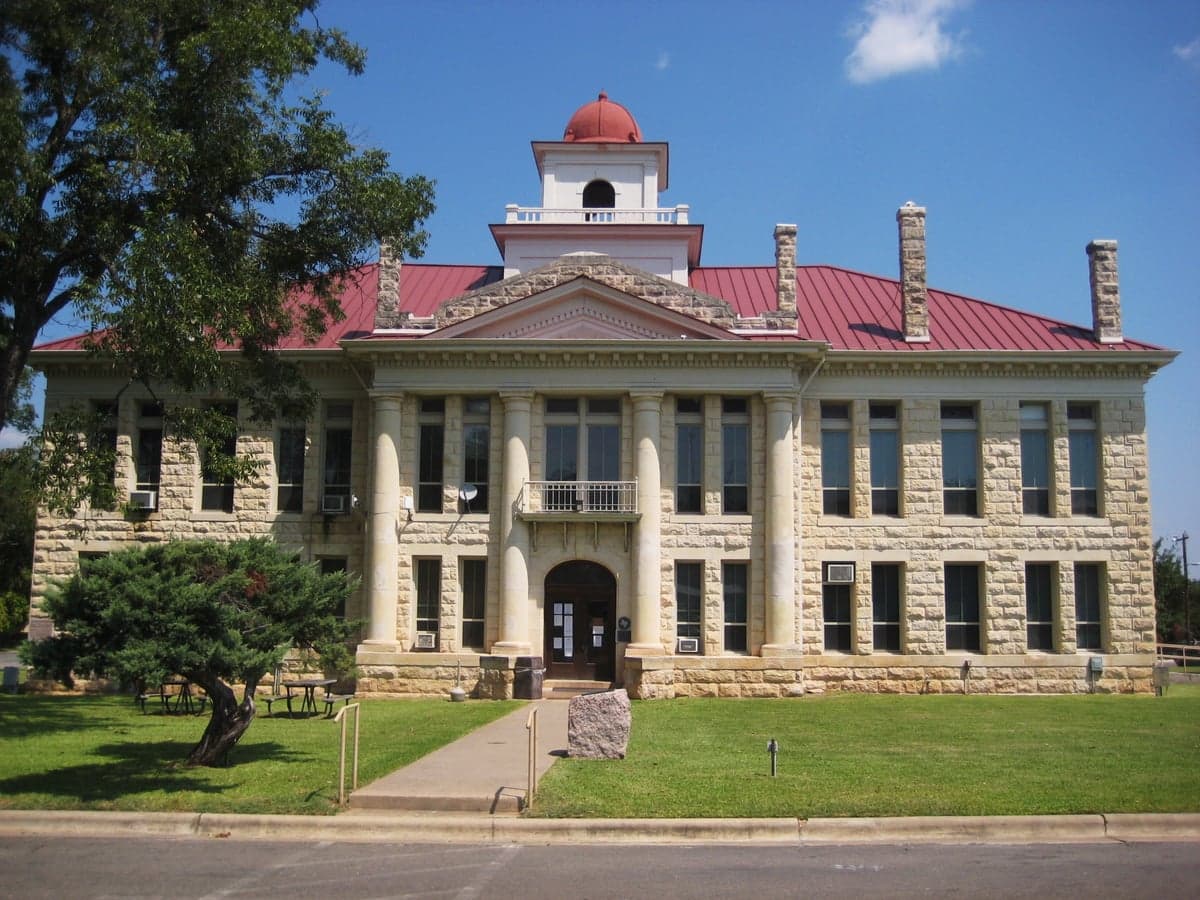
Photo: Wikipedia
Demographics of Blanco County
Affluence Level in Blanco County
An upper-middle-class area. Household wealth, education levels, and homeownership run ahead of national benchmarks.
People of Blanco County
Blanco County, Texas, is home to roughly 12,000 residents who maintain a distinctly rural, conservative character shaped by generations of German and Anglo settlement. The population is 76.0% white and 18.4% Hispanic, with a foreign-born share of just 2.9%—far below the national average—and 34.3% of adults hold a college degree. This is a place where family ranches, limestone hills, and small towns like Blanco and Johnson City anchor a way of life that prizes self-reliance, local governance, and a slow pace of change.
Settlement & growth (pre-1960)
Before European contact, the area now known as Blanco County was home to Lipan Apache and Comanche bands, who followed bison herds across the Edwards Plateau. Spanish expeditions passed through as early as the 17th century, but no permanent Spanish or Mexican settlements took root in the rugged Blanco River valley. The region remained a contested frontier until the mid-19th century.
Anglo-American settlement began in earnest after Texas joined the Union in 1845. The Texas legislature created Blanco County in 1858 from parts of Burnet, Comal, and Hays counties. The earliest settlers were primarily Anglo farmers and ranchers from the American South—Tennessee, Kentucky, and Missouri—drawn by cheap land grants and the promise of open range. They established the county seat of Blanco (originally called "Blanco City") in 1858, building a courthouse and a handful of stores along the Blanco River. A second wave of German immigrants arrived in the 1860s and 1870s, pushing up from the established German settlements in New Braunfels and Fredericksburg. These families—many bearing surnames like Klaerner, Pfeiffer, and Schmidt—settled around Round Mountain and Johnson City, bringing with them a tradition of stone masonry, tight-knit Lutheran congregations, and a preference for small, diversified farms over large plantations. By 1880, the county's population had reached roughly 1,500, overwhelmingly white and native-born, with a small number of Mexican-heritage families working as ranch hands.
The arrival of the Fredericksburg and Northern Railway in 1913 transformed the county's economy. The railroad connected Johnson City and Blanco to San Antonio and Austin, allowing ranchers to ship cattle and wool to market efficiently. Johnson City, named after early settler James Polk Johnson (a relative of future President Lyndon B. Johnson), grew into the county's commercial hub. The 1920s and 1930s saw a modest influx of Anglo families from the Dust Bowl regions of Oklahoma and the Texas Panhandle, who took up dryland farming and sheep ranching. The county's population peaked at around 4,000 in the 1930s, then declined slightly as mechanization reduced the need for farm labor. Through the 1950s, Blanco County remained overwhelmingly white, Protestant, and rural, with a small Hispanic minority concentrated in seasonal agricultural work around Hye and Stonewall.
Modern era (post-1965)
The 1965 Hart-Cellar Act had minimal direct impact on Blanco County. Unlike urban Texas counties that saw surges of Asian and Latin American immigration, Blanco County's foreign-born population remained below 3% through the 2020s. The county's demographic evolution since 1965 has been driven primarily by domestic migration—specifically, the suburban and exurban spillover from Austin and San Antonio. Beginning in the 1990s, professionals and retirees from the I-35 corridor began buying weekend ranches and building homes in Blanco, Johnson City, and the unincorporated areas around Fischer and Henly. This in-migration raised the county's college-educated share from roughly 15% in 1990 to 34.3% today, and pushed the median home price well above the state average for rural counties.
The Hispanic population grew from 8% in 1990 to 18.4% by 2024, driven by natural increase and a modest inflow of Mexican-heritage families working in construction, hospitality, and landscaping—industries tied to the region's tourism and second-home boom. However, the county has not developed a large immigrant enclave; most Hispanic residents are U.S.-born and English-dominant. The Black population remains negligible at 0.8%, and East/Southeast Asian communities account for just 0.4%, concentrated among a handful of professionals in Johnson City. The Indian-subcontinent population is effectively zero. The county's white population, while still the overwhelming majority, has declined from 85% in 2000 to 76.0% today, largely due to the growth of the Hispanic share.
Politically, Blanco County has become more uniformly conservative over the past two decades. In 2024, the county voted for Donald Trump by a margin of roughly 40 points, reflecting the cultural values of both the long-established ranching families and the newer exurban arrivals, who tend to be fiscally conservative and wary of Austin's progressive politics. The county's small-town character is fiercely defended; zoning is minimal, and development is largely limited to the two incorporated towns.
The future
Blanco County's population is projected to grow to roughly 15,000 by 2035, driven by continued exurban migration from Austin and San Antonio. This growth will likely be concentrated in the eastern half of the county, closer to the I-35 corridor, particularly around Johnson City and along the US-281 corridor. The Hispanic share is expected to rise slowly, reaching perhaps 22-25% by 2040, but the county will remain majority-white and culturally Anglo-German. The foreign-born share will likely stay below 5%, as the county lacks the industrial or service-sector jobs that attract large immigrant populations.
The most significant demographic tension will be between long-established ranching families and newer residents who commute to Austin or San Antonio. These newcomers tend to be more educated, wealthier, and more likely to support limited conservation measures and historic preservation—positions that can clash with the ranching community's emphasis on property rights and minimal regulation. However, both groups share a strong preference for low taxes, limited government, and traditional social values, which will likely prevent the kind of deep cultural polarization seen in more diverse exurban counties. The county is not tribalizing into distinct ethnic enclaves; rather, it is slowly homogenizing around a conservative, rural-suburban identity that absorbs newcomers into its existing norms.
For someone moving in now, Blanco County offers a stable, predictable demographic environment. The population is aging slightly—the median age is 48—but the influx of families with school-age children is keeping local schools viable. The county's character will remain that of a quiet, conservative hill-country retreat, with growth managed at a pace that preserves its open spaces and small-town feel. The biggest change will be the gradual replacement of working ranches with hobby farms and residential acreages, but the cultural and political identity of the people will shift only modestly.

* Values derived from national, state, county, city and local statistics and may differ in a specific area. Last updated: 2026-06-07T17:41:09.000Z
Narrative content on this page is AI-generated and may contain mistakes. Verify any details that matter before acting on them.
ReloMaps may earn a commission from affiliate links at no extra cost to you.

