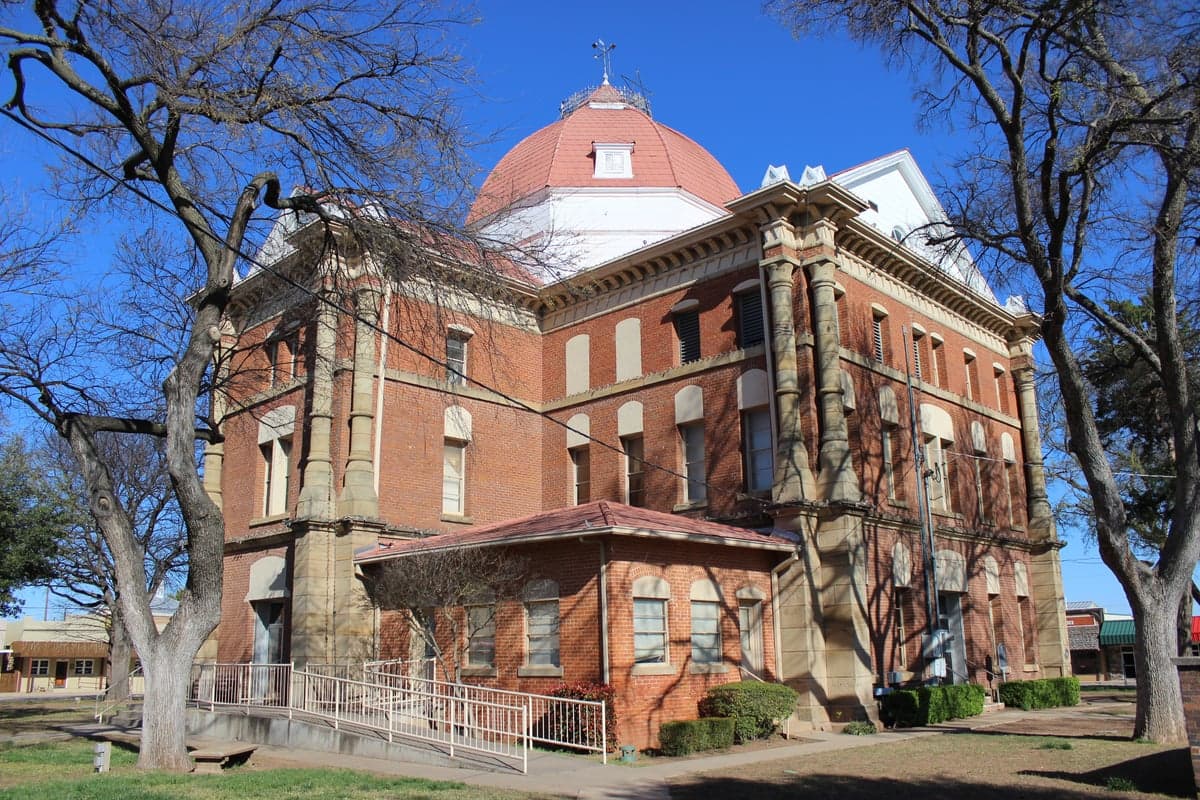
Photo: Wikipedia
Demographics of Clay County
Affluence Level in Clay County
A middle-class area roughly in line with national averages across income, home values, education, and employment.
People of Clay County
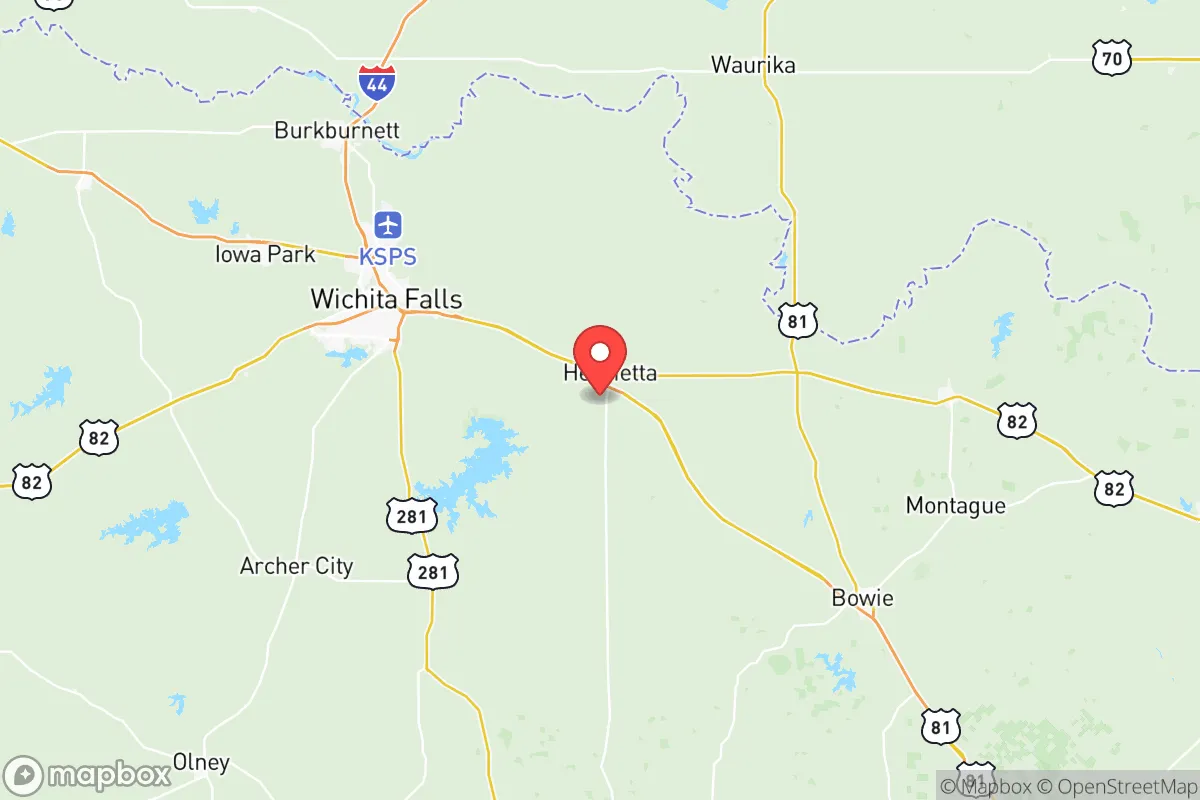
Clay County, Texas, today is a predominantly white, rural community of just over 10,400 residents, characterized by its deep agricultural roots, a strong sense of local independence, and a population density of roughly 12 people per square mile. With a foreign-born population under 1% and a Hispanic share of 6.8%, the county remains one of the least ethnically diverse in North Texas, a demographic profile shaped by over a century of steady, homogeneous settlement. The county seat, Henrietta, anchors the region's identity, while smaller communities like Petrolia and Byers reflect the enduring influence of the area's original Anglo-American settlers and the oil booms that briefly diversified the local economy.
Settlement & growth (pre-1960)
Before Anglo-American settlement, the area now known as Clay County was part of the traditional territory of the Wichita and Comanche nations. The Wichita people established villages along the Red River and its tributaries, including the Wichita River, practicing agriculture and trade. The Comanche, who became dominant in the 18th century, used the region as a hunting ground and a corridor for raids into Mexico. Spanish and French explorers passed through but established no permanent settlements, and the area remained largely outside European control until the mid-19th century.
Clay County was officially organized in 1860, carved from Cooke County as part of Texas's expansion into the Red River Valley. The first wave of settlers were primarily Anglo-Americans from the Upper South—Tennessee, Kentucky, and Missouri—who were drawn by the promise of cheap, fertile land under the Texas land-grant system. These early settlers established farms and ranches along the Red River, founding the county seat of Henrietta in 1860. The town's location on the Butterfield Overland Mail route gave it early economic importance as a stop for travelers and freight. The population grew slowly but steadily through the 1870s and 1880s, reaching about 5,000 by 1890, as more families from the South and Midwest arrived to cultivate cotton and raise cattle.
The arrival of the Fort Worth and Denver City Railway in 1882 transformed the county's economy and settlement patterns. The railroad connected Henrietta and the smaller town of Petrolia to regional markets, enabling the export of cattle, cotton, and grain. Petrolia, founded in the 1880s, became a shipping point for area farmers and ranchers. The discovery of oil in the nearby Electra field in 1911 brought a brief but significant boom to the county's southeastern corner, particularly around the town of Byers. Byers, originally a farming community, saw an influx of oil-field workers, many of whom were Anglo migrants from Oklahoma and other parts of Texas. This oil boom, while short-lived, added a working-class element to the county's otherwise agrarian character.
The Dust Bowl and the Great Depression of the 1930s hit Clay County hard, as cotton prices collapsed and drought devastated crops. Many families left for California or urban centers like Fort Worth and Dallas, but those who remained shifted toward diversified livestock farming and wheat production. The population peaked at around 14,000 in 1930 and then declined through the 1940s and 1950s as agricultural mechanization reduced the need for farm labor. The county's population in 1960 was roughly 9,000, a figure that would remain relatively stable for the next six decades. No significant immigrant groups arrived during this period; the county's population remained overwhelmingly native-born and white, with a small African American community concentrated in Henrietta and a handful of Hispanic families working in agriculture.
Modern era (post-1965)
The 1965 Hart-Cellar Act, which reshaped U.S. immigration policy, had virtually no effect on Clay County. The county's foreign-born population today stands at just 0.9%, far below the national average of roughly 14%. The few foreign-born residents who have arrived since the 1970s are primarily from Mexico and Central America, drawn by agricultural labor opportunities, particularly in the cattle and hay industries. These families have settled mainly in Henrietta and Petrolia, but their numbers remain small, and no distinct ethnic enclaves have formed.
Domestic migration has been the primary demographic force in the modern era, though it has been modest compared to the explosive growth seen in neighboring counties like Wichita and Denton. Clay County has experienced a slow but steady outflow of young adults seeking education and employment in larger cities, offset by an influx of retirees and second-home buyers from the Dallas-Fort Worth metroplex, roughly 90 miles to the south. These newcomers are predominantly white and middle-class, drawn by the county's low cost of living, rural character, and proximity to Lake Arrowhead and Lake Wichita for recreation. The towns of Henrietta and Byers have seen some new housing construction, but the county's overall population has remained flat, hovering between 10,000 and 11,000 since 1990.
The Hispanic share of the population has grown from roughly 3% in 1990 to 6.8% today, driven by natural increase and a small number of new arrivals working in agriculture and construction. The African American population, historically small, has declined from about 2% in 2000 to 1.1% today, reflecting outmigration to urban areas. The East/Southeast Asian population, at 0.9%, is almost entirely composed of a handful of families in Henrietta, many of whom are connected to the medical or academic sectors. The Indian subcontinent population is effectively zero. The county's college-educated share, at 23.9%, is below the Texas average of roughly 31%, reflecting the area's reliance on blue-collar and agricultural employment.
The future
Clay County's population is projected to remain stable or grow very slowly over the next 10 to 20 years, with no major demographic shifts on the horizon. The county's lack of major employment centers, limited housing stock, and distance from large cities make it unlikely to attract significant numbers of new residents from outside the region. The Hispanic share may continue to rise gradually, reaching perhaps 10-12% by 2040, driven by higher birth rates and continued migration into agricultural work. The white population will likely remain the overwhelming majority, though it may decline slightly as older residents pass away and younger adults continue to leave for urban areas.
The county's cultural identity is likely to remain rooted in its rural, conservative, and Anglo-American heritage. Newcomers from the Dallas-Fort Worth area may bring some suburban sensibilities, but their numbers are too small to shift the county's political or social character. The towns of Henrietta, Petrolia, and Byers will continue to function as service centers for the surrounding agricultural community, with little diversification of the local economy or population. The county's school districts, including Henrietta ISD and Petrolia ISD, will likely see flat or declining enrollment, with no major influx of students from immigrant or minority families.
For someone moving in now, Clay County offers a stable, predictable, and deeply traditional community where change comes slowly. The population is homogeneous, the economy is tied to agriculture and small-town services, and the social fabric is built around churches, schools, and family networks. Those seeking ethnic diversity, rapid growth, or urban amenities will not find them here. But for those who value quiet, low-cost rural living with a strong sense of local identity, Clay County remains a place where the past century's demographic patterns are likely to persist for decades to come.

* Values derived from national, state, county, city and local statistics and may differ in a specific area. Last updated: 2026-08-08T13:35:36.000Z
Narrative content on this page is AI-generated and may contain mistakes. Verify any details that matter before acting on them.
ReloMaps may earn a commission from affiliate links at no extra cost to you.

