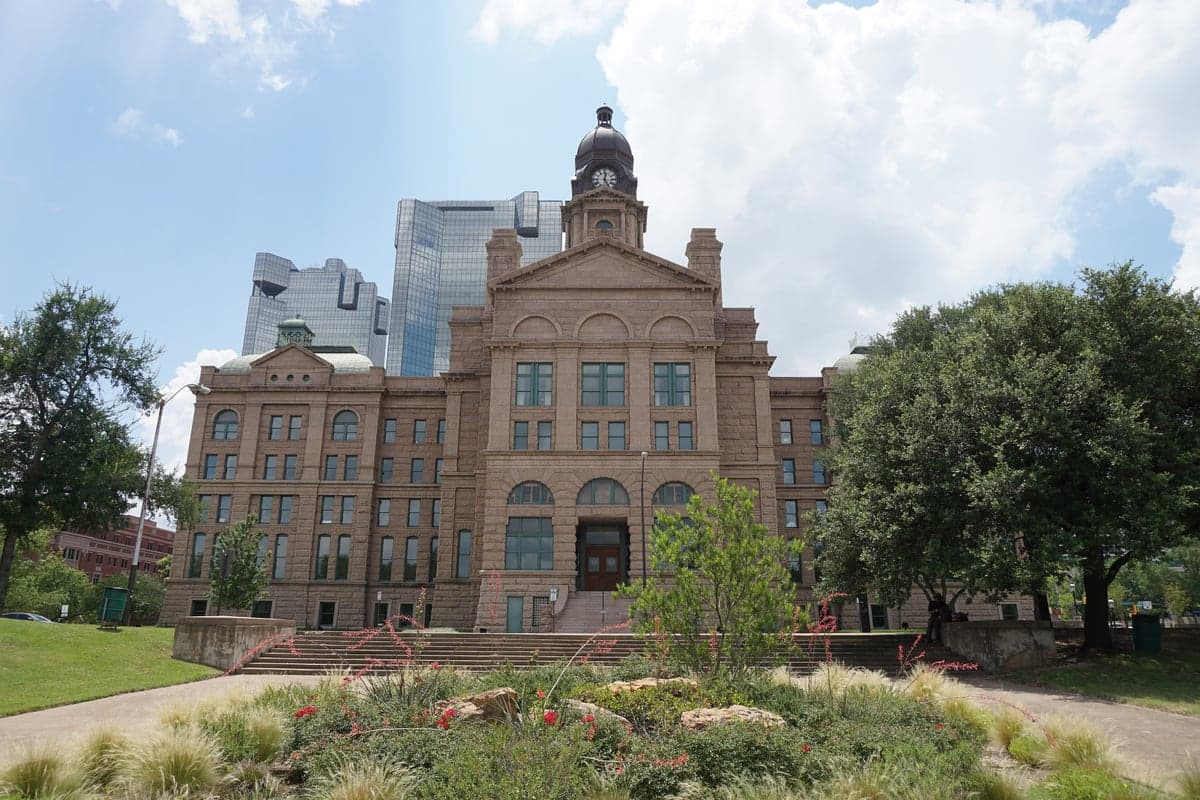
Photo: Wikipedia
Demographics of Tarrant County
Affluence Level in Tarrant County
A middle-class area roughly in line with national averages across income, home values, education, and employment.
People of Tarrant County
Tarrant County, home to over 2.1 million residents, is a demographic crossroads where the historic white Protestant majority (43.2% of the population) now shares the landscape with a substantial Hispanic community (29.9%), a significant Black population (17.2%), and growing East/Southeast Asian (3.7%) and Indian (2.1%) enclaves. The county's identity is defined by its role as the industrial and aviation heart of North Texas, anchored by Fort Worth's stockyards and defense plants, yet its people are increasingly suburban, diverse, and politically conservative-leaning. With only 9.6% foreign-born, Tarrant County remains more native-born than Dallas or Houston, but its future is being reshaped by domestic migration from the coasts and Rust Belt, as well as steady Hispanic and Asian growth.
Settlement & growth (pre-1960)
Before Anglo-American settlement, the region was home to the Wichita and Comanche peoples, who used the Trinity River valley for hunting and seasonal camps. Spanish explorers passed through in the 16th and 17th centuries, but no permanent Spanish or French settlements took root in what is now Tarrant County. The first permanent Anglo settlers arrived in the 1840s, after Texas annexation, when the Peters Colony land grant program attracted farmers from the Upper South—primarily Tennessee, Kentucky, and Missouri. These early settlers were overwhelmingly Scots-Irish and English, and they founded the county seat of Fort Worth in 1849 as a military outpost on the Trinity River. The town grew slowly as a trading post for cattle drives, with the Chisholm Trail passing through in the 1860s and 1870s.
The railroad's arrival in 1876 transformed Fort Worth into a livestock shipping hub, drawing a wave of German and Czech immigrants who settled in the surrounding farmlands, particularly around Arlington and Grapevine. These groups established small farming communities and churches, and their descendants remain visible in the county's older rural pockets. The post-Civil War period also saw the first significant Black migration to Tarrant County, as freedmen moved to Fort Worth's Stop Six neighborhood and the Como area, working as laborers, domestics, and later in the meatpacking plants. By 1900, Fort Worth's population was about 26,000, with a Black share of roughly 15%.
The early 20th century brought two transformative waves. First, the discovery of oil in the nearby Ranger field in 1917 turned Fort Worth into a petroleum finance center, drawing white and Black workers from East Texas and Oklahoma. Second, World War II and the Cold War established Tarrant County as a defense manufacturing hub. The construction of Naval Air Station Joint Reserve Base Fort Worth (now NAS Fort Worth JRB) and the arrival of Convair (later General Dynamics, now Lockheed Martin) in the 1940s pulled in thousands of workers from across the Midwest and South. The White Settlement area, named for its early white homesteaders, became a bedroom community for defense plant employees. The Dust Bowl of the 1930s also drove a wave of "Okies" and Arkies into the county, settling in working-class neighborhoods like Polytechnic Heights in Fort Worth. By 1960, Tarrant County's population had reached 538,000, with a white share above 85% and a Black share of about 10%.
Modern era (post-1965)
The 1965 Hart-Cellar Act had a modest direct effect on Tarrant County compared to coastal metros, but its indirect consequences reshaped the county through chain migration and suburbanization. The first post-1965 immigrant wave was Mexican and Central American, drawn by agricultural and construction work in the 1970s and 1980s. These families settled in Fort Worth's North Side neighborhood, around the historic stockyards, and in Eagle Mountain Lake area. The Hispanic share of the county rose from 5% in 1970 to 15% by 1990, and today stands at 29.9%.
The 1980s and 1990s saw the arrival of East/Southeast Asian communities, particularly Vietnamese and Chinese, who came as refugees and professionals. They concentrated in Arlington and Haltom City, where a small but visible Vietnamese commercial corridor developed along Belknap Street. The Indian subcontinent community, now 2.1% of the county, grew later, in the 2000s and 2010s, driven by tech and medical professionals working at Lockheed Martin, Texas Health Resources, and the University of Texas at Arlington. Their enclaves are less concentrated than in Dallas's suburbs, but Southlake and Colleyville have notable Indian populations.
The most dramatic modern shift, however, has been domestic migration. Since the 1990s, Tarrant County has absorbed tens of thousands of relocating families from California, the Northeast, and the Rust Belt, drawn by lower housing costs, no state income tax, and job growth in logistics, healthcare, and aviation. This in-migration has been predominantly white and Hispanic, but also includes a growing number of Black professionals moving from the Midwest. The county's Black population, historically concentrated in Fort Worth's east side and Forest Hill, has suburbanized into Mansfield and Arlington, where Black share now exceeds 20% in some census tracts. Suburbanization has been the dominant pattern: the city of Fort Worth grew from 447,000 in 1980 to 978,000 in 2024, but the unincorporated and small-town population exploded even faster, with Keller, Flower Mound, and North Richland Hills each quintupling in size since 1980.
The future
Tarrant County's population is projected to reach 2.5 million by 2035, driven primarily by natural increase among Hispanic families and continued domestic in-migration. The county is not homogenizing into a single melting pot; rather, it is tribalizing into distinct suburban enclaves. The white population is aging and declining as a share, but remains the largest single group. Hispanic growth is concentrated in Fort Worth's north and east sides, as well as in Euless and Bedford, where Hispanic share now exceeds 35%. East/Southeast Asian communities are growing slowly but steadily, with Arlington emerging as a regional hub for Vietnamese and Korean businesses. The Indian community is growing faster, but from a small base, and is likely to remain a professional, suburban cohort rather than forming a dense ethnic enclave.
The cultural identity of Tarrant County is being reshaped by its newcomers. The historic cowboy-and-defense-worker ethos is giving way to a more suburban, family-oriented conservatism, exemplified by the politics of Southlake and Keller, where school board battles over curriculum have become national news. The county voted for Donald Trump by 11 points in 2024, but the margin has narrowed from 15 points in 2016, driven by Hispanic and Asian suburban voters who lean more moderate than the white base. The next decade will likely see continued Hispanic growth, plateauing Black share, and slow but steady Asian and Indian expansion, all while the white population remains the largest single group but no longer a majority.
For someone moving in now, Tarrant County offers a conservative-leaning, family-oriented environment with strong job growth in aviation, logistics, and healthcare, but with increasing diversity that is reshaping schools, churches, and local politics. The county is becoming more suburban, more Hispanic, and more politically contested, but its core identity as a place of affordable homes, good schools, and traditional values remains intact. The key question for newcomers is which enclave they choose—the historic white suburbs of the north, the diverse family communities of the south, or the rapidly changing neighborhoods of Fort Worth itself.

* Values derived from national, state, county, city and local statistics and may differ in a specific area. Last updated: 2026-04-13T02:41:30.000Z
Narrative content on this page is AI-generated and may contain mistakes. Verify any details that matter before acting on them.
ReloMaps may earn a commission from affiliate links at no extra cost to you.

