Demographics of Trophy Club, TX
Affluence Level in Trophy Club, TX
A wealthy area with high-earning, well-educated households. Incomes, home values, and educational attainment meaningfully outpace national averages.
People of Trophy Club, TX
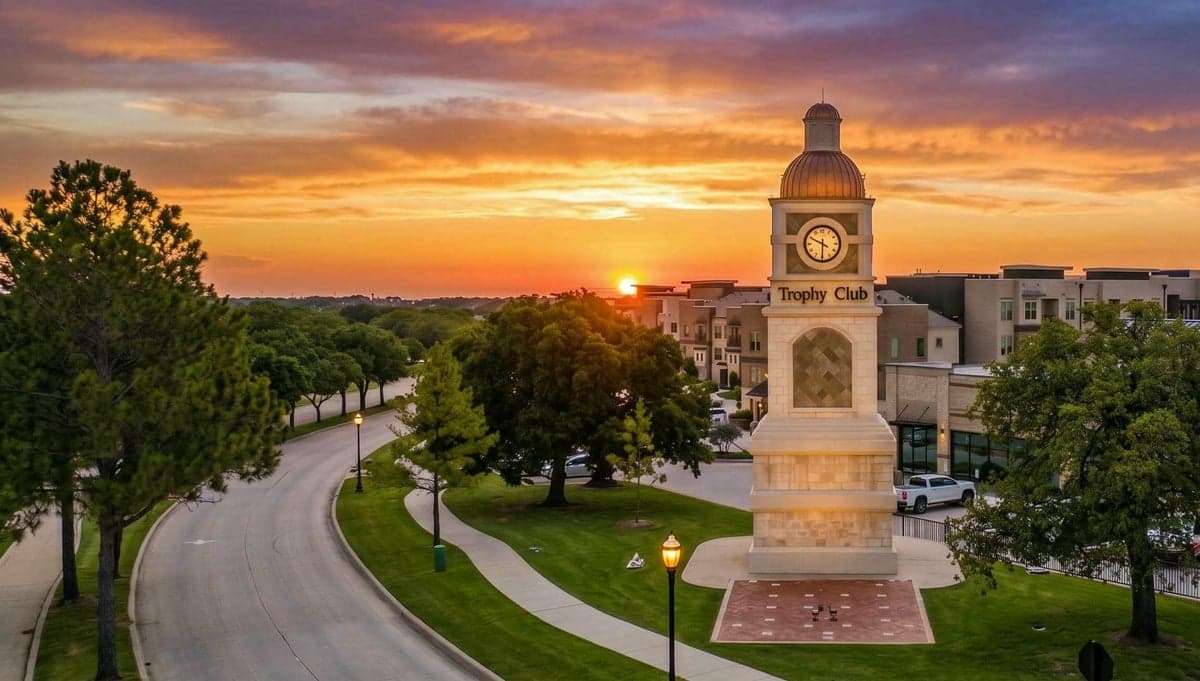
Trophy Club, Texas, is a master-planned community of 13,454 residents that blends suburban affluence with a distinct small-town identity. The population is predominantly White (74.6%), with notable and growing Asian (4.5%) and Indian (4.1%) communities, a Hispanic population of 11.7%, and a very small Black population of 1.1%. With 68.4% of adults holding a college degree and a foreign-born share of just 3.2%, Trophy Club is a highly educated, largely native-born enclave that prizes its golf-course lifestyle, low crime, and proximity to both Fort Worth and DFW Airport.
How the city was settled and grew
Trophy Club is a genuinely post-1900 planned community, not a historic settlement. The land was originally part of the Peters Colony land grants in the 1840s, attracting Anglo-American farmers and ranchers who established scattered homesteads in what is now far-northwest Tarrant County. No significant town formed here until the 1970s. The area remained sparsely populated ranchland for over a century, with the only early cluster being the small, unincorporated community of Avondale (now a neighborhood within Trophy Club) along the old Denton Highway. The original population was entirely Anglo, drawn by cheap grazing land and the promise of the expanding Fort Worth stockyards economy.
Modern era (post-1965)
Trophy Club's modern population history begins in 1973, when developer Ben Carpenter envisioned a golf-course community on the former Circle T Ranch. The first wave of residents were upper-middle-class White families from Dallas and Fort Worth seeking larger lots and a resort-style setting. They built homes in the original Golf Course Estates and The Hills neighborhoods, which remain the core of the community's identity. The city incorporated in 1985, and growth accelerated through the 1990s and 2000s as the Dallas-Fort Worth metroplex expanded northwest. A second wave of domestic in-migration brought professionals from the Northeast and California, attracted by Trophy Club's reputation for top-rated schools (Northwest ISD) and low property taxes relative to Collin County. These newcomers filled the Pecan Creek and Whispering Oaks subdivisions, which offer newer, larger homes. The Indian and East/Southeast Asian populations began arriving in the 2010s, drawn by tech and healthcare jobs in nearby Las Colinas and the Alliance Corridor. These families concentrated in the Lake Forest and Estates at Trophy Club sections, where newer construction and larger floor plans appealed to multigenerational households. The Hispanic population, at 11.7%, is largely composed of long-term Tarrant County families who moved into the Avondale area and the older, more affordable homes near the original golf course. The Black population remains very small (1.1%), reflecting Trophy Club's historical lack of diversity and the high entry cost of its housing market.
The future
Trophy Club is homogenizing in income and education but slowly diversifying in ethnicity. The White share has declined from over 85% in 2000 to 74.6% today, driven entirely by the growth of Indian and East/Southeast Asian families. These groups are not forming separate enclaves; they are assimilating into the same neighborhoods, particularly Lake Forest and Estates at Trophy Club, and their children attend the same schools. The Hispanic population is plateauing, as the area's high home prices ($600,000+ median) limit in-migration from lower-income households. The foreign-born share (3.2%) is low and stable, indicating that most new residents are domestic movers. Over the next 10–20 years, Trophy Club will likely become slightly more Asian and Indian (projected to reach 6–7% each), while remaining overwhelmingly White and college-educated. The city is not tribalizing into distinct ethnic zones; rather, it is becoming a more diverse but still highly affluent, culturally conservative suburb where property values and school rankings drive all demographic decisions.
For a conservative-leaning mover today, Trophy Club offers a stable, low-crime environment with excellent schools and a strong sense of community identity. The population is becoming more ethnically varied but remains culturally unified around family values, outdoor recreation, and fiscal conservatism. New arrivals will find a place where the golf course and the homeowners' association define daily life more than any ethnic or political divide.

* Values derived from national, state, county, city and local statistics and may differ in a specific area. Last updated: 2026-05-16T22:26:59.000Z
Narrative content on this page is AI-generated and may contain mistakes. Verify any details that matter before acting on them.
ReloMaps may earn a commission from affiliate links at no extra cost to you.

