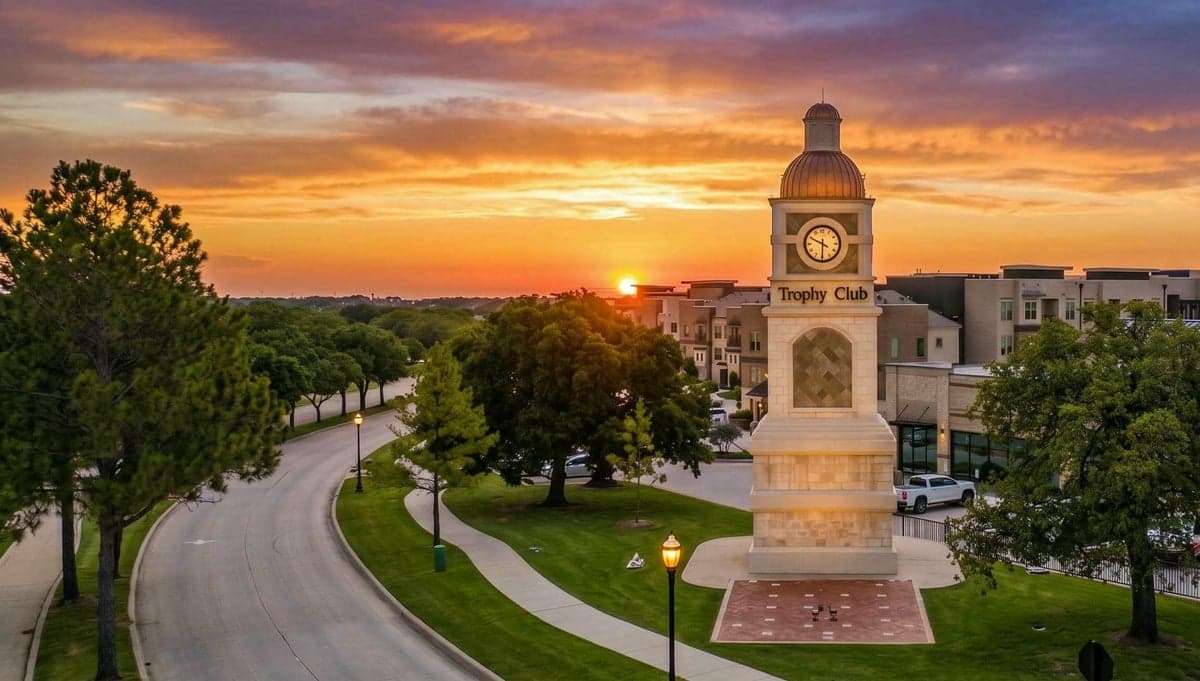
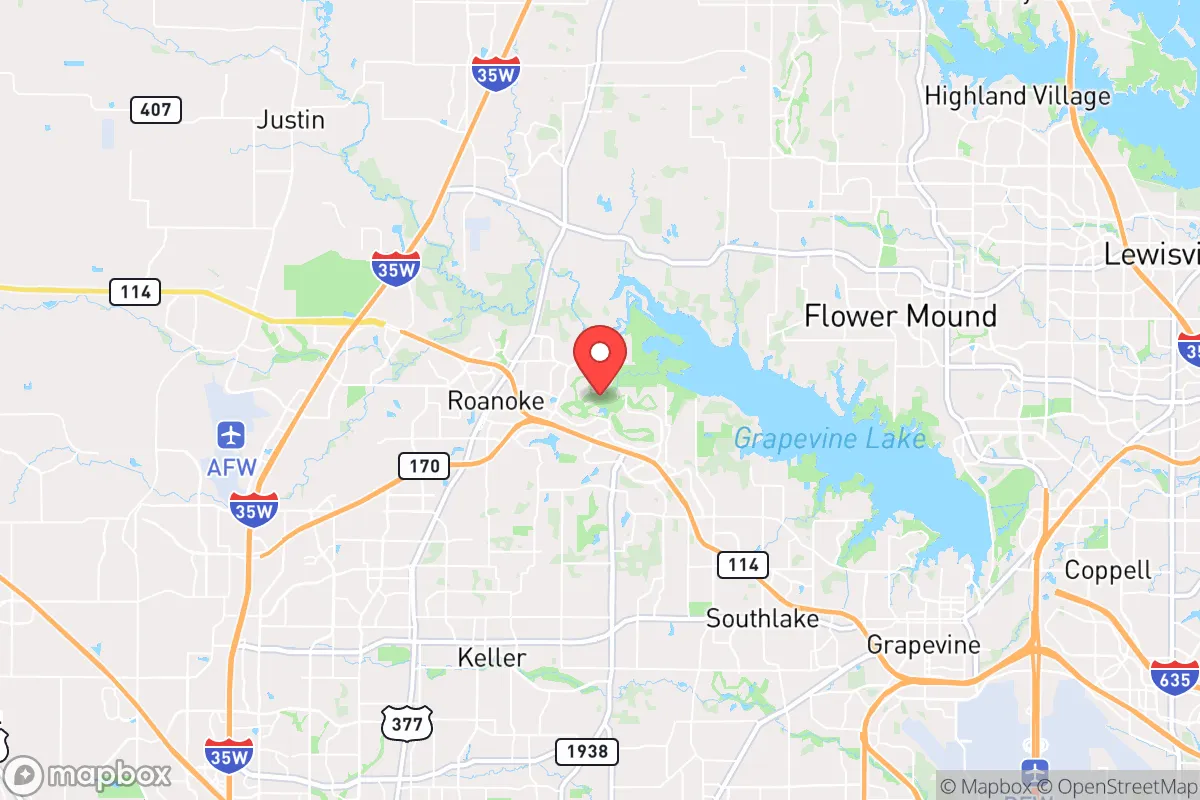
Personal Sovereignty in Trophy Club, TX
Strong independent fundamentals that actively favor personal liberty and low regulation.
What does Personal Sovereignty tell us?
Personal Sovereignty measures your capacity for self-reliance and independence with minimal government friction. Higher scores mean fewer barriers between you and the way you want to live... but it assumes you have the space you need and good neighbors.
What does this tell us?
Personal Sovereignty measures your capacity for self-reliance and independence with minimal government friction. Higher scores mean fewer barriers between you and the way you want to live... but it assumes you have the space you need and good neighbors.
State Policy
Energy independence: Net exporter (220% of energy produced in-state)
Personal Liberty
Homesteading

Personal Liberty Analysis
Trophy Club, Texas, offers a notably high degree of personal sovereignty compared to most suburban enclaves in the United States, largely because it sits within a state that has aggressively pushed back against federal overreach and maintains a legal framework that prioritizes individual autonomy. For the strategic-minded individual or family concerned with preserving freedom in an era of expanding government control, this community provides a rare blend of small-town governance, low regulatory burden, and a legal culture that respects the right to self-determination. The key question for anyone evaluating this area is whether the local HOA and municipal ordinances create meaningful friction against the broader state-level protections, and the answer is nuanced but generally favorable for those who value liberty.
Tax burden and regulatory posture: How Texas state law limits local overreach
The most immediate advantage for personal sovereignty in Trophy Club is the absence of a state income tax, which directly reduces the government's claim on your earnings and leaves more capital in your hands for self-reliance investments. Texas operates under a property-tax-heavy system, and Trophy Club's effective property tax rate hovers around 2.1% of assessed value, which is moderate for the Dallas-Fort Worth metroplex but still significant. However, the state's Proposition 2 (2023) and Proposition 4 (2023) have tightened appraisal caps and increased homestead exemptions, meaning your tax burden is more predictable and less subject to inflationary government grabs. On the regulatory front, Texas has no statewide building codes in unincorporated areas, and while Trophy Club is incorporated and enforces its own codes, they are generally aligned with the International Residential Code (IRC) rather than more restrictive local amendments found in cities like Austin or Dallas. The town's zoning is primarily residential, with minimal commercial interference, and there are no city-level rent control or business licensing schemes that would choke personal enterprise. For a prepper or survivalist, the key takeaway is that Texas law preempts many local ordinances that would infringe on property rights—such as bans on rainwater harvesting, solar panels, or backyard chickens—though Trophy Club's HOA covenants may impose their own restrictions, which we'll address later.
Self-defense and gun law specifics: Constitutional carry and castle doctrine in practice
Texas is a constitutional carry state as of September 2021, meaning any law-abiding adult 21 or older can carry a handgun openly or concealed without a permit, and Trophy Club residents enjoy this right fully within town limits. The state's castle doctrine (Texas Penal Code §9.32) is among the strongest in the nation, establishing no duty to retreat in your home, vehicle, or workplace, and providing civil immunity for justified use of deadly force. This is critical for a survivalist mindset: if a threat enters your property, the law is on your side. Additionally, Texas has preempted local governments from enacting their own gun control ordinances, so Trophy Club cannot ban firearms in parks, libraries, or other public spaces—a stark contrast to cities like Denver or Seattle where local officials have tried to circumvent state law. The only practical limitation is that private businesses and HOAs can post signage prohibiting firearms, and Trophy Club's HOA does not currently restrict legal carry on common areas, but individual homeowners should verify their specific subdivision covenants. For those concerned about government overreach, Texas also has a Second Amendment Sanctuary County resolution in Denton County (which covers Trophy Club), meaning local law enforcement has formally stated they will not enforce federal gun laws they deem unconstitutional. This is a concrete, actionable protection that few suburban communities can offer.
Self-reliance and homesteading viability: Lot sizes, zoning, and off-grid feasibility
Trophy Club's residential lots average between 0.25 and 0.5 acres in the older sections, with newer developments offering slightly larger parcels, but this is not rural homesteading territory. The town's zoning is strictly residential, and the HOA covenants are detailed—they restrict things like outdoor storage of equipment, vehicle repair, and the keeping of livestock (chickens are generally prohibited unless specifically allowed by subdivision). For a serious prepper looking to raise food, store bulk supplies, or install off-grid infrastructure, these restrictions are a meaningful constraint. However, Texas state law provides some relief: Texas Property Code §202.001 prohibits HOAs from banning rainwater harvesting systems, and Texas Government Code §2306.005 prevents HOAs from restricting solar panel installation unless they pose a safety hazard. So you can legally install solar panels and a rainwater collection system, but you cannot keep goats or build a root cellar without HOA approval. The practical workaround is to purchase a lot in the unincorporated areas just outside Trophy Club's town limits—places like Bartonville or Lantana—where county zoning is far more permissive and lot sizes can exceed 1 acre. For those committed to Trophy Club itself, the best strategy is to buy a home with an existing workshop or garage that can be converted into a secure storage and prep space, and to rely on community gardens or local farmers' markets for fresh food rather than on-site production.
Personal liberties: Parental rights, medical autonomy, speech, and property
Texas has become a national leader in protecting parental rights, with House Bill 4545 (2023) requiring school districts to obtain parental consent before administering any medical or mental health survey, and Senate Bill 14 (2023) prohibiting school employees from withholding information about a child's gender identity or medical care from parents. Trophy Club is served by the Northwest Independent School District (NISD), which has publicly stated its compliance with these laws, meaning parents retain significant control over their children's education and medical decisions. On medical autonomy, Texas has banned COVID-19 vaccine mandates for private employers and government entities, and the state's Health and Safety Code §161.0085 prohibits any entity from requiring an individual to receive a vaccine that has not been fully approved by the FDA (which applies to all vaccines under Emergency Use Authorization). This is a concrete protection for those wary of government-mandated medical interventions. Free speech is robustly protected under the Texas Religious Freedom Restoration Act (TRFRA), which requires the government to prove a compelling interest before burdening religious exercise—a powerful tool against local ordinances that might restrict church gatherings or religious expression. Property rights are further secured by Texas Property Code §92.001, which gives homeowners the right to display political signs (within reasonable size limits) and prohibits HOAs from banning the display of the American flag or the Texas flag. The only notable limitation is that Trophy Club's HOA can restrict signage during election periods, but this is a minor inconvenience compared to the broad protections elsewhere.
In the final analysis, Trophy Club offers a strong baseline of personal sovereignty that is rare in suburban America, but it is not a libertarian paradise. The state-level protections—constitutional carry, parental rights, medical autonomy, and property rights—are among the best in the nation, and the town's low crime rate and responsive local government mean you are unlikely to face the kind of bureaucratic harassment common in larger cities. However, the HOA covenants and relatively small lot sizes impose real limits on self-reliance and off-grid living, making this a better fit for someone who values legal autonomy and community stability over full homesteading independence. For the strategic relocator who wants to be within 30 minutes of Fort Worth's job market while retaining the ability to defend their family, control their medical decisions, and keep more of their income, Trophy Club ranks highly—especially when compared to similarly affluent suburbs in blue states where local governments actively undermine state-level freedoms. The bottom line: if you can live with an HOA that tells you what color your mailbox can be, but won't tell you what you can teach your kids or whether you can carry a gun, this is a solid choice.

* Values derived from national, state, county, city and local statistics and may differ in a specific area. Last updated: 2026-05-16T22:26:59.000Z
Narrative content on this page is AI-generated and may contain mistakes. Verify any details that matter before acting on them.
ReloMaps may earn a commission from affiliate links at no extra cost to you.

