Political ClimatePolitical Climate in Hopewell City County
Showing state-level results — no local-only data available.
Local Political AnalysisPolitical Analysis of Hopewell City County
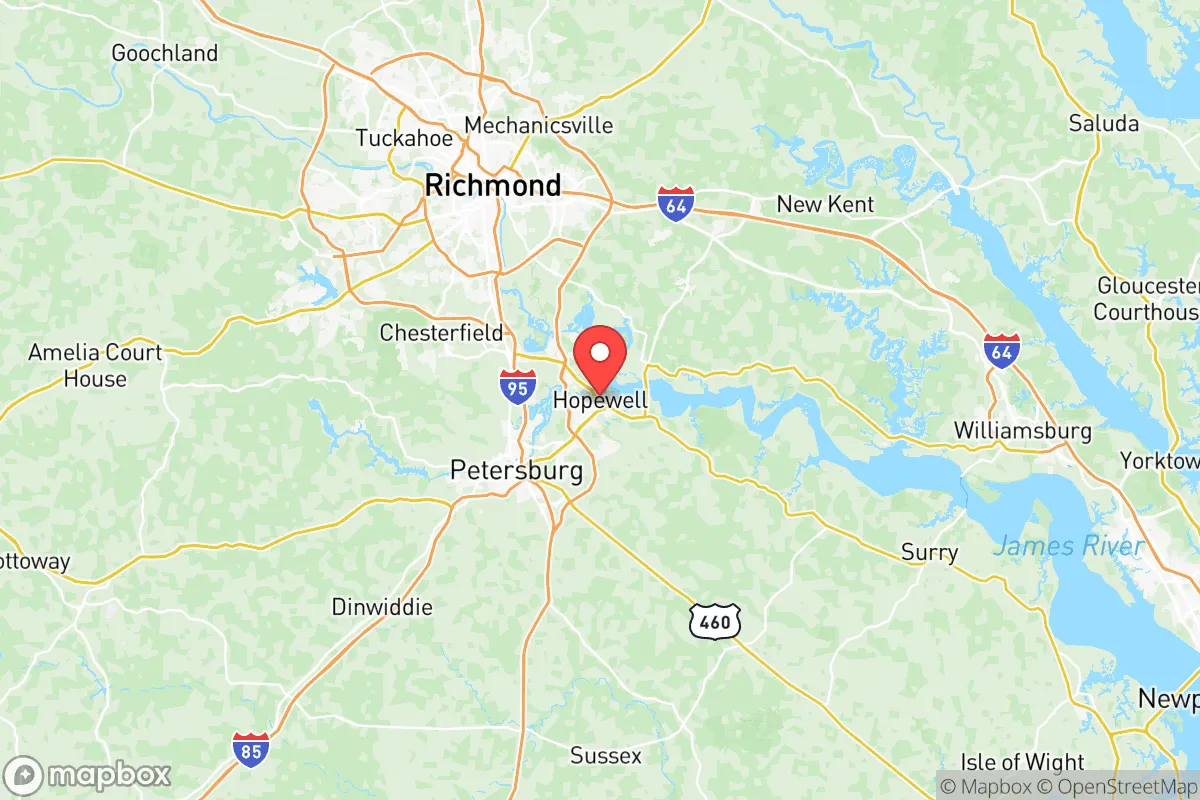
Hopewell City County, VA, is a solidly Democratic stronghold with a Cook Partisan Voting Index (PVI) of D+17, making it one of the most reliably blue jurisdictions in the state. This isn't a recent shift—the city has voted for Democratic presidential candidates by wide margins for decades, with the 2020 election seeing Joe Biden carry the county by roughly 30 points. The political DNA here is deeply working-class and union-influenced, a legacy of the city's industrial roots in chemical manufacturing and paper milling. While the national Democratic brand has evolved, Hopewell's local Democratic machine remains focused on bread-and-butter issues like job retention at major employers like Honeywell and Smurfit-Stone, rather than the cultural flashpoints that dominate national headlines.
How it compares
Compared to the rest of Virginia, which has a PVI of D+4, Hopewell is significantly more Democratic—about 13 points bluer on the index. The state as a whole is a competitive purple-to-light-blue entity, driven by the massive suburban vote in Northern Virginia and the growing urban centers of Richmond and Hampton Roads. Hopewell, by contrast, is a small, dense city of about 22,000 people where the Democratic advantage is baked into the local electorate. There's no real internal political variation within Hopewell City County because it's an independent city—there are no towns or precincts with distinct names to point to. The entire county is the city. That said, the precincts near the industrial corridor along the Appomattox River tend to be the most reliably blue, while the more residential areas near the city's western edge, closer to Prince George County, can sometimes show slightly more competitive numbers, though still comfortably Democratic. The real contrast is with the surrounding counties: Chesterfield County to the north and Prince George County to the east are both reliably Republican, creating a sharp political border that makes Hopewell feel like a blue island in a red sea.
What this means for residents
For liberal residents, Hopewell offers a rare sense of political alignment in a region that otherwise leans conservative. Local elections are dominated by Democrats, and the city council and school board tend to reflect that majority. Progressive policy priorities—like funding for public housing, support for the local community college (Richard Bland College), and maintaining the city's safety net programs—get a more sympathetic hearing here than in neighboring jurisdictions. For conservative residents, the reality is that they are a clear minority in local politics, but not an invisible one. The city's small size means that personal relationships still matter more than party labels in many local decisions, and conservative voices are often heard on fiscal issues, especially regarding tax rates and economic development incentives. The practical effect of the D+17 lean is that national Republican candidates rarely campaign here, but local GOP candidates can still be competitive in city council races if they focus on local issues like infrastructure and public safety rather than national culture wars.
One cultural distinction worth noting: Hopewell's political identity is more "old-school" Democratic than the progressive activism seen in Richmond or Northern Virginia. The city's Democratic voters are older, more moderate, and more focused on industrial jobs and union protections than on the social justice movements that define the party's left flank. This creates a unique political culture where a conservative resident might find common ground with a liberal neighbor on issues like opposing new environmental regulations that could threaten local manufacturing jobs. The trajectory is stable—there's no sign of the city flipping red anytime soon, but also no indication of it moving further left. Hopewell is what it is: a reliably blue, working-class city that votes its economic interests first and foremost.

State Political ClimatePolitical Climate in Virginia
State Political AnalysisPolitical Environment in the State
Virginia has shifted from a reliably purple swing state to a solidly Democratic-leaning one over the past two decades, with a Cook PVI of D+4. The dominant coalition is a growing suburban and exurban voting bloc, powered by the D.C. metro area’s federal workforce and tech sector, combined with the state’s increasingly diverse population. This marks a dramatic reversal from the early 2000s, when Virginia was a perennial battleground that voted Republican in five of six presidential elections from 1968 to 2004; since 2008, it has voted Democratic in every presidential contest, often by margins of 5-10 points.
Urban vs. rural divide
The political map of Virginia is a textbook case of the urban-rural split. The Democratic stronghold is the densely populated Northern Virginia crescent—Arlington, Alexandria, Fairfax, Loudoun, and Prince William counties—which alone accounts for roughly one-third of the state’s vote. These suburbs are dominated by federal employees, defense contractors, and tech workers, and they vote Democratic by margins of 20-40 points. The other major blue anchor is the Richmond metro area, particularly the city itself and Henrico County, plus the Hampton Roads region around Norfolk and Virginia Beach, where military and port workers lean left. In contrast, rural and exurban areas are deeply Republican. Southwest Virginia—places like Bristol, Abingdon, and Wytheville—votes Republican by 40-60 points, driven by coal country, manufacturing, and evangelical voters. The Shenandoah Valley (e.g., Harrisonburg, Staunton) is more competitive but still leans right. The key swing counties are the outer suburbs and exurbs: Loudoun County flipped from red to deep blue between 2008 and 2020, while Chesterfield and Hanover counties near Richmond remain Republican but are trending purple. The result is a state where Democrats win statewide by piling up huge margins in NoVA and Richmond, while Republicans dominate the landmass but lack the population density to overcome that deficit.
Policy environment
Virginia’s policy environment is a mixed bag that reflects its purple-to-blue trajectory. The state has a flat income tax rate of 5.75% (as of 2026), with no local income taxes, and a state sales tax of 4.3% (plus local add-ons up to 2.7%). Property taxes are set locally and vary widely—Loudoun County has rates around $1.20 per $100 of assessed value, while Bristol is closer to $0.80. The state’s regulatory posture is moderate: it’s a right-to-work state (no forced union membership), but it has adopted many environmental regulations aligned with the Regional Greenhouse Gas Initiative (RGGI), which Virginia joined in 2021 and then left in 2023 under Governor Glenn Youngkin. Education policy is a flashpoint: the state has a strong public school system, but school choice is limited—there are no private school vouchers, though charter schools exist in a few districts. Healthcare is relatively progressive: Virginia expanded Medicaid in 2019 under a bipartisan deal, covering roughly 400,000 additional residents. Election laws are moderately restrictive: the state requires a photo ID to vote, but also offers no-excuse absentee voting and same-day voter registration during early voting. The governor’s office is term-limited to one consecutive term, which keeps the political cycle short and unpredictable.
Recent policy direction
Virginia’s recent policy direction has been a tug-of-war between the Democratic legislature and Republican Governor Youngkin, who took office in 2022. On gun and self-defense law, the state has moved left: in 2020, Democrats passed a package including universal background checks, a one-handgun-per-month limit, and a “red flag” law allowing temporary seizure of firearms from individuals deemed a threat. Youngkin has been unable to roll these back due to Democratic control of the state Senate. On parental and education rights, Youngkin made this a signature issue, issuing executive orders banning “inherently divisive concepts” in schools and requiring parental notification of curriculum changes. The legislature has blocked most of these, but local school boards in conservative areas like Hanover County have adopted their own policies. On speech and privacy, Virginia passed the Consumer Data Protection Act in 2021, one of the strongest state privacy laws, giving residents control over how companies use their personal data. On medical and bodily autonomy, the state has become a regional haven: abortion remains legal up to 26 weeks (with a 24-hour waiting period), and in 2024, Democrats passed a constitutional amendment to enshrine abortion rights, which will appear on the ballot in 2026. On property rights, Virginia is a “Dillon’s Rule” state, meaning local governments have only the powers explicitly granted by the state—this limits local zoning and land-use control, but also gives the state legislature significant power over development. On taxation, Youngkin has pushed for a reduction in the income tax rate (from 5.75% to 5.5%), but the Democratic legislature has resisted, instead offering a one-time tax rebate in 2023. On voting and ballot access, the state has expanded access: no-excuse absentee voting, 45 days of early voting, and automatic voter registration at the DMV are all in place.
Civil unrest & political movements
Virginia has been a flashpoint for political movements on both sides. The 2017 Unite the Right rally in Charlottesville remains the most infamous event, where white nationalist groups clashed with counter-protesters, resulting in the death of Heather Heyer. That event galvanized the state’s shift left, with Democrats winning control of the legislature in 2019. On the right, the 2021 “Parents Matter” movement in Loudoun County—sparked by controversies over critical race theory and transgender policies in schools—helped propel Youngkin to victory. Immigration politics are less heated than in border states, but Northern Virginia has several sanctuary jurisdictions (e.g., Arlington County and Alexandria) that limit cooperation with federal immigration enforcement, while rural areas like Augusta County have passed resolutions opposing sanctuary policies. Election integrity controversies flared in 2020, with Trump supporters challenging absentee ballot procedures, but no major fraud was found. The state’s secession or nullification rhetoric is minimal—unlike Texas or California, there’s no serious movement for independence. What a new resident would notice is the stark cultural divide: drive 30 minutes west of Fairfax into Fauquier County, and the political signs, bumper stickers, and church steeples change completely.
Projection
Over the next 5-10 years, Virginia will likely continue its slow drift leftward, driven by demographic trends. The Northern Virginia population is growing faster than the rest of the state, and it’s becoming more diverse and more Democratic. The Hampton Roads region is also trending blue as the military population becomes more suburban. Rural areas will continue to hemorrhage population, especially in Southwest Virginia, where coal jobs have vanished. However, the state’s purple roots mean it won’t become a deep-blue state like California or New York—the exurban counties like Chesterfield and Spotsylvania are growing and are more competitive. The wildcard is the D.C. metro area’s housing costs: if remote work persists, some NoVA residents may move to cheaper areas like Fredericksburg or Winchester, potentially shifting those areas left. The 2025 gubernatorial election will be a key test: if a Democrat wins, expect continued expansion of abortion rights, gun control, and climate regulations. If a Republican wins, expect a push for school choice, tax cuts, and parental rights. Either way, the state will remain a battleground for control of the legislature, with the state Senate likely staying Democratic and the House of Delegates flipping every few cycles.
For a new resident, the bottom line is that Virginia offers a politically diverse environment where your experience depends heavily on where you live. If you’re a conservative, you’ll find a welcoming community in the Shenandoah Valley or Southwest Virginia, but you’ll be voting in a state that consistently elects Democratic governors and senators. If you’re a liberal, you’ll feel at home in Northern Virginia or Richmond, but you’ll pay higher taxes and housing costs. The practical takeaway: choose your county carefully, because the political climate in Loudoun is a world away from Bristol, and the state government in Richmond will often feel like it’s working against your local preferences. Virginia is a state of two realities, and your daily life will reflect that divide.
* Values derived from national, state, county, city and local statistics and may differ in a specific area. Last updated: 2026-08-14T22:26:53.000Z
Narrative content on this page is AI-generated and may contain mistakes. Verify any details that matter before acting on them.
ReloMaps may earn a commission from affiliate links at no extra cost to you.

