Demographics of Norfolk City County
Affluence Level in Norfolk City County
A middle-class area roughly in line with national averages across income, home values, education, and employment.
People of Norfolk City County
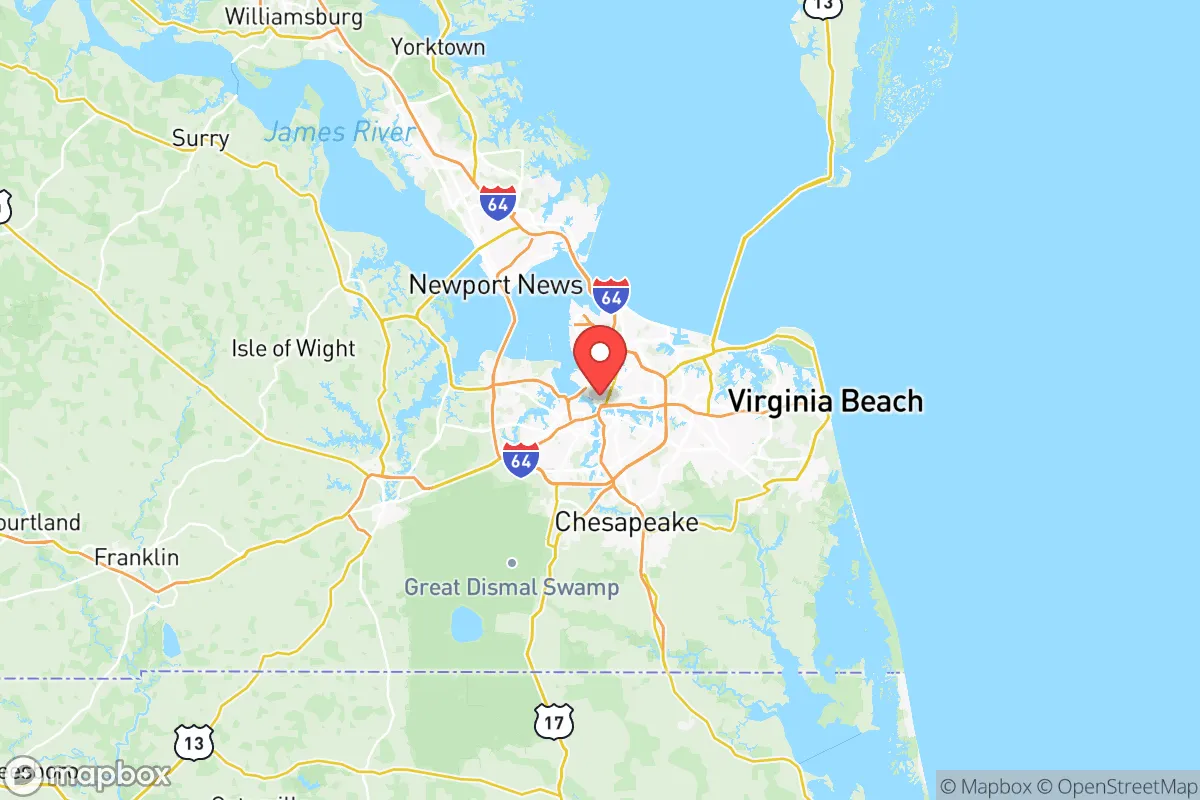
Norfolk City County, Virginia, is a dense, majority-minority urban county of 235,037 residents, defined by its deep-rooted Black and White populations alongside a small but growing Hispanic and East/Southeast Asian presence. Its people are shaped by centuries of maritime and military industry, with a distinctive Tidewater accent and a strong sense of place rooted in naval service, historically Black neighborhoods, and a slow but steady diversification. The county is simultaneously one of the oldest continuously inhabited English-speaking settlements in America and a modern city grappling with suburban flight and redevelopment.
Settlement & growth (pre-1960)
Long before European arrival, the region was home to the Chesapeake and Nansemond tribes of the Algonquian-speaking Powhatan Confederacy, who lived along the Elizabeth River and its tributaries. Their population was decimated by disease and conflict after English colonists established Jamestown in 1607, and by the 1640s, English planters had begun patenting land on the south side of the James River, founding the settlement that would become Norfolk. The town of Norfolk was formally established in 1682 as a port for the export of tobacco, and its location on the deep-water Elizabeth River made it a natural hub for Atlantic trade.
Throughout the 18th and early 19th centuries, Norfolk's population was overwhelmingly of English and Scots-Irish descent, with a significant enslaved African workforce that by 1790 made up roughly one-third of the town's residents. The city was burned during the Revolutionary War and again during the War of 1812, but each time rebuilt around its maritime economy. The construction of the Gosport Navy Yard (now Norfolk Naval Shipyard) in Portsmouth in 1767 and the establishment of Fort Monroe in 1819 cemented the region's military character, drawing workers and soldiers from across the British Isles and Germany.
The Civil War and Reconstruction brought profound change. Norfolk was occupied by Union forces in 1862, and the city became a haven for freed slaves, who established neighborhoods like Huntersville and Berkley. These areas grew rapidly after emancipation, forming the core of Norfolk's Black community. The late 19th and early 20th centuries saw waves of European immigrants—primarily Germans, Irish, Italians, and Greeks—who settled in working-class districts like Ghent and Ocean View, working on the docks, in the shipyards, and in the growing railroad industry. The Great Migration (1910–1970) brought tens of thousands of Black Americans from the rural South to Norfolk, seeking jobs in the naval shipyards and defense plants. By 1950, Norfolk's population was roughly 35% Black and 65% White, with a small but established Jewish community centered around Colley Avenue.
World War II was the single greatest demographic event in Norfolk's history. The city's population exploded from 144,000 in 1940 to over 300,000 by 1945, as the Navy expanded the Norfolk Naval Base (now Naval Station Norfolk) into the world's largest naval installation. This influx was overwhelmingly White and Southern, drawn from rural Virginia, North Carolina, and Tennessee, and it permanently reshaped the city's character from a sleepy port town into a bustling, transient military hub. Post-war suburbanization, aided by the 1956 Interstate Highway Act, began pulling White families out of the city proper into newly incorporated suburbs like Virginia Beach and Chesapeake, a trend that would accelerate dramatically after 1960.
Modern era (post-1965)
The 1965 Hart-Cellar Act had a relatively modest impact on Norfolk compared to gateway cities, but it did open the door for new immigrant groups. The most notable post-1965 arrivals have been Hispanic immigrants, primarily from Mexico and Central America, who now make up 9.9% of the county's population. They have concentrated in neighborhoods like Park Place and Fairmount Park, working in construction, hospitality, and the service industries that support the naval base. The East/Southeast Asian community (3.1% of the population) is largely composed of Vietnamese, Filipino, and Korean families, many with ties to the U.S. military—either as service members or as refugees resettled after the Vietnam War. They are most visible in the Wards Corner area and along Little Creek Road, where Vietnamese restaurants and markets have taken root.
The most dramatic demographic shift since 1965 has been the White flight to surrounding counties. In 1960, Norfolk was roughly 65% White; by 2026, the White population had fallen to 41.5%, while the Black population held steady at 39.0%. This exodus was driven by school desegregation orders in the 1970s, the construction of the Hampton Roads Bridge-Tunnel (which made commuting to Virginia Beach easier), and the annexation battles of the 1970s and 1980s, which left Norfolk landlocked and unable to capture the suburban growth that exploded in Virginia Beach and Chesapeake. The result is a city that is now majority-minority, with a Black population that is older and more established, and a White population that is increasingly concentrated in the gentrifying Ghent and Neon District neighborhoods.
The Indian-subcontinent population (0.6%) is small but growing, with families often connected to the medical and technology sectors at Eastern Virginia Medical School and Old Dominion University. They do not have a single concentrated enclave but are dispersed across the city's more affluent areas. The foreign-born share of the population is just 3.5%, well below the national average, reflecting Norfolk's relatively low immigration rate compared to other East Coast cities.
The future
Norfolk's population is projected to remain stable or grow slowly over the next decade, with the city's 235,037 residents likely increasing to around 245,000 by 2035. The key demographic trends are aging (the median age is 31.5, but the senior population is growing), Hispanic growth (the Hispanic share is expected to rise to 12-14% by 2035, driven by both immigration and higher birth rates), and gentrification in the downtown and Ghent areas, which is attracting younger, whiter, and more college-educated residents (32.7% of adults now hold a bachelor's degree or higher). The Black population share is likely to decline slightly as older Black residents pass away and younger Black families continue to move to Chesapeake and Suffolk for better schools and larger homes.
The city's cultural identity is evolving from a historically Black-and-White Southern port into a more diverse, military-tinged urban center. The growing Hispanic and Asian communities are slowly reshaping the city's food scene, religious landscape, and political dynamics, though Norfolk remains a reliably Democratic stronghold. The biggest wildcard is the future of the naval base: any significant reduction in military spending or base realignment could trigger a population decline, while continued investment in shipbuilding and cybersecurity (a growing sector at Old Dominion University) could attract new residents.
For someone moving to Norfolk today, the city offers a dense, walkable urban experience with a rich Black cultural heritage, a strong military community, and a slowly diversifying population. It is not a high-growth boomtown, but a stable, affordable mid-sized city where the cost of living remains reasonable compared to Northern Virginia or the Northeast. The key trade-off is between the historic charm and convenience of the city proper and the better schools and newer housing of the surrounding suburbs—a choice that has defined Norfolk's demographics for sixty years and will continue to do so for the foreseeable future.

* Values derived from national, state, county, city and local statistics and may differ in a specific area. Last updated: 2026-08-25T02:10:12.000Z
Narrative content on this page is AI-generated and may contain mistakes. Verify any details that matter before acting on them.
ReloMaps may earn a commission from affiliate links at no extra cost to you.

