
Photo by Matt Hardison on Unsplash
Demographics of Portsmouth City County
Affluence Level in Portsmouth City County
A below-average socioeconomic profile. Incomes, home values, and educational attainment trail the U.S., with higher poverty and unemployment.
People of Portsmouth City County
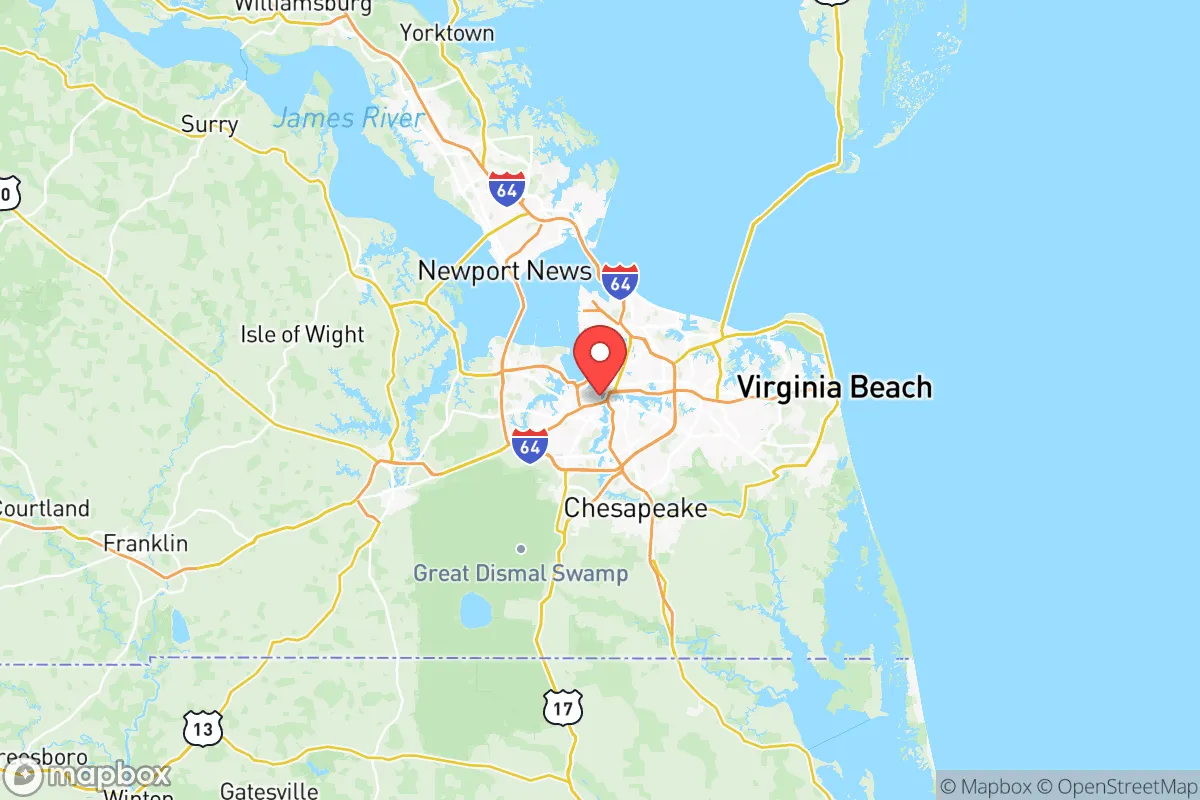
Portsmouth City County, Virginia, is home to 97,299 residents, making it a densely populated urban center within the Hampton Roads region. The city’s population is predominantly Black (51.2%) with a significant White minority (35.9%), a small Hispanic community (5.1%), and a very low foreign-born rate of just 1.4%. This demographic profile reflects a deeply rooted African American heritage, a legacy of naval and industrial employment, and a population that is notably less diverse and less immigrant-heavy than neighboring Virginia Beach or Norfolk.
Settlement & growth (pre-1960)
The area now known as Portsmouth was originally inhabited by the Nansemond and Chesapeake tribes, part of the larger Powhatan Confederacy. English colonists, primarily from the Tidewater region of Virginia, began settling the area in the early 17th century. The town of Portsmouth was officially established in 1752 by the Virginia General Assembly as a port and shipbuilding center on the Elizabeth River. Its deep-water harbor and strategic location made it a natural hub for maritime commerce and, later, naval operations.
The 19th century saw Portsmouth’s population grow steadily, driven by the Gosport Navy Yard (now Norfolk Naval Shipyard), which became a major employer. The city’s shipyard attracted a mix of skilled laborers, including English, Scottish, and Irish immigrants, as well as free Black workers and enslaved people who were forced into labor. After the Civil War, the city’s Black population grew substantially as freedmen and women moved to Portsmouth for work in the shipyard and related industries, establishing neighborhoods like Port Norfolk and Prentis Park.
The early 20th century brought a wave of domestic migration from the rural South, particularly Black families from North Carolina and Virginia’s Tidewater region, seeking industrial jobs. The Great Migration (1910–1970) saw thousands of African Americans move to Portsmouth, solidifying its Black majority by the mid-20th century. White ethnic groups, including Italians, Poles, and Germans, also arrived during this period, settling in areas like Olde Towne and Churchland, often working in the shipyard or as tradesmen. By 1960, Portsmouth was a racially segregated but economically stable city, with a population of roughly 114,000, heavily reliant on the Navy and shipbuilding.
Modern era (post-1965)
The 1965 Hart-Cellar Act had a minimal direct impact on Portsmouth, as the city’s foreign-born population remains exceptionally low at 1.4%. Unlike many U.S. cities, Portsmouth did not experience large waves of post-1965 immigration from Asia, Latin America, or Africa. Instead, the city’s demographic changes since the 1960s have been driven primarily by domestic migration and suburbanization.
The most significant shift has been the out-migration of White residents to surrounding counties, a pattern common in many older industrial cities. From 1960 to 2020, Portsmouth’s White population declined from roughly 60% to 35.9%, while the Black population grew to 51.2%. This “White flight” was accelerated by school desegregation in the 1970s and the expansion of suburban housing in Chesapeake and Suffolk. Today, many White families who remain in Portsmouth live in the Churchland and Western Branch neighborhoods, while Black residents are concentrated in Port Norfolk, Prentis Park, and the Cradock historic district.
The Hispanic population, now 5.1%, has grown modestly since the 1990s, primarily through domestic migration from other U.S. states rather than direct immigration. Small clusters of Hispanic residents can be found in Portsmouth’s midtown and near the Naval Medical Center. The Asian population (East/Southeast Asian) stands at 1.3%, with a tiny Indian-subcontinent community at 0.2%. These groups are largely concentrated in the Churchland area, near the naval base, and are often military-affiliated families. The city’s low college attainment rate (23.2%) reflects a working-class economy centered on the shipyard, logistics, and retail, with fewer high-skilled professional jobs than in neighboring Virginia Beach or Norfolk.
The future
Portsmouth’s population is projected to remain stable or decline slightly over the next decade, as the city continues to lose residents to surrounding suburbs. The Black majority is likely to persist, with the White share continuing a slow decline. The Hispanic and Asian populations are expected to grow gradually, but from a very small base, meaning Portsmouth will remain one of the least diverse cities in Hampton Roads by immigrant status. The city’s low foreign-born rate and high Black concentration make it an outlier in a region that is otherwise becoming more diverse through immigration.
New development is concentrated in the Olde Towne and Waterfront districts, where city leaders are promoting mixed-use housing and commercial spaces to attract younger professionals and empty-nesters. However, the city’s aging housing stock, struggling public schools, and limited job growth outside the shipyard may continue to push families with children to Chesapeake and Suffolk. The cultural identity of Portsmouth is likely to remain strongly tied to its African American heritage and naval history, with less influence from the immigrant-driven diversity seen in other parts of the country.
For someone moving in now, Portsmouth offers a deeply rooted, historically Black community with a strong sense of place and affordable housing compared to neighboring cities. The city is becoming a more intentional choice for those who value urban density, historic architecture, and proximity to the water, rather than a destination for rapid growth or new immigrant enclaves. The population is stable, older, and less transient than in nearby military-heavy cities, making it a place where long-term residents shape the character of the community.

* Values derived from national, state, county, city and local statistics and may differ in a specific area. Last updated: 2026-07-29T07:22:06.000Z
Narrative content on this page is AI-generated and may contain mistakes. Verify any details that matter before acting on them.
ReloMaps may earn a commission from affiliate links at no extra cost to you.

