
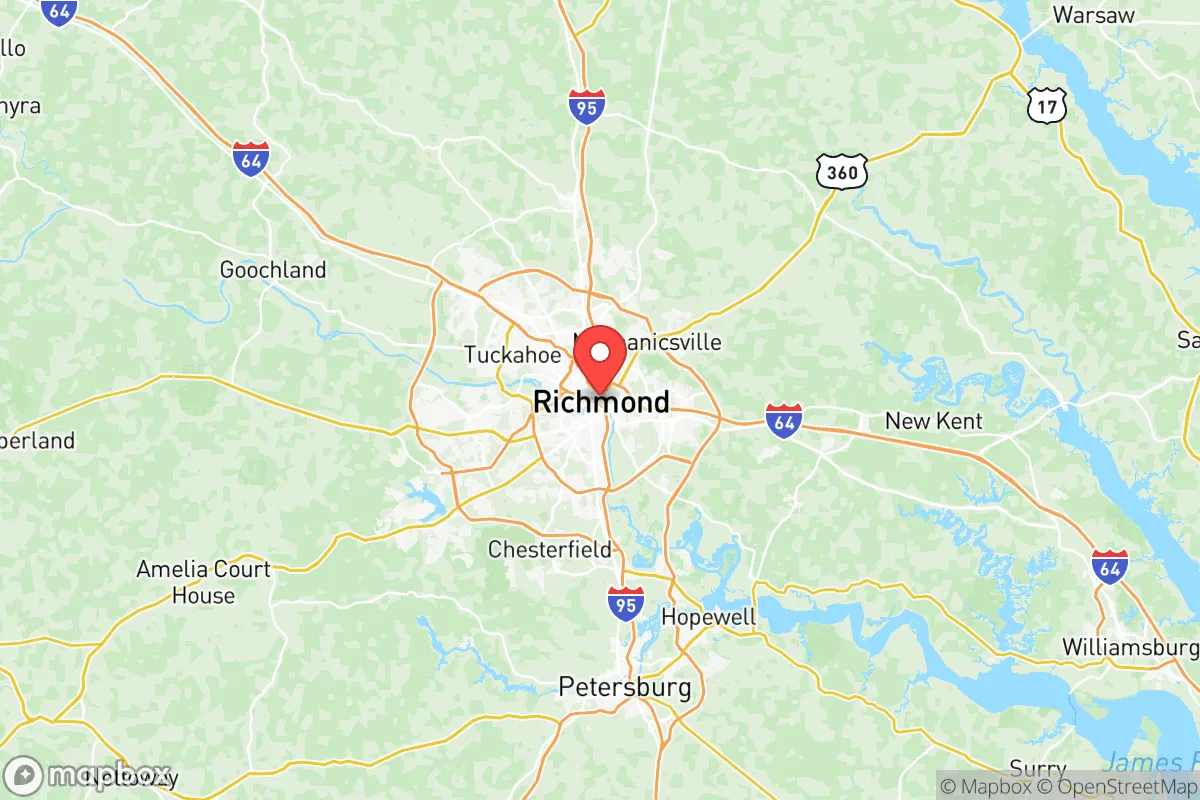
Photo by Nathaniel Villaire on Unsplash
Demographics of Richmond City County
Affluence Level in Richmond City County
A middle-class area roughly in line with national averages across income, home values, education, and employment.
People of Richmond City County
Richmond City County, Virginia, is a majority-minority urban center where Black residents make up 41.6% of the population and White residents 41.0%, creating a nearly balanced biracial core that is unusual among mid-sized American cities. With 227,595 residents, a foreign-born share of just 6.0%, and a college-educated rate of 44.1%, the city is simultaneously more educated and less immigrant-diverse than the national average. Its people are defined by deep-rooted African American heritage, a resurgent White professional class drawn to historic neighborhoods, and a modest but growing Hispanic population of 10.3% that is reshaping parts of the south and east sides.
Settlement & growth (pre-1960)
The area now known as Richmond City County was originally inhabited by the Powhatan Confederacy, a collection of Algonquian-speaking tribes who controlled the tidal James River region. English colonists established the settlement of Farrar's Island in 1611, but the city's permanent founding came in 1737 when William Byrd II laid out the grid of what became Shockoe Bottom and Church Hill. The fall line of the James River made Richmond a natural transshipment point for tobacco, and by the Revolutionary War it had become a key commercial hub.
From the 1790s through the Civil War, Richmond's population was shaped by two forces: the expansion of the tobacco and iron industries, and the domestic slave trade. Enslaved Africans and their descendants were forcibly brought to the city's slave markets in Shockoe Bottom, where they were sold to plantations across the Deep South. By 1860, Black residents—nearly all enslaved—made up roughly 38% of the city's population. Free Black communities also existed, notably in Jackson Ward, which after emancipation became known as the "Black Wall Street of the South."
European immigration to Richmond was modest compared to Northern industrial cities. Irish immigrants arrived in the 1840s and 1850s, settling in Oregon Hill and working in the Tredegar Iron Works and on canal construction. German immigrants followed in the 1850s and 1860s, establishing breweries and bakeries in Manchester (now part of South Richmond). A small but influential Jewish community, primarily German Jews, settled in Church Hill and later moved west toward the Fan District. Italian immigrants arrived in the 1880s and 1890s, concentrating in Highland Park and working as stonemasons and laborers. By 1900, the foreign-born share of Richmond's population peaked at around 8%, then declined steadily as immigration restrictions tightened in the 1920s.
The Great Migration dramatically reshaped Richmond between 1910 and 1960. Hundreds of thousands of Black Americans left the rural South for cities, and Richmond—as a major urban center in the Upper South—absorbed a significant share. Black neighborhoods expanded outward from Jackson Ward into Gilpin Court, Mosby Court, and Creighton Court (public housing projects built from the 1940s onward), as well as into North Side neighborhoods like Battery Park. White flight to the suburbs began in earnest after World War II, with families moving to Henrico County and Chesterfield County, leaving Richmond's city limits increasingly Black and lower-income.
Modern era (post-1965)
The 1965 Hart-Cellar Act had a muted effect on Richmond compared to gateway cities. The foreign-born share remained below 5% until the 2010s, and the city did not develop large ethnic enclaves. The most significant post-1965 immigrant group has been Hispanic, primarily from Mexico and Central America, who began arriving in the 1990s for construction, landscaping, and food service jobs. They concentrated in South Richmond (particularly around Hull Street) and in North Side neighborhoods near Brookland Park Boulevard. The Hispanic share grew from 2.5% in 2000 to 10.3% today, making it the fastest-growing demographic segment.
East and Southeast Asian communities—primarily Vietnamese and Korean—arrived in smaller numbers after the Vietnam War and the 1980s, settling in West End neighborhoods near Libbie Avenue and in parts of Henrico County just outside the city limits. The Asian share of Richmond's population is 1.5%, with an additional 0.6% Indian-subcontinent residents, the latter concentrated in professional and medical fields near Virginia Commonwealth University and the VCU Medical Center.
The most transformative domestic migration since 2000 has been the return of White professionals to the urban core. Young college-educated workers, drawn by historic architecture, walkable neighborhoods, and lower housing costs compared to Washington D.C. or New York, have revitalized Church Hill, The Fan, Museum District, and Scott's Addition. This "back-to-the-city" movement has increased the White share of the population from 38.2% in 2010 to 41.0% today, reversing decades of decline. It has also driven gentrification, displacing Black renters from Jackson Ward and Manchester as property values have risen sharply.
Black out-migration to the suburbs—particularly to Chesterfield County and Henrico County—has continued, as middle-class Black families seek better schools and larger homes. The Black share of Richmond's population has fallen from 57.2% in 1990 to 41.6% today, though the city remains the cultural and political center of Black Virginia.
The future
Richmond's population is likely to continue its slow growth, driven by in-migration of young professionals and Hispanic families. The Hispanic share is projected to reach 15-18% by 2040, with the community consolidating in South Richmond and North Side while also dispersing into Henrico County suburbs. The Black share will likely stabilize around 38-40% as out-migration slows and the city's remaining Black population becomes more economically diverse. The White share may plateau near 42-43% as the urban revival matures and housing affordability constraints limit further influx.
The city is not homogenizing but rather tribalizing into distinct enclaves: affluent White neighborhoods in the West End and Fan District, working-class Hispanic corridors along Hull Street, and historically Black neighborhoods in the East End and North Side that are increasingly mixed with White newcomers. The foreign-born share will rise slowly, likely reaching 8-10% by 2040, but Richmond will remain a predominantly native-born city compared to the national average.
The cultural identity of Richmond is becoming more politically progressive and culturally diverse, but the city's deep-rooted African American heritage and Southern character remain dominant. New arrivals are being absorbed into existing institutions—the Richmond Folk Festival, the Virginia Museum of Fine Arts, and the city's robust food scene—rather than creating entirely separate cultural spheres.
For someone moving to Richmond now, the city offers a rare combination: a majority-minority population with genuine biracial political power, a growing Hispanic community that is still small enough to integrate, and a White professional class that is revitalizing but not overwhelming the historic fabric. The city is becoming more diverse, more educated, and more expensive, but it retains a manageable scale and a sense of place that larger Sun Belt metros have lost. The key question for newcomers is whether they can afford to buy into the neighborhoods that are being remade—and whether they are comfortable with a city where Black political and cultural influence remains central to daily life.

* Values derived from national, state, county, city and local statistics and may differ in a specific area. Last updated: 2026-05-29T05:06:34.000Z
Narrative content on this page is AI-generated and may contain mistakes. Verify any details that matter before acting on them.
ReloMaps may earn a commission from affiliate links at no extra cost to you.

