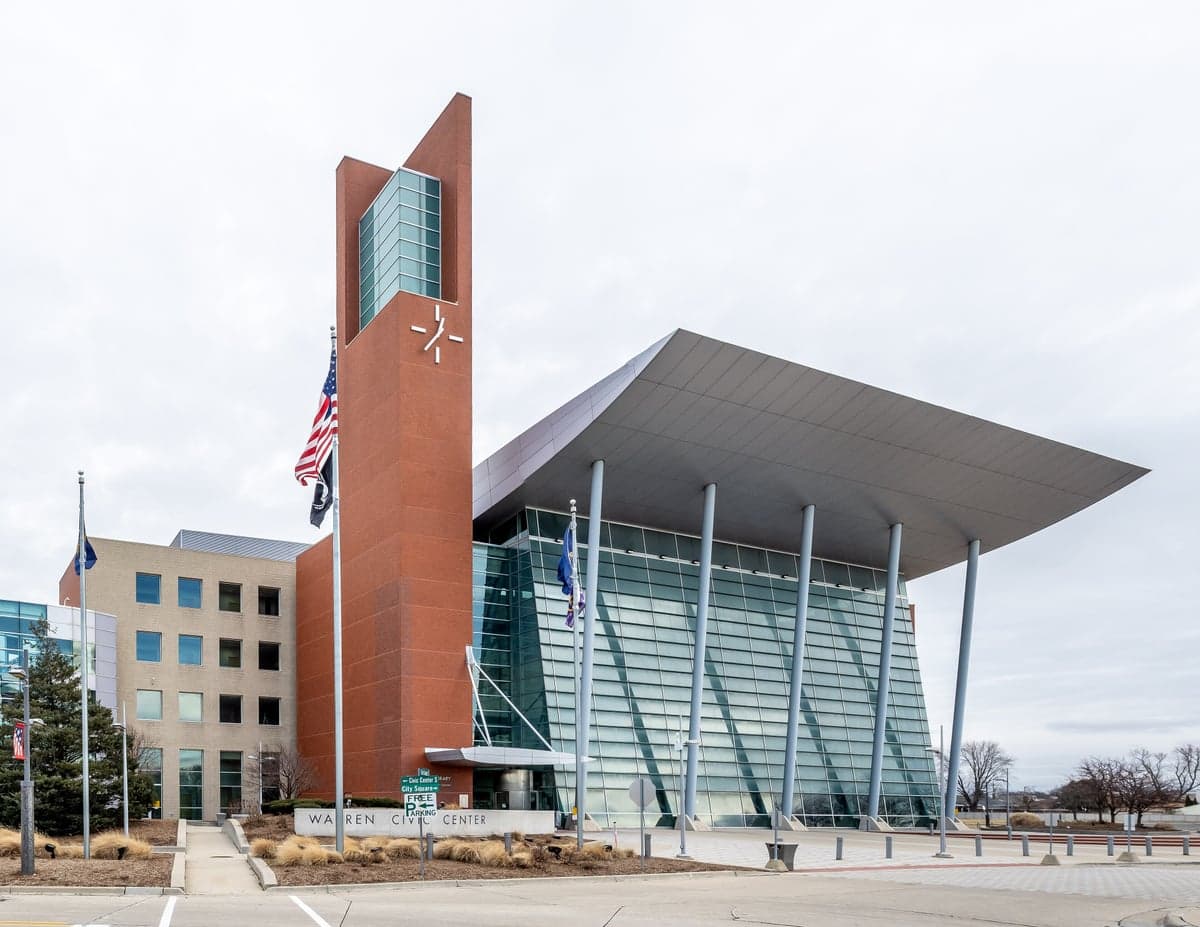
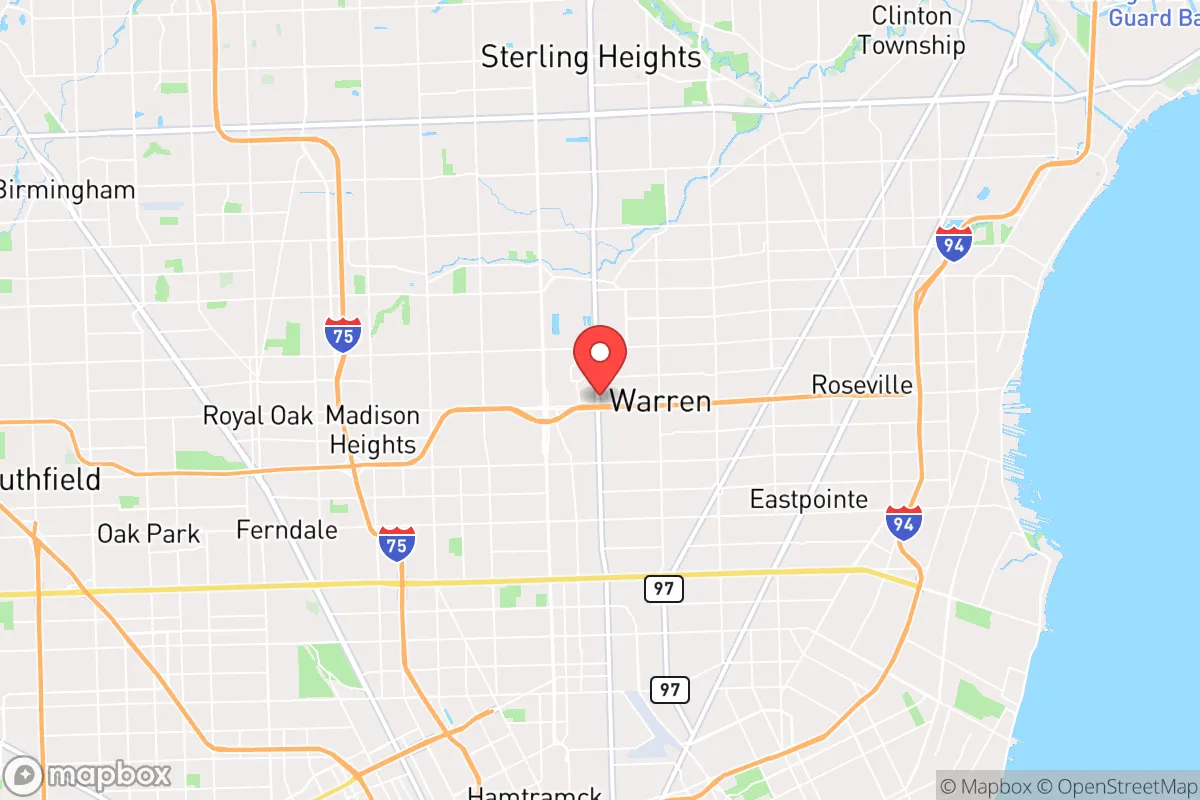
Photo: Wikipedia
Political ClimatePolitical Climate in Warren, MI
District shown is the primary district for this city’s centroid. Cities may span multiple districts.
Local Political AnalysisPolitical Analysis of Warren, MI
Warren, Michigan, has long been a blue-collar stronghold where the political lean is more about kitchen-table economics than any national party label, but the Cook PVI of R+3 tells you the ground has shifted under our feet. For decades, this was a reliably Democratic town—union halls, auto plants, and a deep distrust of anyone who didn't punch a clock. But starting around 2016, you started hearing neighbors say things at the fence line that would've gotten you a cold shoulder twenty years ago: that the party had left them, not the other way around. The 2020 and 2024 elections made it official—Warren is now a genuine swing area, with a conservative tilt that's growing as more folks feel the old guard in Lansing and D.C. just doesn't get what it means to live here anymore.
How it compares
Drive ten miles south into Detroit, and you're in a city that votes 80% Democratic—a world away in priorities and policing. Head north to Sterling Heights or east to St. Clair Shores, and you'll find communities that look similar on paper but have been trending red faster than Warren. The real contrast is with Ann Arbor, 45 minutes west, where the progressive agenda is fully embraced—think sanctuary city policies, heavy zoning restrictions, and a tax base that can afford to experiment. Here in Warren, we watch that and shake our heads. The city council has been a battleground lately, with fights over mask mandates in 2020 and a proposed "Welcoming City" resolution that would've limited cooperation with federal immigration enforcement. That resolution failed, and it was a clear signal: most of us still believe in local control and don't want Lansing or Washington telling us how to run our neighborhoods.
What this means for residents
For the person living here, the political climate means your property rights and personal freedoms are still mostly respected, but you have to stay vigilant. The city has kept its zoning relatively light—you can still run a small business out of your garage without a dozen permits—and the police department hasn't been defunded or turned into a social services agency. That's a win. But the school board has seen some heated meetings over curriculum and library books, and there's a real concern that the progressive push from the state level—like the 2023 expansion of LGBTQ+ nondiscrimination laws—could trickle down into mandates that override local values. Property taxes are manageable compared to Oakland County, but the city's pension obligations are a ticking clock that could force a tax hike down the road. If you're a conservative who values the Second Amendment, you'll be relieved that Warren has resisted the "safe storage" ordinances that some neighboring cities have adopted. The long-term worry is that as the auto industry continues to shrink and younger, more transient renters move in, the political balance could tip. For now, though, Warren is still a place where you can live your life without the government breathing down your neck—and that's worth fighting to keep.
Culturally, Warren is a town of front-porch conversations and backyard barbecues, not protest marches or city-hall sit-ins. The biggest policy distinction you'll notice is the city's aggressive approach to blight and property maintenance—code enforcement is strict, and that's by design. Most residents support it because it keeps property values stable and prevents the kind of decay you see in parts of Detroit. But it also means the city has a long reach into what you can do with your own lawn or driveway. That's the trade-off: a little government overreach in exchange for a clean, safe neighborhood. For now, most of us are willing to make that deal, as long as the overreach stops at the property line.

State Political ClimatePolitical Climate in Michigan
State Political AnalysisPolitical Environment in the State
Michigan has shifted from a reliably purple battleground to a state where Democrats now hold all three levers of state government, a dramatic reversal from just a decade ago. The state went for Donald Trump in 2016 by 0.2 points, then flipped to Joe Biden in 2020 by 2.8 points, and in 2024, Trump reclaimed it by 1.5 points, signaling a deeply divided electorate. The dominant coalitions are a shrinking but still potent union-heavy, urban Democratic base in Southeast Michigan and a growing, energized conservative movement in the western and northern parts of the state, with the critical swing suburbs of Macomb, Oakland, and Kent counties deciding every election.
Urban vs. rural divide
The political map of Michigan is a tale of two peninsulas. The Democratic stronghold is the Detroit metro area, particularly Wayne County (Detroit), which alone delivered over 500,000 votes for Biden in 2020, and the inner-ring suburbs of Oakland County, which have trended sharply left since 2016. Washtenaw County (Ann Arbor) is the state’s most liberal bastion, with a massive university population driving progressive policies. On the flip side, the western side of the state is a conservative fortress. Kent County (Grand Rapids) flipped from red to blue in 2020 but swung back to Trump in 2024, reflecting its status as a bellwether. The rural thumb and northern Lower Peninsula, including Midland County and Traverse City areas, are deeply red, with Trump winning some counties by 30-40 points. The Upper Peninsula, once a Democratic stronghold due to mining unions, has flipped hard red, with Marquette County being the only blue holdout. The key battleground is Macomb County—a working-class suburban county north of Detroit that has become the ultimate swing county, going for Trump in 2016 and 2024, but for Biden in 2020.
Policy environment
Michigan’s policy environment has taken a sharp progressive turn since Democrats gained full control in 2023. The state income tax is a flat 4.25%, but a 2023 law repealed the retirement tax exemption, effectively raising taxes on seniors. Property taxes are high, with an average effective rate of 1.54%, and the state’s Headlee Amendment caps annual assessment increases at the rate of inflation, which is a rare pro-property-owner feature. On education, Michigan eliminated the "right-to-work" law in 2023, a major blow to personal freedom that forces private-sector workers to pay union dues as a condition of employment. The state also expanded the Elliott-Larsen Civil Rights Act to include sexual orientation and gender identity, which has sparked parental rights battles over school curricula and library books. Election laws have been loosened: Proposal 2 in 2022 enshrined nine days of early voting, automatic voter registration, and no-reason absentee voting, which conservatives argue reduces election integrity. The state also repealed its 1931 abortion ban via a 2022 ballot initiative, making Michigan a safe haven for abortion access in the Midwest.
Trajectory & freedom
Michigan is unequivocally becoming less free for conservatives. The 2023 repeal of right-to-work was a direct assault on economic liberty, forcing workers to fund political causes they may oppose. On gun rights, Michigan passed a "red flag" law in 2023, allowing courts to temporarily seize firearms from individuals deemed a threat by family or police, without a criminal conviction—a major concern for due process advocates. The state also enacted universal background checks and safe storage requirements. On the positive side, Michigan has no state-level property tax on business inventory, and the Michigan Business Tax was replaced with a flat 6% corporate income tax in 2011, which remains in place. However, the state’s regulatory environment is tightening: new energy mandates require 100% carbon-free electricity by 2040, which will drive up utility costs. Parental rights have been eroded by the state’s new LGBTQ+ nondiscrimination protections, which have been used to challenge school policies on bathroom access and curriculum transparency. The Whitmer administration has also used executive orders aggressively, including during COVID, when Michigan had some of the nation’s strictest lockdowns, a memory that still stings for many residents.
Civil unrest & political movements
Michigan has been a flashpoint for political activism on both sides. The Wolverine Watchmen militia plot to kidnap Governor Gretchen Whitmer in 2020 exposed deep anti-government sentiment in the state’s rural areas. The Operation Gridlock protests in 2020, where thousands of armed protesters surrounded the state capitol in Lansing, were a defining moment for the Second Amendment movement. On the left, the Michigan Democratic Party has been energized by the Roe v. Wade repeal, with Proposal 3 passing overwhelmingly in 2022. Immigration politics are relatively quiet compared to border states, but Detroit and Ann Arbor have sanctuary city policies, limiting cooperation with ICE. Election integrity remains a hot-button issue: the 2020 election saw massive controversies in Wayne County, with allegations of ballot harvesting and improper absentee ballot processing, leading to a Republican-led investigation that found no widespread fraud but did recommend legislative changes. The Michigan Republican Party has been in turmoil since 2020, with infighting between establishment and Trump-aligned factions, weakening its ability to compete in statewide races.
Projection
Over the next 5-10 years, Michigan is likely to continue its leftward drift, driven by demographic trends. The Detroit suburbs are becoming more diverse and educated, trends that favor Democrats. The state’s population is stagnant, but in-migration from blue states like Illinois and California is concentrated in Ann Arbor and Grand Rapids, bringing progressive voters. The Republican Party’s strength in rural areas is not enough to overcome the growing urban and suburban vote, unless the party can win back Macomb County and parts of Oakland County. The 2024 election showed that Trump can still win Michigan, but down-ballot races remain tough for Republicans. Expect more progressive policies: a potential move to a graduated income tax, further gun control, and expanded government healthcare. The state’s energy mandates will likely increase costs, and the repeal of right-to-work will continue to suppress economic growth. For conservatives, the best hope is a strong gubernatorial candidate in 2026 to break the Democratic trifecta, but the path is narrow.
Bottom line for a new resident: If you value low taxes, gun rights, and limited government, Michigan is a challenging place to live, especially if you settle in the urban core. The western and northern parts of the state offer a more conservative environment, but you’ll still be subject to state-level policies that are increasingly progressive. The cost of living is moderate, but the tax burden is realchers. For a conservative family or individual, the best bet is to look at Midland, Traverse City, or the Grand Rapids exurbs, where local politics can offset some of the state’s leftward tilt. Just know that the state government in Lansing is not your friend, and that trend is likely to continue.
* Values derived from national, state, county, city and local statistics and may differ in a specific area. Last updated: 2026-04-30T03:47:34.000Z
Narrative content on this page is AI-generated and may contain mistakes. Verify any details that matter before acting on them.
ReloMaps may earn a commission from affiliate links at no extra cost to you.

