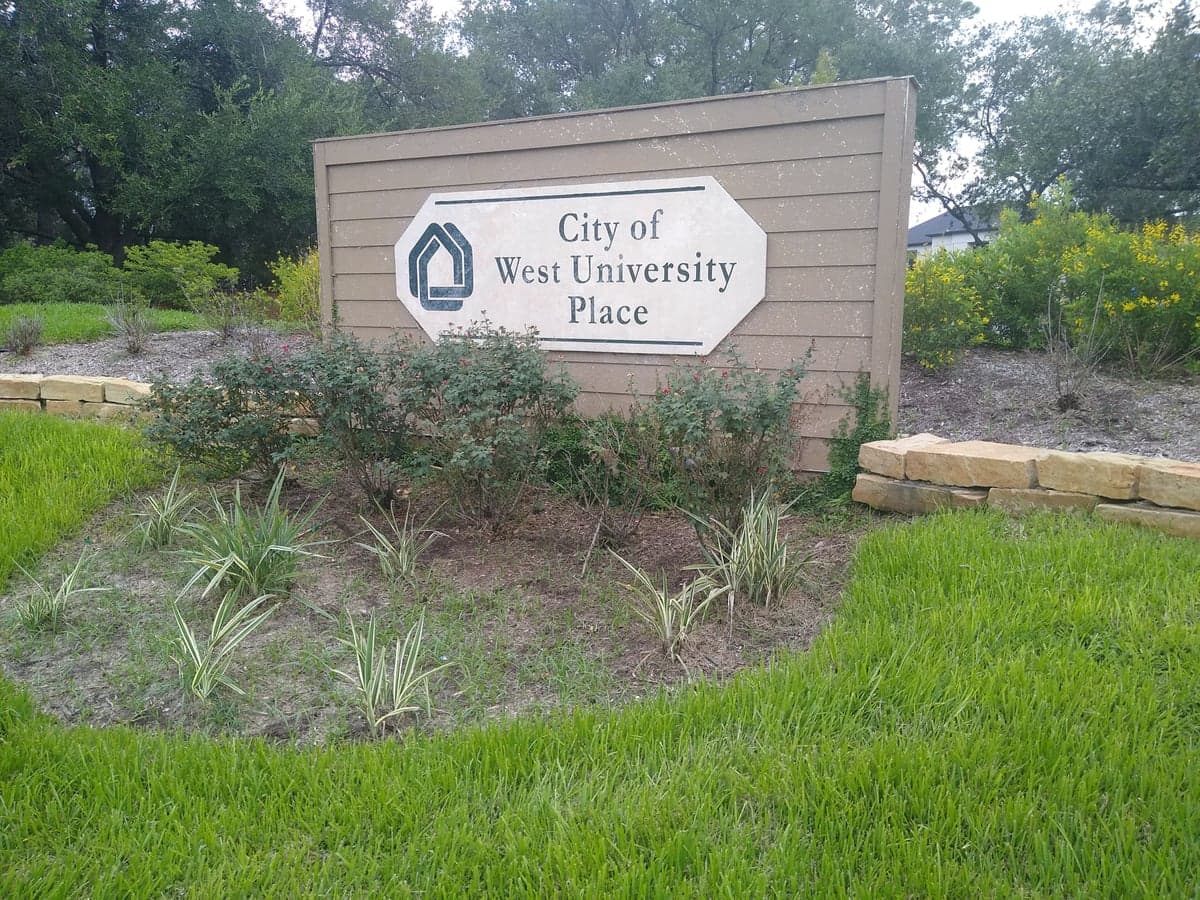
Photo: Wikipedia
Personal Sovereignty in West University Place, TX
Viable for self-reliance. Generally workable, though some barriers may limit total independence.
What does Personal Sovereignty tell us?
Personal Sovereignty measures your capacity for self-reliance and independence with minimal government friction. Higher scores mean fewer barriers between you and the way you want to live... but it assumes you have the space you need and good neighbors.
What does this tell us?
Personal Sovereignty measures your capacity for self-reliance and independence with minimal government friction. Higher scores mean fewer barriers between you and the way you want to live... but it assumes you have the space you need and good neighbors.
State Policy
Energy independence: Net exporter (220% of energy produced in-state)
Personal Liberty
Homesteading

Personal Liberty Analysis
West University Place, a small, affluent enclave inside the 610 Loop in Houston, presents a paradox for the liberty-minded individual. On one hand, you get the full force of Texas state preemption on gun rights and a low-tax state framework; on the other, you are subject to the dense regulatory web of a powerful home-rule city and Harris County, which leans heavily progressive. For a survivalist or prepper, the calculus here is about trading raw autonomy for strategic proximity—you are minutes from world-class medical infrastructure and major supply routes, but you are also inside a jurisdiction that has shown willingness to impose local mandates. The personal sovereignty environment is best described as "defensive" rather than "offensive": you can legally keep and bear arms with minimal interference, but your ability to live off-grid, build independently, or opt out of local ordinances is severely constrained by the city's dense, deed-restricted, and highly regulated character.
Tax burden and regulatory posture: What you pay and what you can't do
Texas has no state income tax, which is a massive win for personal financial sovereignty. However, West University Place levies a property tax rate that, when combined with Harris County and the Houston Independent School District (HISD), typically lands in the 2.0% to 2.3% range of assessed value. On a median home price hovering around $1.5 million, that means an annual tax bill of $30,000 to $34,500. For a prepper, this is a significant fixed cost that eats into capital better spent on land, supplies, or infrastructure. The city also imposes a 8.25% sales tax (state + local), which is standard for the region. Regulatory posture is dense: West U has its own building codes, zoning ordinances, and a strict deed restriction enforcement regime. You cannot park an RV or a boat in your driveway for more than 24 hours. You cannot keep chickens, bees, or livestock. Off-grid solar panels are technically allowed but subject to HOA-style architectural review, and any structural modifications require permits that can take weeks. The city's government is small but active, with a city manager and council that have historically supported local mask mandates and other public health orders. For the liberty-minded, this is a place where you pay a premium for order and conformity, not for freedom to experiment with alternative living.
Self-defense and gun law specifics: What Texas preemption means inside the Loop
Texas law preempts local gun ordinances, so West University Place cannot ban firearms or restrict carry in city parks or streets. This is a critical protection. You can legally carry a handgun openly or concealed without a permit (permitless carry, effective 2021) if you are 21 or older and not prohibited by state or federal law. Magazine capacity is unrestricted, and there is no state-level registry or waiting period for private sales. However, the practical reality inside West U is that you are surrounded by "gun-free zones" by policy: schools (HISD campuses), hospitals (Texas Medical Center is adjacent), and many private businesses post 30.06 or 30.07 signs prohibiting concealed or open carry. The city itself has no dedicated police force—it contracts with the Harris County Sheriff's Office for patrols, supplemented by a small city marshal's office. Response times in this dense, wealthy area are generally under 5 minutes, which is excellent for a prepper scenario. But the proximity to Houston's high-crime areas means that home defense is a practical necessity, not a theoretical exercise. Castle Doctrine and Stand Your Ground laws apply fully, so you have no duty to retreat inside your home or vehicle. For the survivalist, the legal framework is solid, but the social environment is one where carrying a rifle slung across your back would draw immediate police attention and neighbor complaints. Discretion is key.
Self-reliance and homesteading viability: Lot sizes, zoning, and off-grid feasibility
West University Place is the antithesis of a homesteading environment. Lot sizes average 5,000 to 7,000 square feet, with most homes occupying 60-80% of the lot. There is no agricultural zoning, no allowance for livestock, and no space for substantial gardening. The city's tree ordinance restricts removal of mature trees, and the architectural review board must approve any exterior changes. Off-grid water is impossible—you are on municipal water from the City of Houston, and rainwater harvesting is allowed only for irrigation, not potable use, due to state health codes. Solar panels are permitted but must be flush-mounted and not visible from the street in many cases. Composting toilets are not allowed because the city requires connection to the sewer system. For a prepper seeking self-sufficiency, this is a location where you stockpile supplies and maintain a "bug-in" capability, but you cannot produce your own food, water, or energy in any meaningful way. The lot size and zoning effectively make you a consumer, not a producer. Your self-reliance is limited to emergency preparedness: generators (natural gas is common), water storage (cisterns are allowed but must be buried), and food storage. The city's density also means that any grid-down scenario would involve close proximity to neighbors, which has both security risks and mutual-aid potential.
Personal liberties: Parental rights, medical autonomy, speech, and property
Texas has strong parental rights statutes, including the Texas Parental Bill of Rights, which gives parents the authority to direct their child's education, healthcare, and religious upbringing. In West U, this is practically relevant because HISD has been a battleground over curriculum and mask mandates. Parents here have successfully organized to challenge school board policies, and the conservative-leaning city council has supported parental notification for medical procedures. Medical autonomy is mixed: Texas banned vaccine passports and prohibits employer mandates for COVID-19 vaccines, but the Texas Medical Center, which dominates the area's healthcare landscape, is a massive institutional presence that leans heavily into public health orthodoxy. For the liberty-minded, this means you can legally refuse vaccines or treatments, but you may face social pressure or institutional friction. Free speech is protected under the Texas Religious Freedom Restoration Act and the state's strong free speech protections, but West U is a private-property-dominant environment—you cannot protest or leaflet on private property without permission. Property rights are constrained by the city's zoning and deed restrictions, which are aggressively enforced. You cannot run a home business that generates customer traffic, and short-term rentals (Airbnb) are effectively banned. For the prepper, this means your home is a sanctuary, but it is not a fortress of total autonomy—the city can and will fine you for code violations, and the HOA-style restrictions limit your ability to modify your property for defensive or self-sufficient purposes.
Overall, West University Place offers a high degree of personal sovereignty in the areas where Texas state law preempts local control—guns, taxes, and parental rights—but it falls short in the areas where local zoning, HOA culture, and urban density dominate. For a survivalist or prepper, this is a location that works well as a "base camp" for access to resources, medical care, and supply chains, but it is not a place to build a self-sufficient homestead or to live free from regulatory oversight. Compared to rural Texas counties like Gillespie or Bandera, where you can own acreage, keep livestock, and build without permits, West U is a trade-off: you trade raw autonomy for convenience, security, and proximity. If your threat model involves civil unrest or supply chain disruption, the ability to walk to a grocery store or drive 10 minutes to a major medical center is valuable. But if your threat model involves government overreach or long-term grid-down scenarios, the density, regulation, and lack of self-sufficiency capacity make this a fragile environment. The sober assessment is that West University Place is a comfortable, legally protected enclave for the prepared individual, but it is not a sovereign redoubt.

* Values derived from national, state, county, city and local statistics and may differ in a specific area. Last updated: 2026-04-14T00:03:05.000Z
Narrative content on this page is AI-generated and may contain mistakes. Verify any details that matter before acting on them.
ReloMaps may earn a commission from affiliate links at no extra cost to you.

