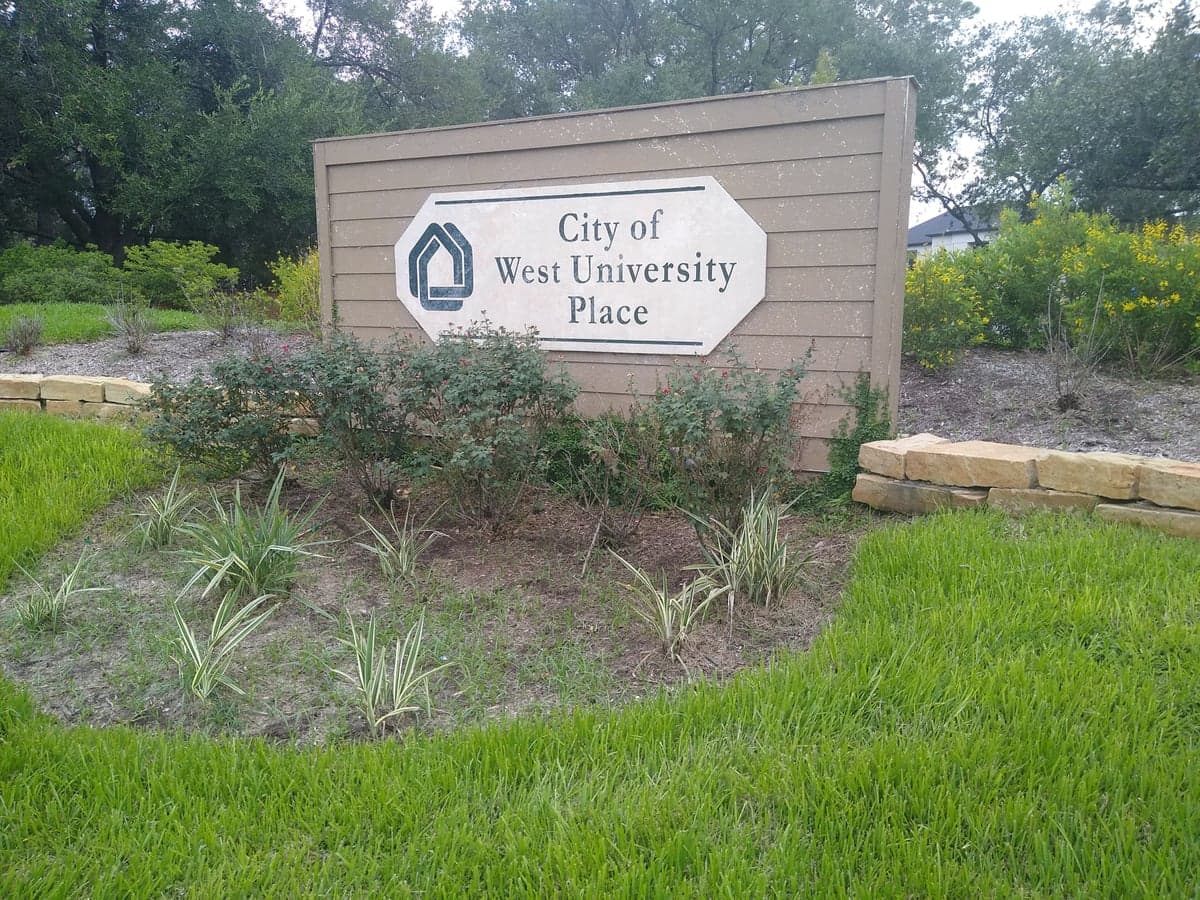
Photo: Wikipedia
Strategic Assessment of West University Place, TX
High tactical risk. This location is likely close to major population centers, strategic targets, or sits in a high-disaster corridor. A retreat property and careful exit planning is required.
What does the Strategic Assessment tell us?
Our Strategic Assessment grades tactical survivability of an area. Major population centers, military targets, fallout zones, natural disasters, and border exposure all drive risk — lower exposure means a more defensible position in a crisis.
This is heavily inspired by Joel Skousen's Strategic Relocation book. Highly recommended you checkout the book ($)What does this tell us?
Our Strategic Assessment grades tactical survivability of an area. Major population centers, military targets, fallout zones, natural disasters, and border exposure all drive risk — lower exposure means a more defensible position in a crisis.
This is heavily inspired by Joel Skousen's Strategic Relocation book. Highly recommended you checkout the book ($)Strategic Pillars

Key Distances
Regional Safe Places
Below is our recommended "safe zones" in Texas and the surrounding area based on our strategic heuristics. For most people, it's unrealistic to live in a “safe zone” full-time due to work, family or other personal reasons. They tend to be more rural. However, many of these areas are perfect for second homes and retreat properties that double as a vacation home or even a short-term rental.

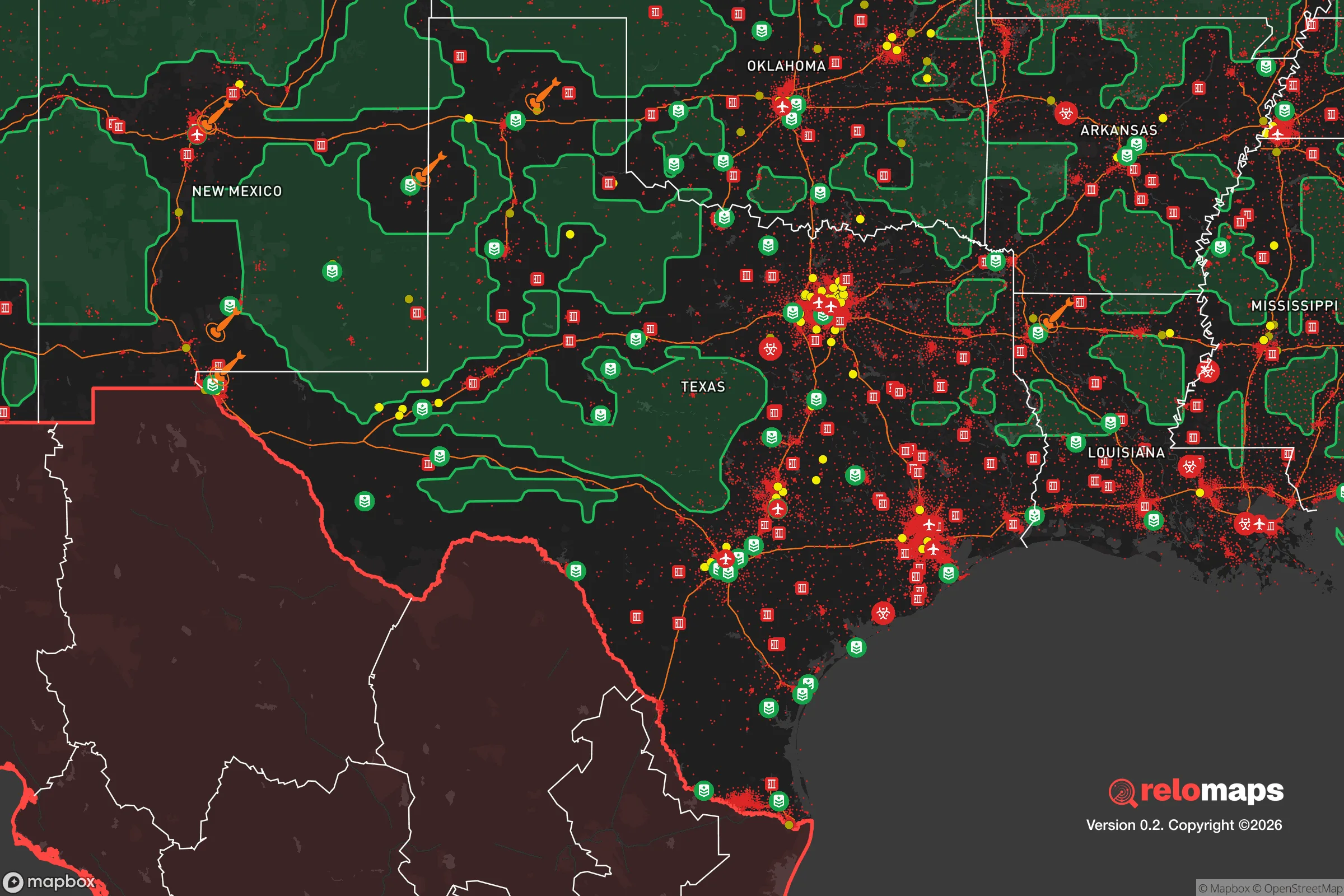


Important Note: For informational purposes only. This does not mean nothing bad ever happens in the green zones. Please use common sense. This is based on public data and modeled with AI. We tried to take a conservative approach but mistakes happen. We update this regularly as new information becomes available.
Solar Generator Recommendations
Backup power matters more here than in safer locations. We've picked three solar generators across budgets and capacity tiers — start with the budget unit if you only need a few essentials, or step up if you want to run a fridge and HVAC for days at a time.

Jackery Portable Power Station Explorer 300
Budget OptionPower on the Go: Weighing only 11 lbs, it's convenient to set up and store with book-sized foldable solar panels

BLUETTI Portable Power Station AC180
Designed for both indoor and outdoor scenarios, AC180 is highly capable as it has a robost capacity and continuous output power.

EF ECOFLOW DELTA Pro Ultra Power Station
Upgraded PickEcoFlow DELTA Pro Ultra is a whole-home energy system designed to grow with your family. Integrated with the Smart Home Panel 2, it scales to meet your evolving energy needs — keeping your home powered, intelligent, and secure through every stage of life.
We earn a commission, at no additional cost to you.
Strategic Assessment Analysis
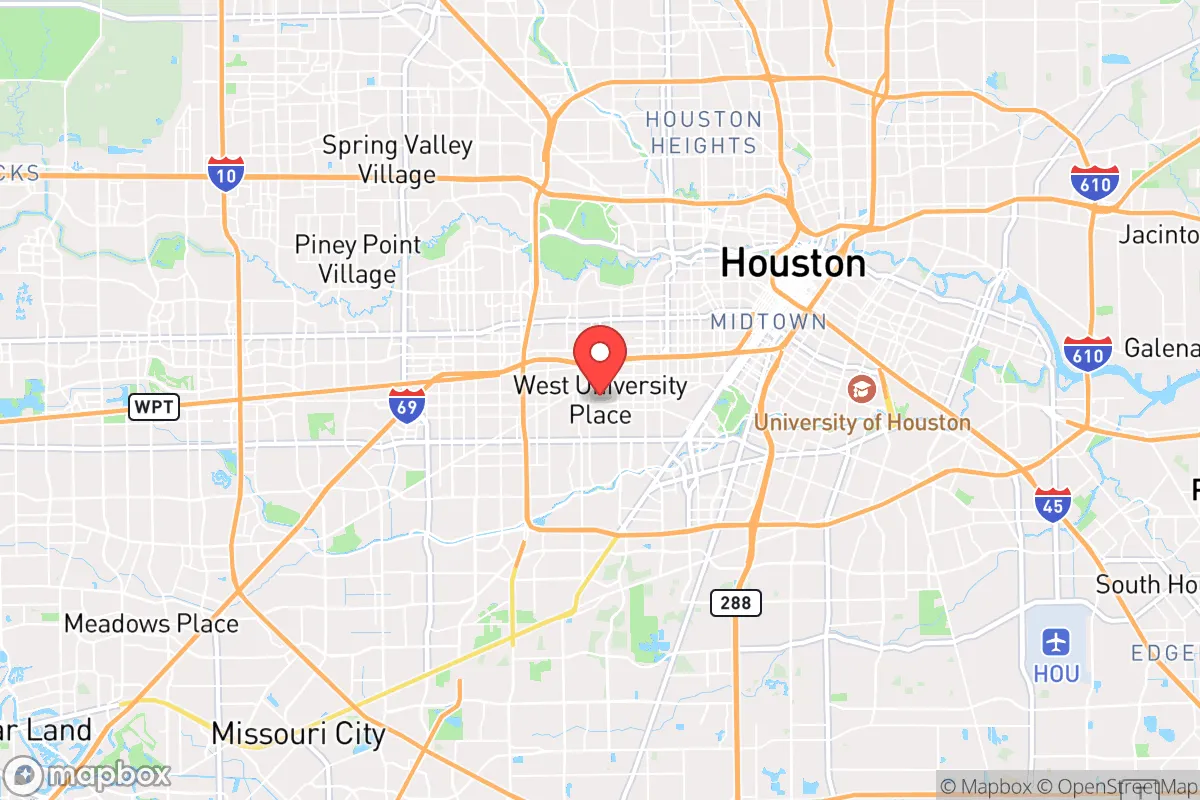
West University Place, Texas, offers a deceptive mix of strategic advantages and serious vulnerabilities for the conservative prepper. Tucked inside the 610 Loop, this 1.2-square-mile enclave of roughly 15,000 residents sits just 4 miles southwest of downtown Houston, placing it squarely in the bullseye of a major metropolitan area. Its immediate resilience comes from high local wealth—median household income exceeds $200,000—and a dense, walkable street grid that could function as a small-town defensive perimeter in a crisis. However, its location within Harris County, a jurisdiction with 4.7 million people and a heavily Democratic administration, means that any large-scale civic unrest or disaster response will prioritize the city core over this affluent pocket. For the relocator weighing long-term security, West U is a fortified outpost with a short logistical tether to a potentially hostile urban environment.
Geographic position and natural advantages for long-term security
West University Place sits on the flat coastal plain of the Gulf Coast, roughly 50 miles from the Gulf of Mexico and 30 miles from the San Jacinto River. Its primary natural advantage is elevation—or rather, the lack of it. The area averages 50 feet above sea level, making it vulnerable to hurricane storm surge from Galveston Bay, but its position inside the 610 Loop means it is protected by the region's extensive flood-control infrastructure, including the Brays Bayou system. The city's street layout is a grid of wide, tree-lined avenues with minimal cul-de-sacs, which provides multiple egress routes in an evacuation scenario—a key advantage over suburban sprawl. The nearby Texas Medical Center, 2 miles east, is a double-edged sword: it offers world-class trauma care but also concentrates 100,000 daily workers and patients, creating a potential humanitarian bottleneck during a mass casualty event. For the prepper, the flat terrain limits natural cover but allows for clear lines of sight and easy movement on foot or bicycle, which is critical if roads become impassable.
Risks, exposures, and proximity to fallout-relevant landmarks
The most significant risk for West University Place is its proximity to Houston's critical infrastructure. The city lies within 3 miles of the Houston Ship Channel, which handles 200 million tons of cargo annually, including petrochemicals, fertilizers, and liquefied natural gas. A major industrial accident or terrorist strike on the channel could release toxic clouds that would drift over West U within minutes, given prevailing southerly winds. Additionally, the nearby Texas Medical Center, with its Level I trauma centers and biocontainment units, is a prime target for biological or chemical attacks. The city is also 12 miles from Ellington Field Joint Reserve Base, a military installation that could become a staging area for federal response—or a target. For the conservative prepper, the concentration of Democratic-voting urban populations (Harris County went +13 for Biden in 2020) means that any civil unrest in downtown Houston, 4 miles north, could spill into West U along major arteries like Kirby Drive or Bissonnet Street. The city's lack of natural barriers—no rivers, hills, or forests—means that a determined mob could reach any home within 15 minutes on foot.
Practical resilience for a relocator: food, water, energy, and defensibility
West University Place's practical resilience is a mixed bag. The city's water supply comes from the City of Houston's system, which draws from surface water (Lake Livingston and Lake Conroe) and groundwater. In a prolonged grid-down scenario, this centralized system is vulnerable to contamination or pressure loss. However, the area's high water table means that shallow wells could be dug, though permits and contamination from nearby industrial sites are concerns. For food, the city has no significant agricultural land—every inch is developed—but the nearby Rice Village shopping district (1 mile north) and H-E-B grocery stores provide immediate supplies. A prepper should stock at least 90 days of food, as resupply will be chaotic. Energy resilience is better: the area is served by CenterPoint Energy, which has a relatively modern grid, but the 2021 winter storm (Uri) showed that rolling blackouts can last days. Solar panels with battery storage are feasible, as West U has no HOA restrictions on rooftop solar, and the flat roofs of many 1940s-era homes are ideal for panel placement. Defensibility is the city's strongest suit. The grid street layout allows for neighborhood watch-style checkpoints at major intersections (e.g., University Boulevard and Edloe Street). The city's own police department, with 30 sworn officers, provides a local law enforcement presence that is more responsive than Harris County Sheriff's Office. For a single individual or family, a home on a corner lot with a fenced backyard offers a defendable perimeter, while the dense tree canopy provides some concealment from aerial surveillance. The biggest weakness is the lack of a natural chokepoint—any approach is wide open.
The overall strategic picture for West University Place is one of calculated risk. It offers the immediate benefits of high wealth, local governance, and a defensible street grid, but it sits inside a metropolitan area that is a prime target for both natural disasters and man-made chaos. For the conservative prepper who values proximity to medical care and a like-minded community (the city voted +24 R in the 2024 presidential election, a stark contrast to Harris County), West U can work as a short-to-medium-term base. But the long-term play requires a secondary location—a rural property 50-100 miles north or west, in counties like Washington or Gillespie, where the grid is less dense and the political climate aligns more closely with self-reliance. In a worst-case scenario, West U is a place to hold for 72 hours, then bug out. In a best-case scenario, it is a comfortable, well-defended neighborhood where you can ride out localized unrest while maintaining access to Houston's resources. The key is to treat it as a forward operating base, not a final redoubt.

* Values derived from national, state, county, city and local statistics and may differ in a specific area. Last updated: 2026-04-14T00:03:05.000Z
Narrative content on this page is AI-generated and may contain mistakes. Verify any details that matter before acting on them.
ReloMaps may earn a commission from affiliate links at no extra cost to you.

