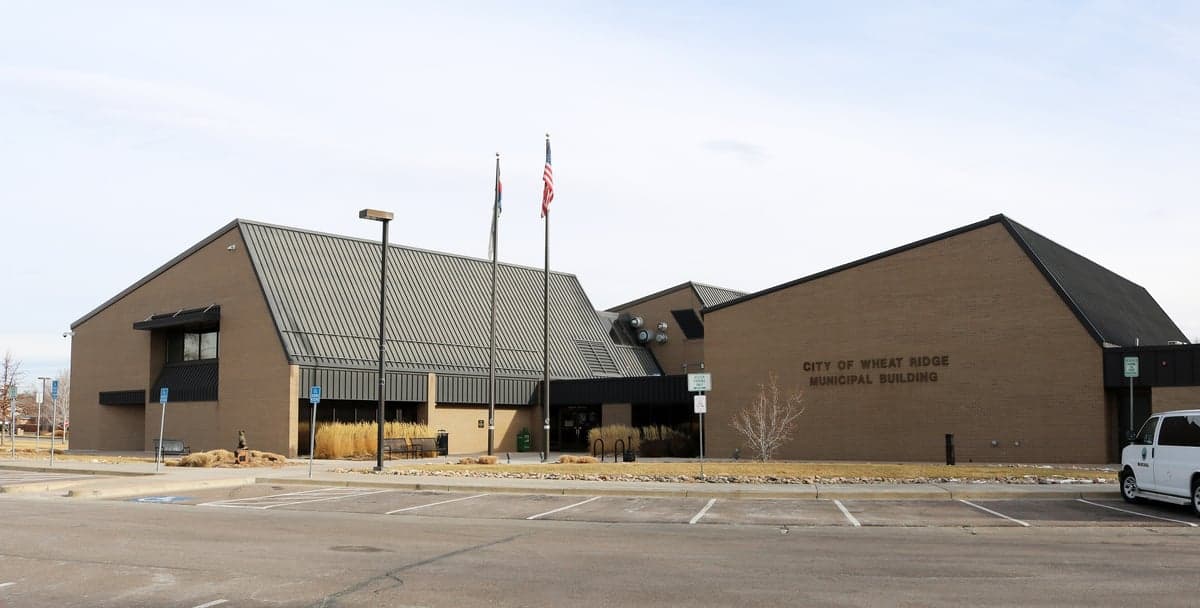
Photo: Wikipedia
Demographics of Wheat Ridge, CO
Affluence Level in Wheat Ridge, CO
An upper-middle-class area. Household wealth, education levels, and homeownership run ahead of national benchmarks.
People of Wheat Ridge, CO
The people of Wheat Ridge, Colorado today form a predominantly white, family-oriented community of 32,158 residents, with a notably low foreign-born share of just 1.8% and a significant Hispanic minority of 21.2%. The city carries a distinct character as an older, established suburb of Denver, with a density of roughly 3,500 people per square mile that gives it a settled, middle-class feel. Its identity markers include a high college education rate of 44.4%, a strong sense of local history, and a population that is overwhelmingly native-born, creating a community where generational roots run deep.
How the city was settled and grew
Wheat Ridge’s population history begins not with a land grant or mining rush, but with agricultural settlement in the 1850s and 1860s. The area was originally part of the vast Jefferson County territory, and the first permanent settlers were Anglo-American farmers drawn by the fertile soil of the South Platte River valley. They named the area "Wheat Ridge" for the wheat fields that lined the ridge above Clear Creek. The original settlement clustered around what is now Olde Town Wheat Ridge, the historic commercial and social heart of the community, where early frame houses and farmsteads were built. These early residents were overwhelmingly of Northern European descent—English, German, and Scandinavian—and they established a pattern of independent, land-owning family farms that defined the area for decades. The arrival of the railroad in the 1870s spurred modest growth, but Wheat Ridge remained a rural farming community well into the early 20th century. The first major population wave came after World War II, when returning veterans and their families sought affordable housing on the outskirts of Denver. This wave built out neighborhoods like Applewood Village and Crown Hill, areas of modest single-family homes on larger lots that still define the city’s residential character. These new residents were almost entirely white, native-born, and drawn by the promise of suburban space and good schools.
Modern era (post-1965)
The post-1965 era brought significant demographic shifts to Wheat Ridge, though less dramatic than in many Denver suburbs. The 1965 Immigration and Nationality Act opened the door to new immigrant groups, but Wheat Ridge’s low foreign-born share of 1.8% today shows that the city never became a major destination for new arrivals. Instead, the most notable change has been the growth of the Hispanic population, which now stands at 21.2%. This growth came primarily through domestic in-migration from other parts of Colorado and the Southwest, as Hispanic families moved into established neighborhoods like Wheat Ridge West and the area around 44th Avenue and Wadsworth Boulevard. These families were drawn by affordable housing stock and proximity to service-sector jobs in Denver and Lakewood. The white population, while still dominant at 73.0%, has aged in place, with many younger white families moving to newer suburbs farther out. The Black population remains very small at 1.3%, and East/Southeast Asian residents make up just 1.2%, concentrated in a few apartment complexes near Wadsworth Bypass. The Indian subcontinent population is negligible at 0.2%. The city’s racial character is thus best described as a white-majority community with a substantial, long-settled Hispanic minority, and very little representation from other groups.
The future
The demographic trajectory of Wheat Ridge points toward gradual homogenization rather than tribalization into distinct enclaves. The Hispanic population is likely to continue growing slowly, as families already in the area have children and as some new arrivals are drawn by the city’s relatively affordable housing compared to Denver proper. However, this growth is likely to be moderate, as the city is largely built out and new housing construction is limited. The white population will continue to age, and the city may see a modest influx of younger, college-educated professionals drawn by the revitalization of Olde Town Wheat Ridge, which has seen new restaurants, breweries, and retail. The foreign-born share is unlikely to rise significantly, as the city lacks the ethnic enclaves, immigrant-serving institutions, and affordable rental stock that attract new arrivals. Over the next 10-20 years, Wheat Ridge will likely remain a predominantly white, middle-class suburb with a stable Hispanic minority, becoming slightly more educated and professional as Olde Town redevelops, but not experiencing the rapid diversification seen in Denver or Aurora.
For someone moving in now, Wheat Ridge offers a stable, safe, and historically rooted community where the population is not rapidly changing. It is a place where families can expect to find neighbors who have been there for decades, good schools, and a quiet suburban lifestyle. The city is not becoming a melting pot or a collection of ethnic enclaves; it is a white-majority, native-born community with a significant Hispanic presence that is integrated into the broader social fabric. This makes it an attractive option for conservative-leaning individuals and parents who value stability, low crime, and a sense of continuity over the dynamism and diversity of a rapidly changing urban core.

* Values derived from national, state, county, city and local statistics and may differ in a specific area. Last updated: 2026-04-23T02:20:42.000Z
Narrative content on this page is AI-generated and may contain mistakes. Verify any details that matter before acting on them.
ReloMaps may earn a commission from affiliate links at no extra cost to you.

