Photo: Wikipedia
Demographics of Winter Park, FL
Affluence Level in Winter Park, FL
An upper-middle-class area. Household wealth, education levels, and homeownership run ahead of national benchmarks.
People of Winter Park, FL
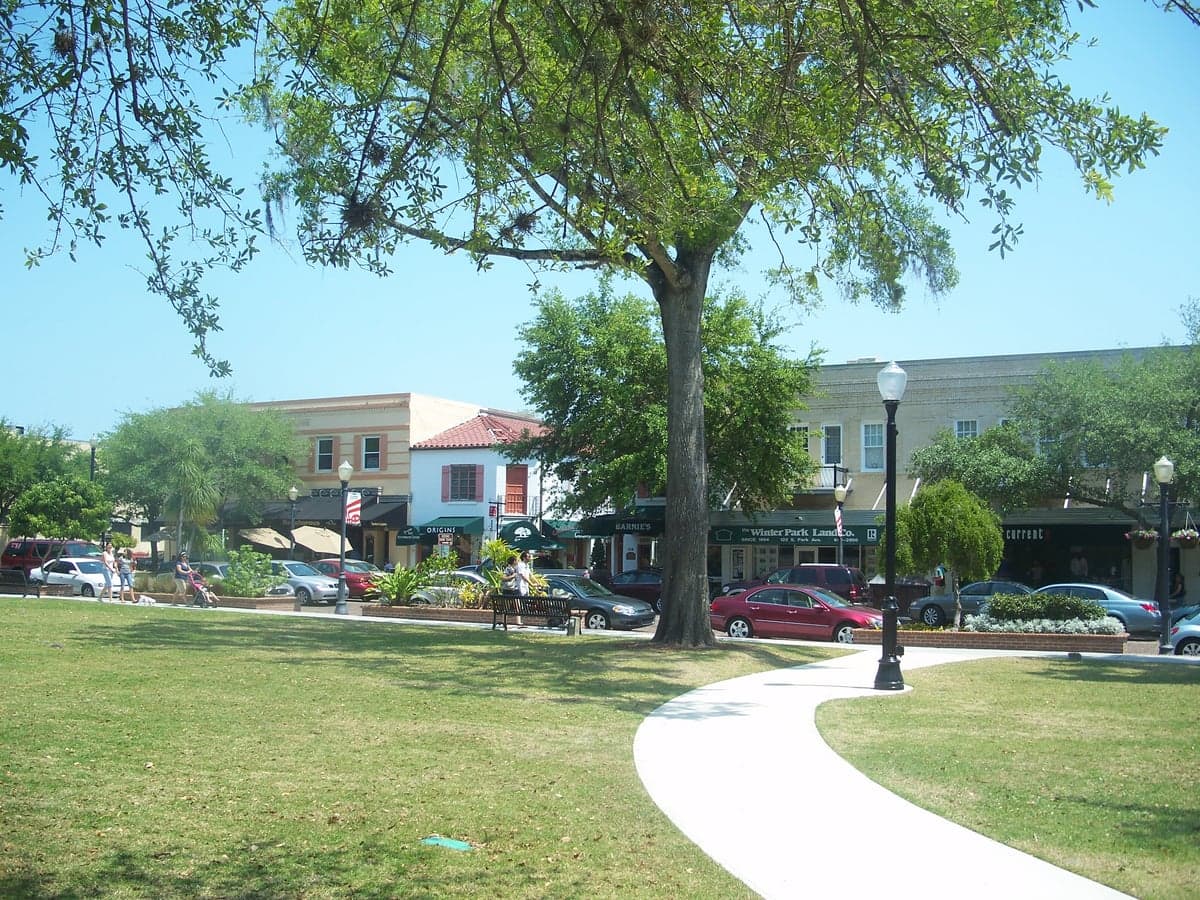
Winter Park, Florida, is home to 29,929 residents who form one of Central Florida’s most educated and historically rooted communities, with 63.6% holding a college degree. The city is predominantly White (72.3%), with a notable Hispanic population (13.4%) and smaller but distinct Black (4.4%), East/Southeast Asian (3.3%), and Indian subcontinent (2.8%) communities. Its character blends old-money Southern charm with a progressive, arts-oriented identity, anchored by Rollins College and a walkable downtown that feels more like a New England village than a Sun Belt suburb. The foreign-born share is low at 4.0%, reflecting a population shaped more by domestic in-migration than international immigration.
How the city was settled and grew
Winter Park was founded in the 1880s as a planned winter resort for wealthy Northerners, not as a pioneer settlement. The land was originally part of a 1,400-acre tract purchased by Loring Chase and Oliver Chapman, who marketed the area to affluent families seeking a warm-weather escape. The first wave of residents were White, Protestant, and largely from the Northeast and Midwest, building grand homes along the chain of lakes in what is now the Lake Virginia and Lake Osceola neighborhoods. The arrival of the South Florida Railroad in 1880 spurred growth, and by the early 1900s, a small African American workforce had settled in the Hannibal Square district, west of the railroad tracks, to serve the resort economy as domestic workers and laborers. This enclave became the city’s historic Black community, with its own businesses, churches, and a two-room schoolhouse. The city incorporated in 1887, and through the mid-20th century, Winter Park remained a small, affluent enclave, with growth driven by Rollins College (founded 1885) and the expansion of Orlando’s tourism economy.
Modern era (post-1965)
After the 1965 Hart-Cellar Act, Winter Park saw modest demographic shifts compared to other Central Florida cities. The foreign-born population remained low, but domestic in-migration accelerated as Orlando’s theme-park boom drew professionals and retirees. The Virginia Heights and Killarney neighborhoods absorbed many of the new White middle-class families moving in from the Midwest and Northeast during the 1970s and 1980s. Hispanic residents, primarily of Puerto Rican and Cuban origin, began settling in the Fairbanks Avenue corridor and parts of western Winter Park, drawn by service-sector jobs in nearby Orlando. The Black population, which had historically concentrated in Hannibal Square, declined in share as gentrification pushed some families east into neighboring Eatonville and Goldsboro. East/Southeast Asian communities, including Chinese and Vietnamese families, arrived in smaller numbers during the 1990s and 2000s, often settling in the Palmer Avenue area near Rollins College, attracted by academic and professional opportunities. Indian subcontinent residents, many working in tech and healthcare, began arriving after 2000, clustering in the Via Tuscany and Winter Park Pines subdivisions. The city’s racial composition today—72.3% White, 13.4% Hispanic, 4.4% Black, 3.3% East/Southeast Asian, and 2.8% Indian—reflects a slow diversification that has not fundamentally altered its affluent, college-educated character.
The future
Winter Park’s population is likely to continue its gradual diversification, but the pace will remain slower than in Orlando or Orange County as a whole. The Hispanic share is the fastest-growing segment, projected to approach 16-18% by 2035, driven by natural increase and continued migration from Puerto Rico and Central America. The East/Southeast Asian and Indian communities are growing from a small base, with new arrivals concentrated among professionals in tech and medicine; these groups are likely to assimilate into the city’s existing high-education, high-income fabric rather than forming distinct ethnic enclaves. The Black population share is expected to remain flat or decline slightly, as Hannibal Square continues to gentrify and affordable housing options shrink. The White population, while still dominant, will see its share edge downward as younger, more diverse families replace aging retirees. The city is not tribalizing into separate enclaves; instead, it is slowly homogenizing around a shared identity of affluence and education, with ethnic differences becoming less pronounced over time. The foreign-born share may rise to 5-6% but will remain well below the national average.
For someone moving in now, Winter Park is becoming a more diverse but still overwhelmingly White, highly educated, and expensive community. The city’s identity as a cultured, lakefront enclave is stable, but newcomers should expect rising housing costs and a population that is slowly shifting toward Hispanic and Asian professional families while retaining its historic character. The bottom line: Winter Park is not a melting pot—it is a carefully curated small city where demographic change happens incrementally, and where the dominant culture remains that of the college-educated, upper-middle-class White families who founded it.

* Values derived from national, state, county, city and local statistics and may differ in a specific area. Last updated: 2026-05-13T16:24:03.000Z
Narrative content on this page is AI-generated and may contain mistakes. Verify any details that matter before acting on them.
ReloMaps may earn a commission from affiliate links at no extra cost to you.

