
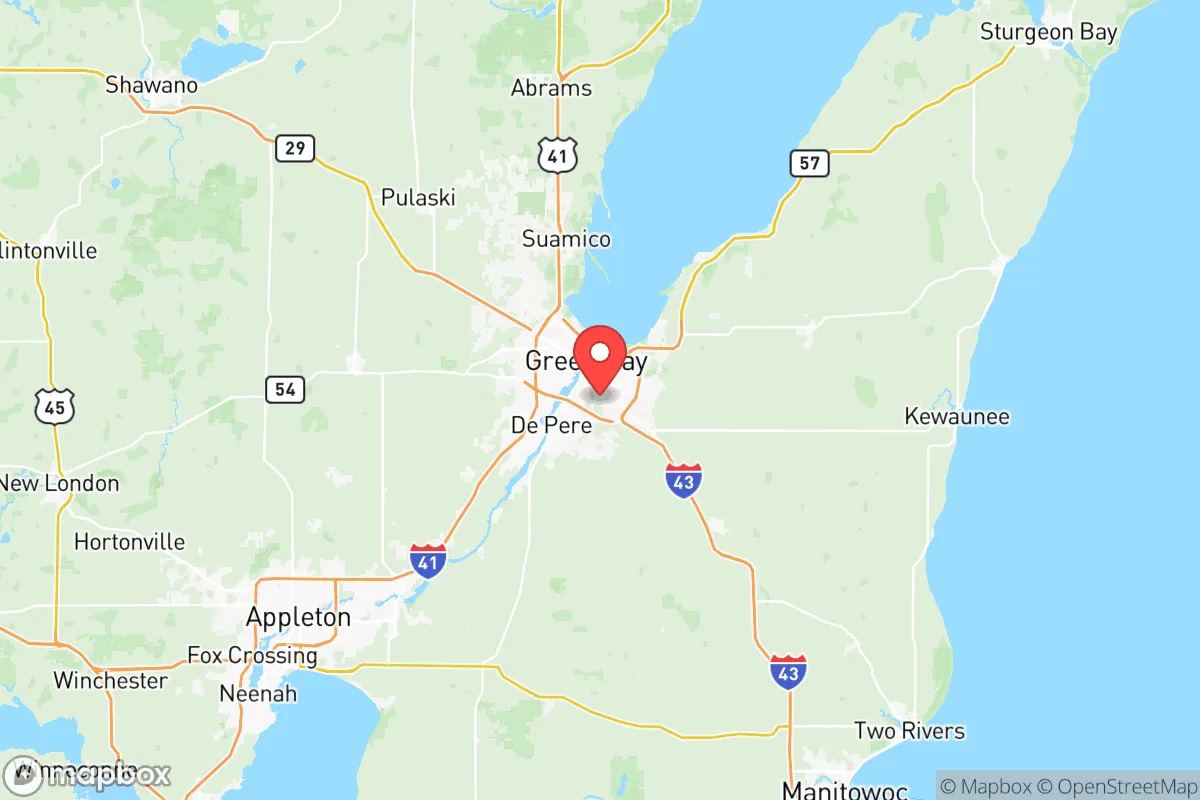
Photo: Wikipedia
Personal Sovereignty in Brown County
Moderate friction. Expect trade-offs in some aspect of personal liberty and independence.
What does Personal Sovereignty tell us?
Personal Sovereignty measures your capacity for self-reliance and independence with minimal government friction. Higher scores mean fewer barriers between you and the way you want to live... but it assumes you have the space you need and good neighbors.
What does this tell us?
Personal Sovereignty measures your capacity for self-reliance and independence with minimal government friction. Higher scores mean fewer barriers between you and the way you want to live... but it assumes you have the space you need and good neighbors.
State Policy
Energy independence: Importer (15% of energy produced in-state)
Personal Liberty
Homesteading

Personal Liberty Analysis
Brown County, Wisconsin, offers a notably high degree of personal sovereignty within a framework of moderate state-level regulation, making it a compelling option for individuals and families who prioritize autonomy without seeking the extremes of frontier living. The county’s regulatory environment is generally permissive, particularly in its rural townships, while its urban core of Green Bay provides necessary services without the heavy-handed oversight found in larger metropolitan areas. For those weighing self-reliance against community access, the balance here leans distinctly toward personal freedom, especially when compared to neighboring states like Illinois or Minnesota.
Tax burden and regulatory posture in Brown County
Wisconsin’s state income tax is progressive, with rates from 3.54% to 7.65%, and its property taxes are among the highest in the nation—averaging roughly 1.6% of home value statewide. However, Brown County’s effective property tax rate sits slightly below the state average, around 1.5%, which is a meaningful advantage for homeowners. Sales tax is a modest 5.5% (5% state plus 0.5% county), and there is no local sales tax surcharge in Green Bay or surrounding towns like De Pere or Howard. The regulatory posture is business-friendly at the county level, with streamlined permitting for small-scale construction and home-based enterprises. Townships such as Wrightstown and Hobart are notably less restrictive than the city of Green Bay, particularly regarding home occupation permits and accessory dwelling units. For a conservative-leaning reader, the overall tax burden is manageable, though property taxes require careful budgeting—especially when comparing to low-tax states like Texas or Florida.
Self-defense and gun law specifics in Brown County
Wisconsin is a shall-issue state for concealed carry permits, meaning the sheriff’s office in Brown County must issue a license to any qualified applicant who passes a background check and completes a training course. Open carry is legal without a permit for anyone 18 or older who can legally possess a firearm, and the state preempts local governments from enacting stricter ordinances—so Green Bay cannot ban guns in parks or other public spaces beyond what state law allows. Stand-your-ground protections apply, with no duty to retreat in any place where a person is lawfully present. The county’s gun culture is robust, with multiple indoor and outdoor ranges near Suamico and Pulaski, and a strong network of private shooting clubs. For self-defense-minded residents, Brown County offers a legal environment that respects the right to bear arms without the friction found in states like California or New York. The only notable limitation is a 48-hour waiting period for handgun purchases, which applies statewide.
Self-reliance and homesteading viability in Brown County
Homesteading and off-grid living are feasible in Brown County, but viability varies sharply by location. In rural townships like Eaton and Glenmore, minimum lot sizes of 5 to 10 acres are common, and zoning codes permit livestock, beekeeping, and small-scale agriculture without special permits. Off-grid solar is legal, though net metering policies with Wisconsin Public Service (the dominant utility) are less favorable than in states with strong solar incentives—excess generation is credited at the retail rate but capped at 20 kW for residential systems. Rainwater collection is unrestricted, and composting toilets are allowed under state plumbing codes if properly installed. In contrast, within Green Bay city limits, lot sizes shrink to under a quarter-acre, and raising chickens or goats requires a conditional use permit. For those serious about self-reliance, the best strategy is to target land in the county’s unincorporated areas, where county oversight is minimal and neighbors are accustomed to independent living. The growing season is short (roughly 140 frost-free days), but the soil is fertile glacial till, ideal for vegetable gardens and small orchards.
Personal liberties in Brown County: parental rights, medical autonomy, speech, and property
Wisconsin law strongly supports parental rights in education and healthcare, including the right to opt children out of sex education and to access private school vouchers through the statewide program. Brown County’s school districts—such as the Howard-Suamico School District and the Pulaski Community School District—are generally responsive to parental concerns, with school board meetings that allow public comment and active parent-teacher organizations. Medical autonomy is more constrained: Wisconsin requires parental consent for minors’ medical treatment, but the state has not enacted broad medical freedom legislation like Idaho or Montana. Vaccine mandates for school attendance exist, though religious and medical exemptions are available. Free speech protections are robust, with no county-level restrictions on political signage or public assembly, and property rights are well-defended through the state’s strong eminent domain protections. For a conservative-leaning family, the environment in Brown County is one where traditional values are respected, and local governance tends to be hands-off in personal matters—especially in towns like Denmark and New Franken, where community norms align closely with individual liberty.
Overall, Brown County presents a solid middle ground for personal sovereignty: it avoids the heavy regulatory hand of the Upper Midwest’s more progressive enclaves while offering the infrastructure and services that make self-reliant living practical. Compared to rural counties in northern Wisconsin, it has more economic opportunity and better schools; compared to urban centers like Milwaukee or Madison, it has far less regulatory friction and a stronger gun-rights culture. For the reader who values independence but does not want to sacrifice access to healthcare, employment, or community, Brown County is a well-calibrated choice—neither libertarian paradise nor nanny state, but a place where personal freedom is the default rather than the exception.

* Values derived from national, state, county, city and local statistics and may differ in a specific area. Last updated: 2026-08-23T03:15:36.000Z
Narrative content on this page is AI-generated and may contain mistakes. Verify any details that matter before acting on them.
ReloMaps may earn a commission from affiliate links at no extra cost to you.

