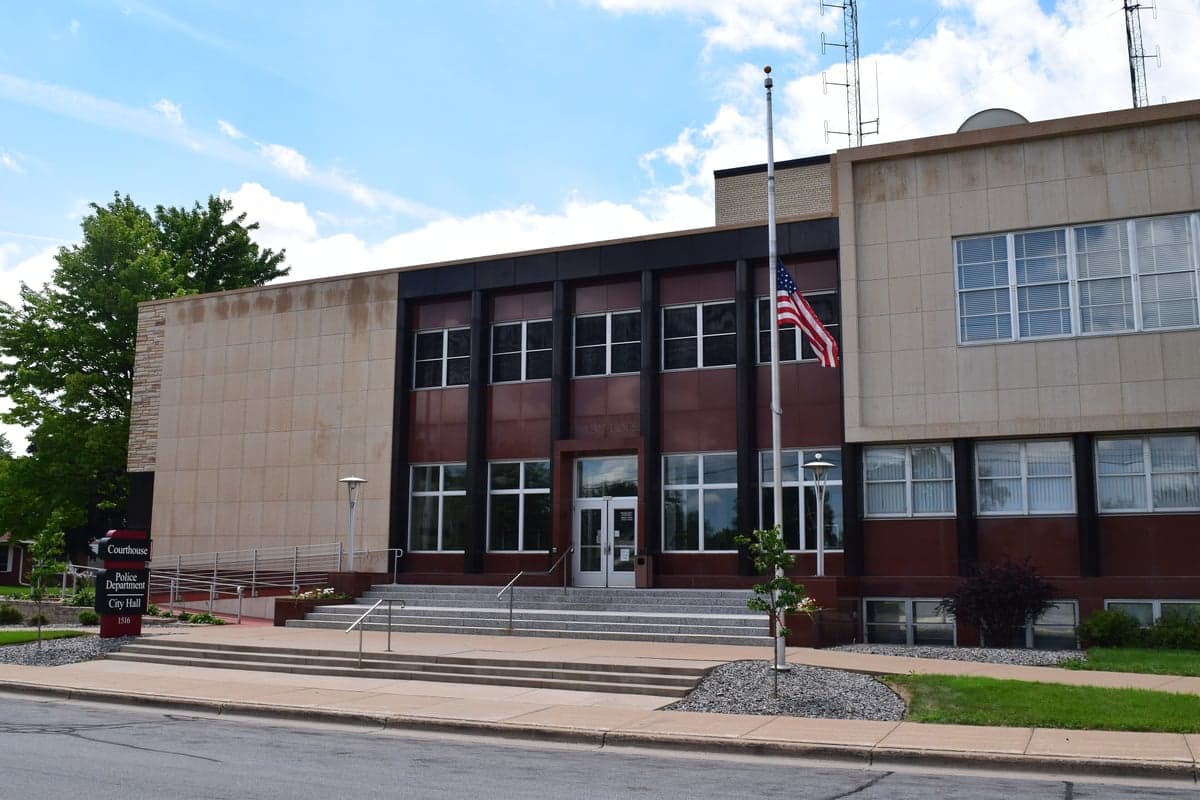
Photo: Wikipedia
Demographics of Portage County
Affluence Level in Portage County
A middle-class area roughly in line with national averages across income, home values, education, and employment.
People of Portage County
Portage County, Wisconsin, is home to 70,375 residents, a population that remains predominantly white (89.5%) with a very low foreign-born share of just 1.3%. The county’s character is shaped by its rural small-town roots, anchored by the city of Stevens Point, and a history of European settlement that has left a lasting cultural imprint. Today, the population is notably more educated than the state average, with 33.7% holding a college degree, yet it remains one of the least ethnically diverse counties in Wisconsin, a fact that defines both its social fabric and its political leanings.
Settlement & growth (pre-1960)
Before European arrival, the area now known as Portage County was inhabited by the Ho-Chunk (Winnebago) and Menominee nations, who used the Wisconsin River as a major transportation and trade corridor. French fur traders and missionaries passed through as early as the 1600s, but no permanent European settlements took root until the 1830s, when the U.S. government forcibly removed Native tribes through treaties, opening the land for American settlers.
The first major wave of American settlers arrived in the 1840s and 1850s, primarily Yankees from New England and New York, drawn by the promise of cheap land under the Preemption Act of 1841. They founded the county seat of Stevens Point in 1845, naming it after a local trader, and established the first farms and sawmills along the Wisconsin River. The lumber boom of the 1850s through the 1880s transformed the county, pulling in a second wave: German and Polish immigrants seeking work in the pine forests and mills. Plover and Amherst became hubs for these German settlers, who brought dairy farming and Catholic parish life. The Polish community concentrated in Polonia (a hamlet named for its founders) and the southern part of the county, where they built St. Casimir’s Church and maintained their language well into the 20th century.
A smaller but notable wave of Scandinavian immigrants—Norwegians and Swedes—arrived in the 1870s and 1880s, settling in the northern townships like Alban and Carson, where they established Lutheran churches and small family farms. By 1900, Portage County was overwhelmingly white, native-born, and rural, with a population of about 30,000. The 20th century brought little change: the lumber industry declined, but dairy farming and the University of Wisconsin–Stevens Point (founded in 1894) stabilized the economy. The county saw no significant new immigrant groups between 1900 and 1960, and the population grew slowly, reaching 36,000 by 1950.
Modern era (post-1965)
The 1965 Hart-Cellar Act had almost no impact on Portage County. Unlike urban centers or Sun Belt destinations, the county did not attract post-1965 immigrants from Asia, Latin America, or Africa. The foreign-born population remains minuscule at 1.3%, and the county’s racial composition has barely shifted: white residents make up 89.5% of the population, a figure that has declined only slightly from 96% in 1990. The largest minority group is Hispanic or Latino at 3.9%, a population that grew modestly from 1.5% in 2000, driven by a small number of Mexican-origin workers in agriculture and food processing, particularly in Stevens Point and Whiting.
East and Southeast Asian communities account for 2.5% of the population, concentrated almost entirely in Stevens Point, where the university has attracted a small number of faculty and students from China, Japan, and Vietnam. The Indian subcontinent population is negligible at 0.3%, and the Black population is just 0.8%, mostly African American families who moved to Stevens Point for university employment or healthcare jobs at Aspirus Stevens Point Hospital. Domestic migration has been the primary demographic force since 1970: the county has seen a slow but steady outflow of young adults to larger cities like Madison and Milwaukee, offset by in-migration of retirees and remote workers from the Chicago and Milwaukee suburbs, drawn by lower housing costs and the rural lifestyle. This has kept the population stable—70,375 in 2024, up from 67,000 in 2000—but has not diversified it.
Suburbanization has been limited. The only notable growth corridor is along Highway 10 between Stevens Point and Plover, where new subdivisions and strip malls have appeared since the 1990s. Plover itself has grown from a village of 2,000 in 1980 to over 13,000 today, absorbing much of the county’s new housing. But the county’s 13 other townships—places like Stockton, Buena Vista, and Grant—remain overwhelmingly white, rural, and aging, with median ages above 45.
The future
Portage County’s demographic future is one of slow homogenization, not diversification. The white population share is projected to remain above 85% through 2040, as the county does not have the economic pull—large employers, major airports, or immigrant networks—to attract significant new non-white populations. The Hispanic share may inch toward 5% as agricultural and food-processing jobs draw a few more families, but this growth will be concentrated in Stevens Point and will not alter the county’s overall character. The East and Southeast Asian population will likely plateau at around 3%, tied to the university’s modest international enrollment.
The more significant trend is aging and population decline in the rural townships. The county’s under-18 population has fallen from 22% in 2010 to 19% in 2024, while the 65+ share has risen from 14% to 20%. Young adults continue to leave for college and careers, and the county is not attracting enough in-migrants to replace them. The villages of Amherst Junction and Nelsonville are already seeing school consolidations and church closures. In contrast, Stevens Point and Plover will likely hold steady or grow slightly, buoyed by the university, healthcare, and a small influx of remote workers seeking a lower cost of living.
Culturally, the county is absorbing its modest in-migration into its existing identity rather than being reshaped by it. New residents from Chicago or Milwaukee tend to be white, middle-class, and politically moderate, and they adapt to the county’s conservative-leaning norms rather than challenging them. The county voted +18 points for Donald Trump in 2024, a margin that has widened since 2016, reflecting its resistance to the demographic and cultural changes seen in urban Wisconsin.
For someone moving to Portage County now, the bottom line is this: you are entering a stable, predominantly white, and culturally conservative community that values its rural roots and small-town institutions. The population is not diversifying, not growing rapidly, and not likely to change its character in the next decade. The trade-off is a safe, affordable, and predictable environment—but one with limited ethnic diversity and a shrinking youth population. If you seek a place where your neighbors will likely share your background and values, Portage County delivers. If you seek demographic dynamism or a multicultural environment, you will need to look elsewhere.

* Values derived from national, state, county, city and local statistics and may differ in a specific area. Last updated: 2026-05-12T10:04:25.000Z
Narrative content on this page is AI-generated and may contain mistakes. Verify any details that matter before acting on them.
ReloMaps may earn a commission from affiliate links at no extra cost to you.

