Photo: Wikipedia
Demographics of Woonsocket, RI
Affluence Level in Woonsocket, RI
A below-average socioeconomic profile. Incomes, home values, and educational attainment trail the U.S., with higher poverty and unemployment.
People of Woonsocket, RI
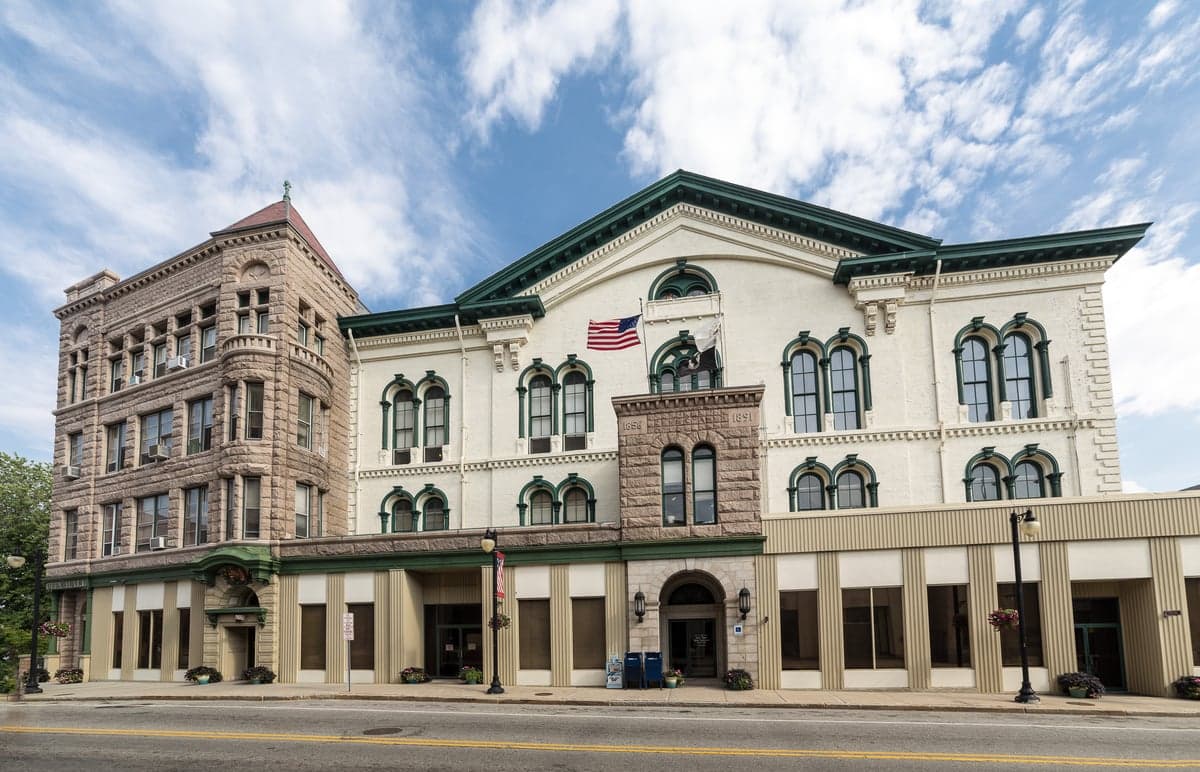
The people of Woonsocket, Rhode Island today number 43,074, forming a dense, historically grounded city where a white plurality of 53.8% coexists with a substantial Hispanic population of 25.8% and smaller but established Black, East/Southeast Asian, and Indian communities. The city’s identity is shaped by its Franco-American Catholic heritage, visible in the architecture of churches like Precious Blood and the annual Franco-American Festival, yet it is increasingly a multi-ethnic, working-class hub. With only 18.6% of adults holding a college degree, Woonsocket remains a blue-collar city where manufacturing’s decline has left economic scars but also created affordable housing and a tight-knit, resilient character.
How the city was settled and grew
Woonsocket’s population history begins with its founding as a mill village along the Blackstone River, powered by the falls that gave the city its name (from the Nipmuc word for “thunder mist”). The first major wave of settlers were Anglo-American farmers and millwrights in the late 18th century, but the city’s explosive growth came with the textile boom of the 19th century. French-Canadian immigrants, fleeing Quebec’s agricultural depression, arrived in massive numbers between 1850 and 1910, settling in the Social District (around Social Street) and the Fairmount neighborhood, where they built the dense triple-decker homes and Catholic parishes that still define the cityscape. By 1900, Woonsocket was the most French city in the United States by percentage, with French spoken in homes, stores, and churches. A smaller wave of Irish and Italian immigrants followed, clustering in the North End near the mills, but the Franco-American character remained dominant through the mid-20th century, sustained by the city’s textile and rubber industries.
Modern era (post-1965)
The post-1965 era brought profound demographic change as the textile industry collapsed, shedding thousands of jobs between 1950 and 1980. The city’s white population, which had been over 95% as late as 1970, began a slow decline as younger Franco-Americans moved to suburbs like North Smithfield and Lincoln. Into this vacuum came new waves of immigration. Hispanic migration, primarily from Puerto Rico and the Dominican Republic, accelerated in the 1990s and 2000s, with families settling in the East Side and South End neighborhoods, where affordable triple-deckers and rental units were available. Today, the Hispanic share stands at 25.8%, making Woonsocket one of the most Hispanic cities in Rhode Island outside Providence. East/Southeast Asian communities (4.4%), largely Cambodian and Vietnamese, arrived as refugees in the 1980s and 1990s, concentrating in the West End near the former mill complexes. The Indian subcontinent population (2.5%) is a more recent addition, drawn by jobs in healthcare and technology in the Providence metro area, with families settling in the Bernon neighborhood’s newer housing stock. The Black population (6.0%) includes both African American families who moved from Providence and a smaller Liberian refugee community. The foreign-born share is 8.1%, lower than Providence’s 29% but significant for a small city.
The future
The population trajectory points toward continued diversification, but at a slower pace than in the 1990s and 2000s. The white share (53.8%) is projected to drop below 50% within the next decade, driven by an aging Franco-American population and out-migration of younger white residents to suburbs. The Hispanic share is likely to grow to around 30% by 2035, fueled by higher birth rates and continued migration from Puerto Rico and Central America, with the South End becoming an increasingly Hispanic-majority neighborhood. East/Southeast Asian and Indian communities are plateauing, as refugee resettlement has slowed and newer immigrants tend to settle in Providence or Cranston. The city is not tribalizing into starkly separate enclaves—neighborhoods like Fairmount remain mixed, with older French-Canadian homeowners living alongside Hispanic renters—but economic divides are sharpening. The college education rate (18.6%) is half the state average, limiting upward mobility, while the city’s affordable housing stock (median home value around $250,000) continues to attract working-class families priced out of Providence.
For someone moving in now, Woonsocket is a city in transition: still anchored by its Franco-American past, but increasingly defined by its Hispanic and immigrant communities. It offers a dense, walkable urban fabric, a strong sense of neighborhood identity, and housing costs that are among the lowest in Rhode Island. The trade-off is a struggling local economy, limited retail and dining options, and a school system that faces challenges with poverty and English-language learners. It is a place for those who value authenticity and community over polish and prestige—a working-class city that is slowly, unevenly becoming a multi-ethnic one.

* Values derived from national, state, county, city and local statistics and may differ in a specific area. Last updated: 2026-04-30T05:28:22.000Z
Narrative content on this page is AI-generated and may contain mistakes. Verify any details that matter before acting on them.
ReloMaps may earn a commission from affiliate links at no extra cost to you.

