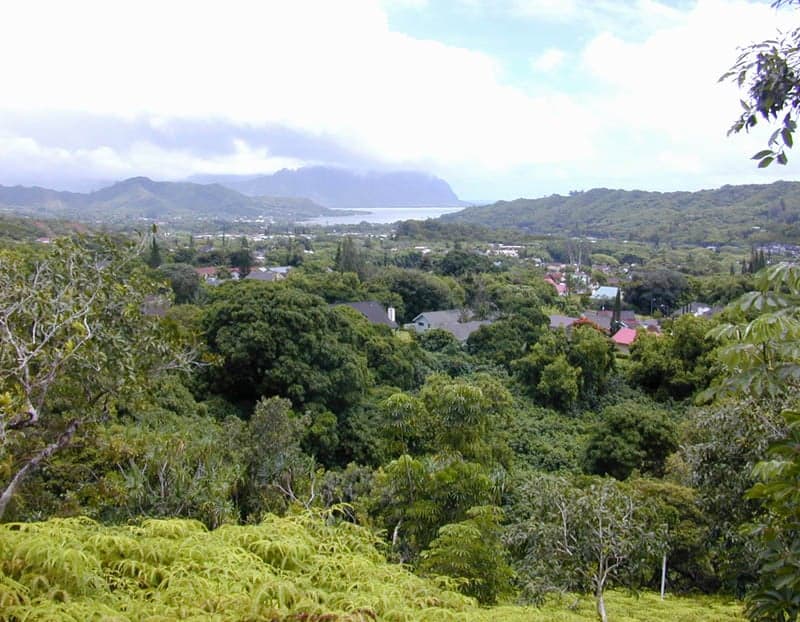
Photo: Wikipedia
Demographics of Ahuimanu, HI
Affluence Level in Ahuimanu, HI
An upper-middle-class area. Household wealth, education levels, and homeownership run ahead of national benchmarks.
People of Ahuimanu, HI
The people of Ahuimanu, Hawaii, today form a distinctive, family-oriented community of 8,520 residents characterized by a high proportion of East and Southeast Asian ancestry (29.4%) alongside a significant White minority (18.2%) and a notable Hispanic presence (13.6%). The population is highly educated, with 49.2% holding a college degree, and overwhelmingly native-born, as only 1.7% of residents are foreign-born. This creates a stable, multigenerational community where local identity is shaped more by shared island roots and suburban lifestyle than by recent immigration waves.
How the city was settled and grew
Ahuimanu’s human history begins with Native Hawaiians, who established agricultural communities along the windward side of Oahu, utilizing the fertile soil and abundant water from the Ko‘olau Mountains for taro farming. The name "Ahuimanu" itself translates to "bird collection" or "bird altar," reflecting the area’s original ecological and cultural significance. Following the Great Mahele of 1848, which privatized land, much of the area was acquired by foreign interests, but large-scale plantation agriculture did not dominate here as it did in central Oahu. Instead, Ahuimanu remained a sparsely populated rural area through the early 20th century, with small clusters of Native Hawaiian families living in what is now known as Hauula Homesteads and along Kamehameha Highway. The first significant non-Hawaiian settlers were Portuguese and Chinese laborers who moved into the area after working on sugar plantations elsewhere on the island, establishing small farms and homesteads in the Waikane Valley and Waiahole Valley areas. These early agricultural settlers laid the groundwork for a community that valued self-sufficiency and close-knit family ties.
Modern era (post-1965)
The modern demographic transformation of Ahuimanu began in earnest after the 1965 Immigration and Nationality Act, though its effects were muted compared to other Oahu communities due to the area’s limited rental housing and single-family home character. The most significant population shift occurred during the 1970s and 1980s as suburban development expanded from Kaneohe northward. New subdivisions like Hauula Kai and Punaluu attracted middle-class families, particularly those of Japanese and Filipino ancestry, who sought larger lots and quieter streets away from Honolulu’s congestion. These East and Southeast Asian families, many already second- or third-generation Hawaii residents, formed the backbone of Ahuimanu’s modern population. The White population, largely composed of military-affiliated families from nearby Marine Corps Base Hawaii in Kaneohe and professionals working in Honolulu, settled in newer developments like Kualoa Ranch and along Kamehameha Highway near the Ahuimanu Elementary School corridor. The Hispanic population, which now stands at 13.6%, is a more recent addition, growing primarily through domestic migration from the U.S. mainland rather than direct immigration, with families settling in the Hauula Homesteads area and the more affordable rental properties near Kahekili Highway. Notably, the Black population is recorded at 0.0%, and the Indian subcontinent population is also 0.0%, making Ahuimanu one of the most ethnically binary communities on Oahu in terms of its major groups.
The future
Demographic projections for Ahuimanu suggest a period of slow, steady homogenization rather than rapid diversification. The extremely low foreign-born share (1.7%) indicates that future population changes will come almost entirely from domestic migration and natural increase, not international immigration. The East and Southeast Asian population, already the largest group, is likely to maintain or slightly increase its share as younger generations remain in the area due to family property ties and the high cost of leaving Oahu’s windward side. The White population may decline modestly as military families rotate out and are not fully replaced, while the Hispanic population could grow incrementally through continued mainland migration, particularly into the more affordable Waikane Valley and Waiahole Valley neighborhoods. The community is not tribalizing into distinct ethnic enclaves; rather, it is becoming a more uniformly middle-class, family-oriented suburb where ethnic identity is secondary to a shared local lifestyle. The next 10-20 years will likely see Ahuimanu remain a stable, low-turnover community with gradual demographic shifts mirroring broader trends in windward Oahu.
For someone moving in now, Ahuimanu offers a rare combination: a highly educated, native-born population with deep local roots, minimal ethnic tension, and a suburban character that prioritizes family life and outdoor recreation. The absence of significant immigrant communities means less cultural diversity than in Honolulu, but also a predictable, stable social environment. This is a place where residents know their neighbors, property values hold steady, and the population is not expected to undergo dramatic change—making it a solid choice for those seeking long-term community integration rather than urban dynamism.

* Values derived from national, state, county, city and local statistics and may differ in a specific area. Last updated: 2026-05-04T03:00:12.000Z
Narrative content on this page is AI-generated and may contain mistakes. Verify any details that matter before acting on them.
ReloMaps may earn a commission from affiliate links at no extra cost to you.

