
Photo: Wikipedia
Demographics of Santa Cruz County
Affluence Level in Santa Cruz County
A below-average socioeconomic profile. Incomes, home values, and educational attainment trail the U.S., with higher poverty and unemployment.
People of Santa Cruz County
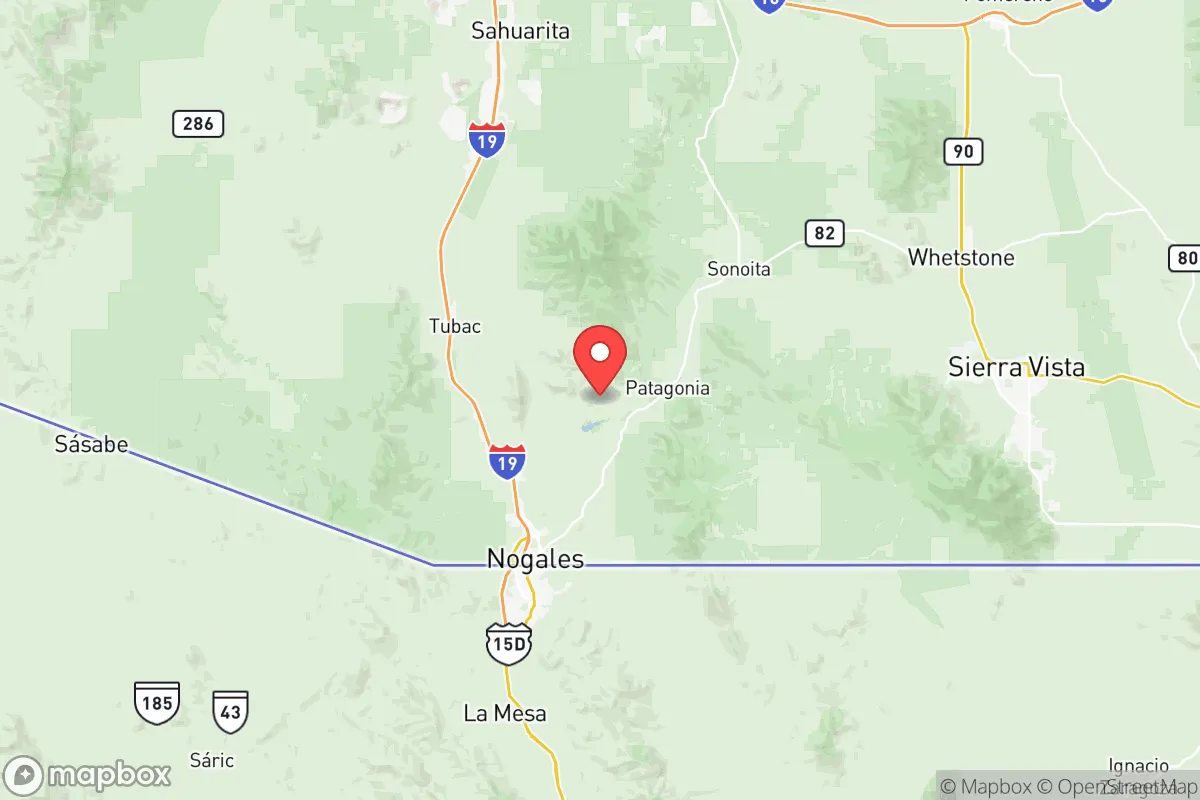
Santa Cruz County, Arizona, is a predominantly Hispanic border community of 48,209 residents, where 82.7% of the population identifies as Hispanic or Latino and only 15.3% as non-Hispanic White. The county is defined by its binational character, with the twin cities of Nogales, Arizona, and Nogales, Sonora, forming a single economic and cultural zone. With a foreign-born population of 13.4% and a college attainment rate of 24.1%, Santa Cruz County is one of the most ethnically distinct counties in the United States, shaped by centuries of cross-border movement rather than by the domestic migration patterns that built most of the American West.
Settlement & growth (pre-1960)
Long before European contact, the region was home to the O'odham (specifically the Sobipuri subgroup) and the Apache, who used the Santa Cruz River valley as a travel corridor and seasonal settlement zone. The river itself—the Santa Cruz—was the lifeblood of the area, supporting agriculture along its floodplain. Spanish colonization arrived in the late 17th century with Jesuit missionaries, most notably Father Eusebio Kino, who established Mission San Cayetano de Tumacácori near present-day Tumacácori in 1691. The mission system brought Spanish soldiers, settlers, and livestock, creating the first permanent European settlements in what is now Santa Cruz County.
After Mexican independence in 1821, the region became part of the Mexican state of Sonora. Land grants attracted Mexican ranchers and farmers to the Santa Cruz Valley, with settlements forming at Calabasas, Tubac, and Santa Cruz (the town, now in Sonora). The Gadsden Purchase of 1854 transferred the area south of the Gila River—including all of present-day Santa Cruz County—to the United States. This boundary change split existing Mexican communities, leaving families on both sides of the new international line. The town of Nogales was founded in 1880 as a railroad terminus, and the arrival of the Southern Pacific and Santa Fe railroads turned it into a major port of entry. By 1900, Nogales was a bustling border town of several thousand, overwhelmingly Mexican and Mexican-American in character.
Mining booms in the late 19th and early 20th centuries drew additional Mexican laborers to the region, particularly to the Patagonia and Harshaw mining districts, where silver, lead, and zinc were extracted. The Mexican Revolution (1910–1920) sent waves of refugees north across the border, many of whom settled permanently in Nogales and surrounding communities. The 1920s and 1930s saw the establishment of the Porter and Rio Rico areas as agricultural zones, growing apples, pecans, and grapes. Unlike much of Arizona, Santa Cruz County experienced little Anglo-American settlement during this period; the county remained overwhelmingly Hispanic, with Spanish as the dominant language in daily life.
Modern era (post-1965)
The 1965 Hart-Cellar Act did not dramatically alter Santa Cruz County's demographic composition, as the region had been majority Hispanic for centuries. However, it did accelerate cross-border family reunification and legal immigration from Mexico, reinforcing the county's existing character. The population grew from roughly 14,000 in 1960 to 29,000 by 1980 and 38,000 by 2000, driven largely by natural increase and continued immigration from Sonora and other Mexican states. The Nogales port of entry became one of the busiest in the United States for pedestrian crossings, with thousands of Mexican nationals commuting daily for work, shopping, and family visits.
The 1990s and 2000s saw significant suburban-style development in Rio Rico, a master-planned community 10 miles north of Nogales that grew from a few hundred residents to over 18,000 by 2020. Rio Rico attracted middle-class Mexican-American families seeking newer housing and larger lots while remaining close to the border. The town of Patagonia became a destination for Anglo retirees and artists, creating a small but visible non-Hispanic enclave in the Sonoita Creek valley. Tubac, with its historic Spanish mission and arts colony, also drew a modest Anglo population, though the county as a whole remained overwhelmingly Hispanic.
Domestic migration from other parts of the United States has been minimal compared to the rest of Arizona. Santa Cruz County lacks the large-scale master-planned communities and corporate relocations that drove growth in Maricopa and Pima counties. The county's economy is dominated by cross-border trade, with Nogales serving as the primary port of entry for Mexican winter produce. This economic base has created a stable but insular labor market, with limited attraction for out-of-state transplants. The Black population is 0.2%, East/Southeast Asian 0.1%, and Indian subcontinent 0.0%—reflecting almost no non-Hispanic immigration to the area.
The future
Santa Cruz County is projected to grow slowly, reaching roughly 55,000–60,000 by 2040, according to state demographic estimates. The population is becoming slightly more diverse in the sense that the non-Hispanic White share is declining (from 18% in 2010 to 15.3% in 2024), while the Hispanic share continues to rise. However, this is driven by higher birth rates among Hispanic families and continued immigration from Mexico, not by new immigrant groups from other regions. The county remains one of the least diverse in the United States by racial/ethnic variety, with a single group—Mexican-Americans and Mexican nationals—making up the overwhelming majority.
New residential development is concentrating in Rio Rico and the northern outskirts of Nogales, where land is cheaper and water access more reliable. The Amado area, at the county's northern edge, is seeing scattered rural subdivisions as commuters who work in Tucson (45 miles north) seek lower housing costs. The cultural identity of the county is likely to remain binational, with Spanish-language media, Mexican holidays, and cross-border family ties remaining central to daily life. The next 10–20 years will likely see continued slow growth, an aging population (the median age is 38.5), and a gradual shift toward more English-Spanish bilingualism among younger generations.
For someone moving into Santa Cruz County now, the region offers a distinct cultural experience unlike any other in Arizona—a place where the border is not a line but a lived reality. The population is stable, family-oriented, and deeply rooted, with little of the transience or rapid change seen in Phoenix or Tucson. New residents, particularly those who do not speak Spanish, should expect to be a minority in a community where Mexican-American identity is the norm, not the exception. The county's future is one of continuity rather than transformation, making it best suited for those who value cultural authenticity over demographic diversity.

* Values derived from national, state, county, city and local statistics and may differ in a specific area. Last updated: 2026-07-30T07:59:17.000Z
Narrative content on this page is AI-generated and may contain mistakes. Verify any details that matter before acting on them.
ReloMaps may earn a commission from affiliate links at no extra cost to you.

