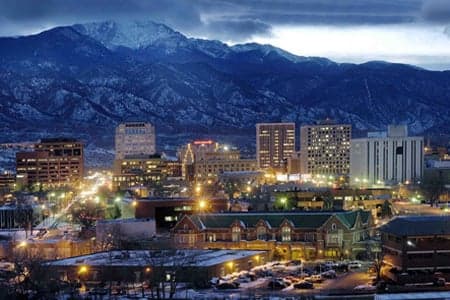
Photo: Wikipedia
Demographics of Colorado Springs, CO
Affluence Level in Colorado Springs, CO
A middle-class area roughly in line with national averages across income, home values, education, and employment.
People of Colorado Springs, CO
Colorado Springs today is a city of 483,099 residents defined by a strong military and evangelical Christian presence, a predominantly white population (66.2%), and a growing Hispanic community (18.7%). It is notably less diverse than the national average, with a foreign-born population of just 3.2%—roughly one-third the U.S. rate—and a highly educated workforce, with 41.9% holding a bachelor’s degree or higher. The city’s character is shaped by its role as a hub for the U.S. military, conservative Christian organizations, and outdoor recreation, creating a culture that prizes self-reliance, patriotism, and family stability.
How the city was settled and grew
Colorado Springs was founded in 1871 by railroad magnate William Jackson Palmer as a resort and health destination, deliberately planned to attract wealthy Easterners seeking the dry mountain air for tuberculosis treatment. The original population was overwhelmingly white, Anglo-Saxon Protestant, drawn by Palmer’s vision of a refined, orderly community free from the rowdiness of mining towns like Cripple Creek. The Old North End neighborhood, with its Victorian mansions, became the enclave of these early elite settlers, while working-class laborers—many of them Irish and German immigrants—built homes in the Westside near the railroad yards and the Colorado Midland Railway. The city’s first major growth wave came with the establishment of Fort Carson in 1942, which brought a steady influx of military personnel and their families, many of whom settled in the Broadmoor area and the newly developed Powers Boulevard corridor. By 1960, the population had reached 70,000, still overwhelmingly white and native-born, with a small but established Hispanic community concentrated in the Boulder Street neighborhood near downtown.
Modern era (post-1965)
The post-1965 period saw Colorado Springs explode in size, driven by the expansion of the military-industrial complex and the rise of evangelical Christian organizations. The 1970s and 1980s brought a wave of domestic in-migration from the Midwest and California, attracted by the city’s conservative politics, low crime, and the presence of Focus on the Family (relocated from California in 1991) and other parachurch ministries. These newcomers—overwhelmingly white, college-educated, and Republican—settled in master-planned suburbs like Briargate in the north and Rockrimmon in the northwest, creating a ring of affluent, homogeneous neighborhoods. The Hispanic population grew steadily but remained concentrated in the Southeast side, particularly around Pikes Peak Avenue and Academy Boulevard, where older housing stock and lower costs attracted working-class families from Texas and New Mexico. The Black population, at 5.4%, is largely tied to Fort Carson and the military, with clusters near the base in Fountain and the Security-Widefield area. East and Southeast Asian communities (2.4%) are smaller and more dispersed, with a notable concentration of Vietnamese and Korean families in the Powers Boulevard corridor, often connected to military service. The Indian subcontinent population (0.5%) is tiny but growing, with professionals drawn to the tech sector and the University of Colorado Colorado Springs, settling in Briargate and Flying Horse.
The future
Colorado Springs is likely to remain a predominantly white, conservative city, but demographic trends point to gradual diversification driven by Hispanic growth and military rotations. The Hispanic share (18.7%) is the fastest-growing segment, projected to reach 25-30% by 2040, with new arrivals from Mexico and Central America settling in the Southeast and Powers Boulevard corridors, where housing is more affordable. The white population is aging and declining in share, but the city’s strong economy—anchored by the military, tech, and healthcare—continues to attract domestic migrants from California and the Midwest, who are disproportionately white and college-educated. The city is not tribalizing into distinct ethnic enclaves in the way that Denver or Aurora have; instead, it is experiencing a slow, steady assimilation of Hispanic families into predominantly white neighborhoods, particularly in the Briargate and Flying Horse areas, where income parity is higher. The foreign-born population is unlikely to rise dramatically, as the city lacks the industrial and service-sector jobs that draw large immigrant populations to other Colorado cities. The next 10-20 years will see a city that is slightly more Hispanic, slightly less white, but still defined by its military and evangelical character—a place where newcomers, regardless of background, are expected to assimilate into a culture of self-reliance and community involvement.
For someone moving in now, Colorado Springs offers a stable, family-oriented environment with a strong sense of local identity, but it is not a melting pot. The city rewards those who align with its conservative, patriotic ethos, and the growing Hispanic community is integrating into that framework rather than creating parallel enclaves. The bottom line: this is a city that is slowly diversifying without losing its core character, making it a predictable, low-friction choice for families seeking safety, schools, and community values.

* Values derived from national, state, county, city and local statistics and may differ in a specific area. Last updated: 2026-04-21T10:26:08.000Z
Narrative content on this page is AI-generated and may contain mistakes. Verify any details that matter before acting on them.
ReloMaps may earn a commission from affiliate links at no extra cost to you.

